Home mining vs cloud mining: a complete comparison
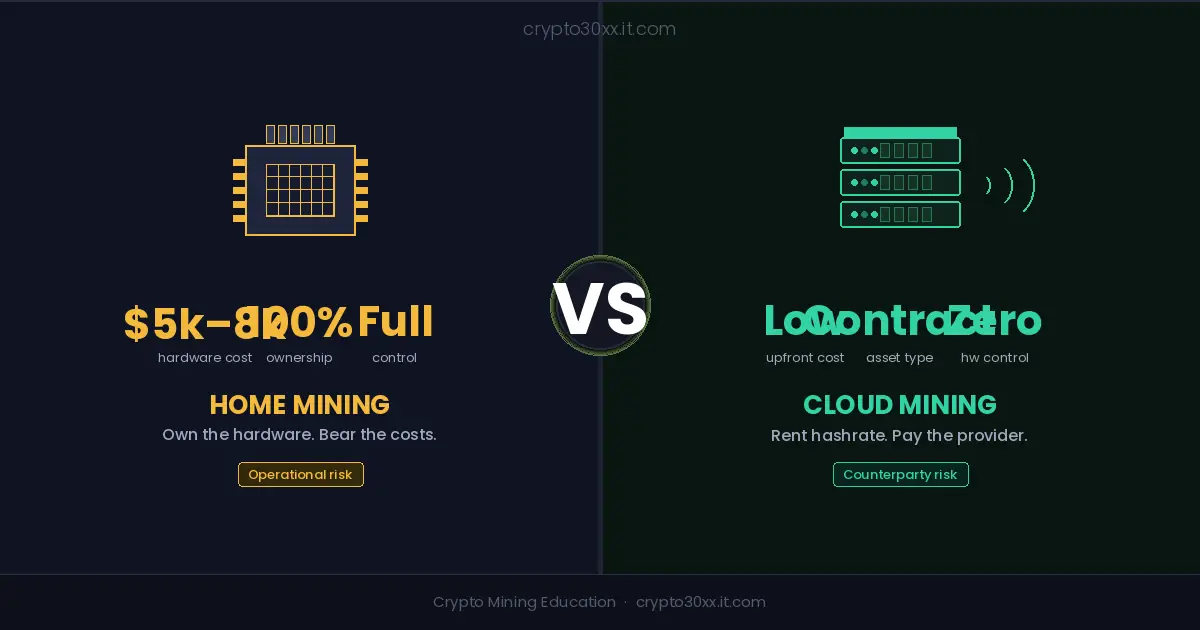
Home mining vs cloud mining are the two main ways a non-institutional participant can access cryptocurrency mining — one through owning and operating physical hardware, the other through renting computational power from a remote data center. Each model carries a fundamentally different cost structure, risk profile, and degree of operational control. This guide breaks down both approaches with enough structural detail to help learners, researchers, and analysts understand what separates them — and why the choice between them matters more than most introductions to mining acknowledge.
What is home mining and how does it work?
Home mining is the practice of running proof-of-work mining hardware in a location you control — typically a residence, garage, or small commercial space — to generate cryptocurrency block rewards. The operator owns the equipment outright, bears all operating costs directly, and has full custody of whatever coins are produced.
The hardware layer
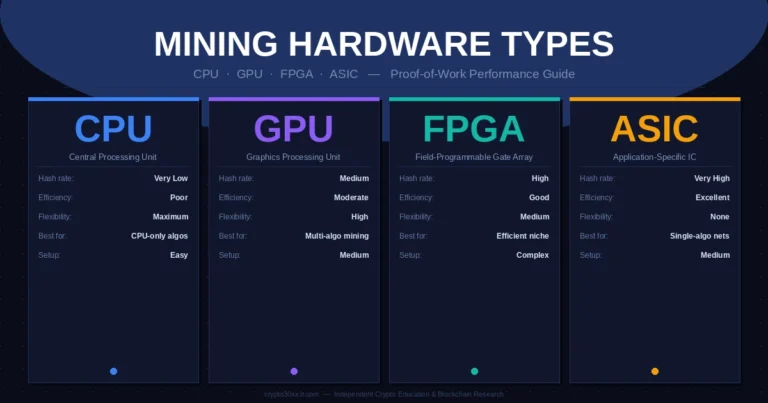
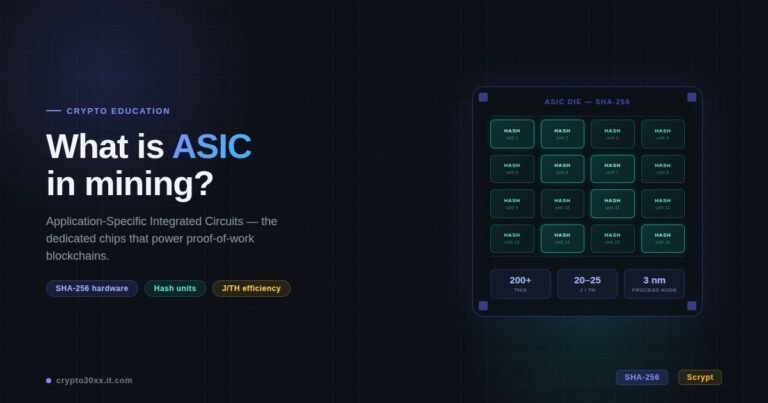
For Bitcoin specifically, only ASIC (Application-Specific Integrated Circuit) hardware produces economically meaningful results at current network difficulty levels. An ASIC is a chip engineered to perform a single function — executing SHA-256 hash computations as fast and efficiently as possible — and nothing else. General-purpose CPUs and GPUs fall orders of magnitude short of competing with modern ASICs on a per-watt basis.
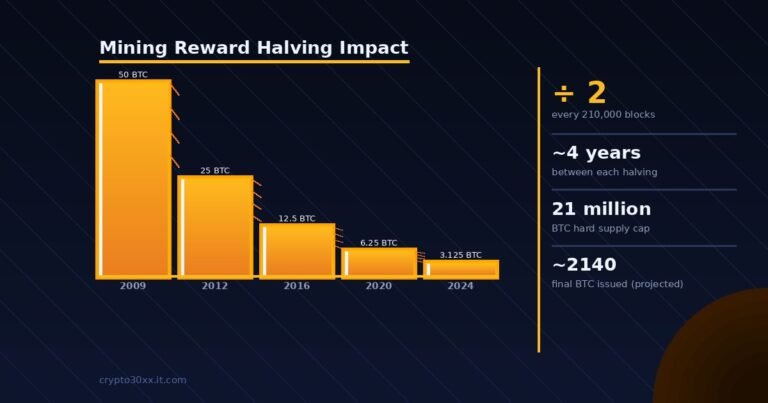
Current-generation machines run from roughly $3,000 to $8,000 per unit depending on model, efficiency rating, and market conditions. Efficiency is measured in joules per terahash (J/TH). Hardware above roughly 25 J/TH is no longer cost-competitive in most electricity markets following each successive halving, which cuts block rewards by 50% approximately every four years.
Some alternative cryptocurrencies — those using ASIC-resistant algorithms such as RandomX (Monero) or EtHash variants — can still be mined meaningfully with consumer GPUs. The economics and competitive dynamics differ substantially from Bitcoin mining, though the structural framework of home mining applies to both.
Operating costs beyond the sticker price
The purchase price of an ASIC is only the first cost. Home miners face a stack of additional expenses that frequently go unaccounted in basic profitability estimates:
- Electrical infrastructure: Modern ASICs draw between 1,500 W and 3,500 W of continuous power and require dedicated 240V circuits. Residential panels not rated for sustained high-amperage loads may need upgrades costing anywhere from $1,500 to $4,000 depending on existing infrastructure and local rates.
- Electricity consumption: This is the largest ongoing cost in home mining. Profitability is highly sensitive to the cost per kilowatt-hour. Operations with rates below roughly $0.06/kWh stand a reasonable chance of generating positive margins on efficient hardware; operations at $0.10–$0.15/kWh face steep challenges.
- Cooling and ventilation: ASICs generate substantial heat as a byproduct of computation. Inadequate cooling shortens hardware lifespan and creates fire risk. Additional cooling infrastructure adds both capital costs and ongoing electricity draw.
- Noise: A single mid-range ASIC typically produces 70–75 decibels — comparable to a vacuum cleaner running continuously. This is a genuine operational constraint, not a minor inconvenience, for residential settings.
- Import duties and taxes: In the United States, Section 301 tariffs on Chinese-manufactured mining hardware have historically added 25–34% to purchase costs before shipping.
What the home miner controls
Full hardware ownership gives the home miner direct control over pool selection, firmware configuration, wallet settings, and payout routing. Coins can flow directly to a self-custodied wallet without passing through any third party. The miner can independently verify hashrate output through pool dashboards. Hardware retains measurable resale value on secondary markets even as it depreciates.
What is cloud mining and how does it work?
Cloud mining is the practice of purchasing a contract for a defined share of computing power (hashrate) from a company operating remote data center infrastructure. The buyer pays for the contract, receives periodic payouts representing their proportional share of mining rewards minus fees, and never touches any physical hardware.
The contract structure
A cloud mining agreement typically specifies three core elements:
- Hashrate allocation — the amount of computing power assigned to the buyer’s contract, measured in terahashes per second (TH/s) for Bitcoin contracts
- Contract duration — fixed terms commonly range from 12 to 36 months, though open-ended contracts exist
- Fee structure — maintenance fees are deducted from gross mining output before the buyer receives anything; these are often expressed as a daily dollar amount per TH/s or as a percentage of daily payouts
The buyer has no physical access to hardware, no ability to verify which specific machines are mining on their behalf, and no claim to any equipment at contract end. What they own is a contractual right to receive payouts according to the stated terms.
How payouts work in practice
The provider operates mining hardware, collects block rewards from the pool, deducts maintenance fees, and distributes the remainder to contract holders proportionally. Payout frequency varies by provider — daily, weekly, or upon hitting a minimum threshold are all common.
A structural issue specific to cloud mining: network difficulty adjusts approximately every two weeks to maintain Bitcoin’s consistent 10-minute block time. As global hashrate rises — which has been the long-run trend since Bitcoin’s genesis — difficulty rises with it. A fixed hashrate allocation therefore earns a declining share of total network rewards over time, even if the raw number of terahashes per second on the contract stays constant. Maintenance fees, however, do not automatically decline. This asymmetry tends to erode net returns over a contract’s term even when the operator is entirely legitimate.
Home mining vs cloud mining: direct comparison
| Factor | Home mining | Cloud mining |
|---|---|---|
| Upfront capital | High ($3,000–$8,000+ for one ASIC, plus infrastructure) | Low to moderate (contract cost only) |
| Hardware ownership | Full — operator owns the equipment | None — buyer holds a contract, not hardware |
| Ongoing costs | Electricity, cooling, maintenance (direct) | Maintenance fees deducted from payouts |
| Operational control | Full (pool, firmware, wallet) | None — entirely provider-dependent |
| Hardware resale value | Yes — secondary ASIC market exists | No — contracts have no resale value |
| Counterparty risk | Low (direct network participation) | High (depends on provider solvency and honesty) |
| Setup complexity | High — electrical, cooling, software configuration | Low — purchase contract, receive payouts |
| Noise and heat | Significant — residential constraints apply | None for the buyer |
| Hashrate verification | Independent (pool dashboards) | Unverifiable by buyer |
| Break-even transparency | Calculable (hardware cost + electricity formula) | Opaque (fee structures and difficulty erode advertised returns) |
The economics of each model
How home mining break-even works
Break-even for a home miner depends on three variables: the hardware’s efficiency rating, the local electricity rate, and the cryptocurrency’s market price (which determines the dollar value of mined coins). A simplified structural formula:
Daily revenue = (machine hashrate in TH/s × network block reward × 86,400 seconds) ÷ (network hashrate in TH/s)
Daily electricity cost = (machine power draw in kW) × (hours per day) × (rate per kWh)
At any given electricity rate and difficulty level, a miner either operates above or below the break-even line. The machine still runs either way — the economics just determine whether it produces net positive output or destroys value. The upfront hardware cost creates an additional threshold: total hardware expenditure must be recovered through net mining margin before the operation reaches overall profitability.
How cloud mining costs are structured
Cloud mining providers price contracts to ensure they capture profit regardless of market conditions. Maintenance fees are designed to cover the provider’s electricity and operating costs at a minimum; in many contracts, fee structures leave the buyer bearing all upside risk and limited downside protection. Some contracts include automatic termination clauses — if daily mining revenue falls below the maintenance fee, the contract ends and the buyer receives nothing back.
A $500 cloud mining contract may gross a certain amount of Bitcoin over 12 months in favorable conditions. After maintenance fee deductions, the net figure is typically substantially lower. The buyer has no way to independently verify whether the stated hashrate is actually allocated to their account or whether the provider’s cost assumptions in the fee schedule are accurate.
Risk profile: where each model fails
Risks specific to home mining
Hardware depreciation: ASIC equipment loses value continuously as more efficient models enter the market and network difficulty rises. A machine bought at the start of a halving cycle may be economically obsolete before the next one.
Electricity rate exposure: Home miners pay residential electricity rates, which are typically higher than the industrial rates available to large-scale operators. A rate increase from a utility provider can turn a marginally profitable operation into a loss-making one with no recourse.
Difficulty escalation: As more mining hardware connects to the network globally, difficulty adjusts upward. A machine generating a certain daily output at one difficulty level generates less as difficulty rises — even with no change in the machine or the operator’s setup.
Physical and logistical risk: Hardware failures, cooling failures, power outages, and internet interruptions all interrupt mining. These are manageable but real operational risks.
Risks specific to cloud mining
Counterparty risk: This is the defining structural risk of cloud mining. The buyer is entirely dependent on the provider to operate as claimed, report hashrate accurately, pay out correctly, and remain solvent. The CFTC has documented cases of fraudulent cloud mining operations that claimed to run mining farms while using new investor funds to pay existing holders — a structure with characteristics of a Ponzi scheme.
Fee opacity: Maintenance fee schedules are set by the provider and can be structured in ways that appear reasonable on the front page but erode returns substantially in the fine print. Fees don’t decline as difficulty rises and reward share falls.
Non-refundable capital: Cloud mining contracts are generally non-refundable. If the provider fails, changes terms, or terminates contracts early, the buyer has limited or no recourse. Unlike hardware, a cloud mining contract has no resale value.
Verification gap: The buyer cannot independently confirm that any specific hardware is mining on their behalf. Hash rate figures on a dashboard are claims by the provider, not independently auditable facts.
Regulatory exposure: Cloud mining providers may operate across multiple jurisdictions, complicating any legal recourse in the event of fraud or insolvency.
A third option: hosted mining
Home mining vs cloud mining is not the only binary. A third structural model — hosted or colocated mining — sits between them and is worth understanding for anyone researching this space seriously.
In hosted mining, the buyer purchases physical ASIC hardware (often from the hosting facility or a third party) and pays the facility to operate it in their data center. The buyer owns the machine. The facility provides power, cooling, internet connectivity, and physical security. The buyer specifies pool and wallet settings; payouts go directly to the buyer’s wallet.
Hosted mining combines hardware ownership (and its resale value) with data center efficiency (access to industrial electricity rates and cooling infrastructure). The cost model is different: no cloud mining maintenance fees, but monthly hosting fees per machine instead. The key distinction from cloud mining is that the buyer owns a specific, identifiable asset — not a contract.
FAQs
Is home mining profitable for small operators? Profitability for individual home miners depends heavily on local electricity rates and hardware efficiency. At rates above roughly $0.10/kWh, most current-generation ASICs operate near break-even or at a loss after electricity costs, before hardware cost recovery. Operations with access to sub-$0.06/kWh electricity through hydroelectric, flared gas, or other low-cost sources have meaningfully different economics.
Can you mine Bitcoin with a GPU at home? GPU hardware cannot compete with ASIC miners for Bitcoin mining at current network difficulty. The hash rate differential is too large for GPU mining to generate economically meaningful returns on Bitcoin. For certain alternative cryptocurrencies that use ASIC-resistant algorithms, GPU mining remains viable, though those markets are smaller and less liquid than Bitcoin.
What fees should I expect with a cloud mining contract? Contract terms vary by provider. Common fee structures include a fixed daily maintenance fee per terahash (expressed in dollars), a percentage deduction from gross mining output, or a combination. The critical thing to examine in any contract is whether fees are fixed or variable and what happens if daily mining revenue falls below the maintenance fee threshold.
How do I verify that a cloud mining provider is legitimate? Full verification is not possible from the buyer’s position — this is inherent to the cloud mining model. Partial signals of legitimacy include: verifiable corporate registration, publicly audited hash rate data, transparent fee schedules with no guaranteed return promises, and a documented operating history. Publicly traded operators (verifiable on major exchanges) carry higher accountability than anonymous providers. Any provider promising fixed daily returns regardless of market conditions is a structural red flag.
What happens to my cloud mining contract if the provider shuts down? Most contracts contain no asset recovery mechanism. If the provider becomes insolvent, ceases operations, or is a fraudulent operation, buyers typically have no claim on physical hardware and limited legal recourse, especially for offshore providers. This is the core counterparty risk that distinguishes cloud mining from direct hardware ownership.
What is the difference between cloud mining and hosted mining? In cloud mining, you buy a contract for a share of hashrate — you own no hardware. In hosted mining, you buy physical ASIC hardware and pay a facility to operate it. The structural difference matters because hosted mining gives you an asset with resale value and independent verifiability; cloud mining gives you a contractual claim against a provider.
Is cloud mining a scam? Not inherently, but the sector has a well-documented fraud problem. The structure of cloud mining — no verifiable hardware, pre-paid non-refundable contracts, promises of passive income — creates ideal conditions for fraudulent operators. Legitimate cloud mining providers exist, but they are a minority of the operators that market their services actively, and their returns are typically modest after fees. Regulatory bodies including the CFTC have issued warnings about fraudulent cloud mining schemes.
Disclaimer
This article is written for educational and research purposes only. It does not constitute financial, investment, or tax advice of any kind. Cryptocurrency mining involves significant financial risk, including the potential total loss of invested capital. Mining economics depend on variables — including hardware costs, electricity rates, network difficulty, and market prices — that change continuously and unpredictably. Readers should conduct independent research and consult qualified professionals before making any financial decisions. crypto30xx.it.com is an independent educational blog and is not affiliated with any mining hardware manufacturer, cloud mining provider, exchange, or financial institution.
The core structural difference between home mining and cloud mining reduces to one question: do you want to own hardware or own a contract? Hardware ownership means bearing full operational complexity and upfront capital cost, in exchange for transparency, direct control, and a physical asset with resale value. A cloud mining contract trades those operational burdens for a simpler entry point, at the cost of counterparty risk and a layer of opacity that buyers cannot independently audit. Neither model is inherently superior — they carry different risk profiles for different types of participants. Understanding the mechanics of each, rather than the marketing around them, is where any serious analysis of cryptocurrency mining has to begin.
Curated content that respects your intelligence—browse our thoughtfully selected reads.