Solo vs pool mining difference: the complete guide
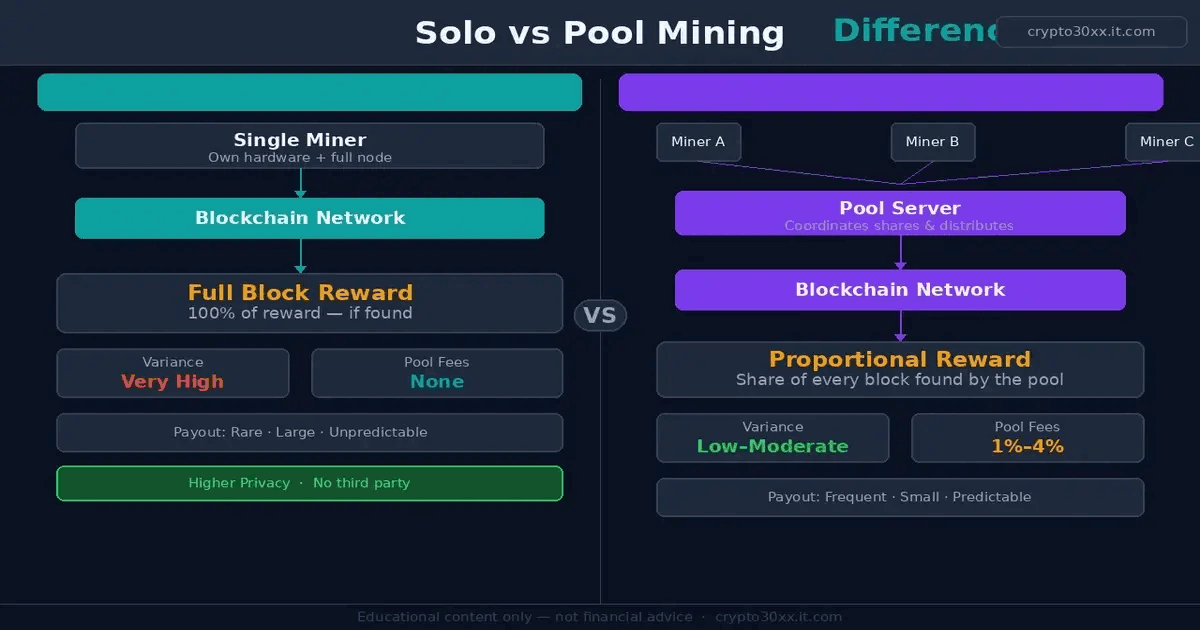
The solo vs pool mining difference is the fundamental choice every proof-of-work miner faces: compete alone for the entire block reward, or combine hash rate with other miners and share proportional payouts. Solo mining connects a miner’s hardware directly to the blockchain, claiming the full reward when a block is found but producing zero income during stretches of unsuccessful computation. Pool mining aggregates hash power from hundreds or thousands of participants, finds blocks collectively, and distributes rewards proportionally based on each miner’s contributed work. Both methods operate under the same consensus rules, but they produce radically different income profiles, risk levels, and operational demands. This guide explains the mechanics of each approach, maps the structural trade-offs, and outlines how miners analyze the choice between them.
What is solo mining and how does it work?
Solo mining is a method in which a single miner’s hardware competes independently to find valid blocks on a proof-of-work blockchain. The miner connects directly to the network, claims the entire block reward when a block is found, and earns nothing when it is not.
The block discovery process in solo mining
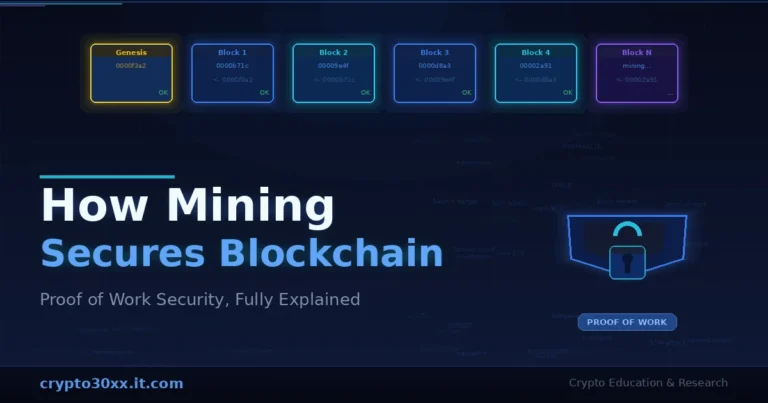
Every proof-of-work blockchain maintains a difficulty target: a numerical threshold that a valid block hash must fall below. Mining hardware runs billions of hash calculations per second, each a separate probabilistic attempt to produce an output below that threshold. The process has no memory; each attempt is statistically independent regardless of how many failed attempts preceded it.
When the hardware produces a hash satisfying the difficulty target, the miner broadcasts the completed block to the peer-to-peer network. Nodes validate it, add it to their chain, and the miner collects the block reward plus all transaction fees included in that block.
Hash rate, difficulty, and the probability of success
A solo miner’s probability of finding any given block equals their share of total network hash rate. If the network generates 1,000 units of combined hash power and a solo miner contributes 1 unit, their probability of finding the next block is 1 in 1,000. Over many thousands of blocks, their actual count converges toward that proportion. Over short periods, results diverge substantially.
Networks recalibrate difficulty periodically to maintain stable block production regardless of total hash power. For Bitcoin, this adjustment happens approximately every 2,016 blocks. When total network hash rate rises, difficulty rises proportionally; when hash rate drops, difficulty falls. Solo miners absorb this variation without any pooled buffer.
What is pool mining and how does it work?
Pool mining is a method in which multiple miners direct their hardware toward a central coordinating server, called a mining pool, and share block rewards proportionally based on each participant’s contributed work. The pool eliminates the extreme income variance of solo mining by aggregating hash power and distributing smaller, frequent payouts to members rather than the full reward to one.
How pools aggregate and coordinate hash rate
A mining pool assigns each connected miner a continuous stream of work units called shares. Shares use a lower difficulty target than the actual network, proving work is occurring without requiring a full-network-difficulty solution on every attempt. Each share submitted records a miner’s proportional claim on future payouts.
When any pool participant produces a hash satisfying full network difficulty, the pool broadcasts the block and collects the reward. The pool then distributes that total across all contributors in proportion to the shares each submitted during the accounting window. The miner who found the block receives no special bonus — their payout reflects only their proportional share contribution.
Pool payout methods: PPS, PPLNS, and FPPS
Pools use different reward distribution formulas that shift variance risk in different directions. The payout model affects income consistency, fee level, and overall risk profile.
PPS — Pay Per Share
PPS pays a fixed, predetermined amount for every valid share submitted, regardless of whether the pool found a block during that session. The pool operator assumes all variance risk. Miners receive predictable, near-immediate payouts in exchange for higher fees, typically between 2% and 4%, because the operator must finance payouts even during dry spells.
PPLNS — Pay Per Last N Shares
PPLNS calculates payouts based on a miner’s shares within a rolling window of the last N shares submitted across the pool. Payouts fluctuate with pool luck: a pool running above statistical expectations produces higher payouts; one running below produces less. PPLNS fees are typically lower than PPS, but income is correspondingly less consistent.
FPPS and solo pool modes
FPPS extends PPS by including transaction fees in the per-share calculation, not just the block subsidy. This gives miners a more precise share of total block revenue when transaction fees are elevated. Some pools also offer a solo mode, where a miner’s hash power routes through pool infrastructure but no reward sharing occurs. If that miner finds a block, they keep the full reward. Solo pool mode retains the high-variance income profile of true solo mining while reducing orphan block risk.
Solo vs pool mining difference: a direct comparison
The fundamental differences between solo and pool mining span reward structure, income timing, operational complexity, and network-level effects. No single dimension captures the full picture, and a comparison across the key variables shows why both approaches attract miners in different contexts.
| Dimension | Solo mining | Pool mining |
|---|---|---|
| Block reward when found | Full block reward + all fees | Proportional share of reward |
| Income frequency | Unpredictable; days to years between payouts | Regular; typically daily or per-threshold |
| Income variance | Extremely high | Low (PPS) to moderate (PPLNS) |
| Pool fees | None | Typically 1–4% of gross earnings |
| Minimum viable scale | Requires meaningful network hash rate share | Viable at any scale |
| Privacy | Higher; no third party logs activity | Lower; pool records hash rate and addresses |
| Infrastructure complexity | Requires full node or direct node connection | Pool handles all protocol connectivity |
| Orphan block risk | Higher without optimized connectivity | Lower; pool infrastructure reduces this |
| Decentralization effect | Distributes block production | Concentrates production in fewer operators |
How variance shapes the economics of each approach
Variance is the dimension of the solo vs pool mining difference that most directly determines whether an operation is financially sustainable. Solo mining produces a binary outcome per block: the full reward or nothing. Pool mining converts that binary outcome into a proportional, continuous income stream, making day-to-day operational planning possible at almost any hash rate scale.
Calculating expected block time for a solo miner
A concrete illustration: if a miner controls 0.01% of a network’s total hash rate, and the network produces one block every ten minutes, the miner’s expected solo block interval is 10 minutes divided by 0.0001, which equals roughly 69 days. That figure is the statistical average, not a guarantee. Block discovery follows a memoryless exponential distribution, meaning the miner might find a block in 10 days or wait 300 days, and neither outcome updates the expected time to the next one.
With that same 0.01% share inside a pool, the miner receives approximately 0.01% of every block the pool finds, distributed on a regular schedule. Over a full year or more, cumulative income converges toward the same expected total. The difference lies entirely in how that income is distributed across time.
Why variance matters beyond statistics
Mining operations carry fixed costs: hardware depreciation, electricity, cooling, and maintenance arrive on a predictable monthly schedule. Solo mining income does not. A miner facing a 90-day block-free period is not simply receiving delayed income — they are paying fixed costs from reserves during a period of zero revenue.
Large-scale operations with a substantial hash rate share face a different problem. Their expected block interval might measure in hours or days, making income statistically smooth even without pooling. At that scale, pool fees represent a continuous cost drain rather than a variance hedge, and the economic logic of solo mining strengthens.
Fees, independence, and network-level considerations
The solo vs pool mining difference extends well beyond variance into cost structure, data privacy, and the broader health of the blockchain network. Each factor points in a different direction, and understanding all three is essential for a complete analysis.
The real cost of pool fees
A 2% pool fee applied to all payouts reduces annual gross earnings by 2%. For high-volume operations running on thin margins, that cost compounds over time. Solo miners pay no pool fees, but they carry variance as an implicit substitute cost that is harder to quantify. If a dry spell forces an operation to slow down, sell equipment, or borrow to cover electricity, those disruption costs can exceed any fee percentage.
The rational comparison is not “fee versus no fee” but “fee cost versus the operational cost of income instability.”
Privacy and blockchain decentralization
Solo miners submit blocks directly to the peer-to-peer network. No intermediary records their hash rate, links their identity to a payout address, or holds earned balances pending withdrawal. Pool participation requires trusting an operator with operational data and earned rewards.
At the network level, mining pool concentration creates structural pressure points. When a small number of pools control a large fraction of total hash rate, they gain disproportionate influence over block production timing and transaction inclusion priorities. This does not immediately break the network’s security model, but it concentrates power in a way that conflicts with the decentralization goals proof-of-work is designed to achieve. Protocol researchers and analysts track hash rate distribution figures as a key measure of network health.
How miners typically choose between solo and pool
Neither solo nor pool mining is a universal best choice. The rational decision depends on hash rate scale, income requirements, the specific blockchain’s total difficulty, and whether operational stability or maximum potential reward per block takes priority. Both approaches suit different operator profiles.
When solo mining is structurally viable
Solo mining produces reliable income only when a miner’s hash rate represents a meaningful fraction of the total network. A common practical benchmark places this threshold at roughly 0.5% to 1% of total network hash rate, enough to expect a block at least several times per month. At that share, variance remains present but becomes manageable within normal business cash flow.
On lower-difficulty networks (smaller proof-of-work coins that share an algorithm with larger chains but attract far fewer total miners), a modest hardware setup can represent a substantial share of total hash rate. Solo mining also makes sense for operators who prioritize privacy, want to eliminate fee drag on high-volume production, or run infrastructure sophisticated enough to minimize orphan block exposure.
Understanding orphan block risk in solo mining
An orphaned block occurs when two miners find valid blocks at nearly the same height simultaneously, and the network builds on only one chain. The miner whose block gets orphaned receives nothing for that work. Solo miners broadcasting through slower or less-connected nodes face higher orphan exposure than pool operators, who run high-redundancy infrastructure across multiple geographic locations. Solo pool mode addresses this problem without requiring reward sharing.
When pool mining is the practical choice
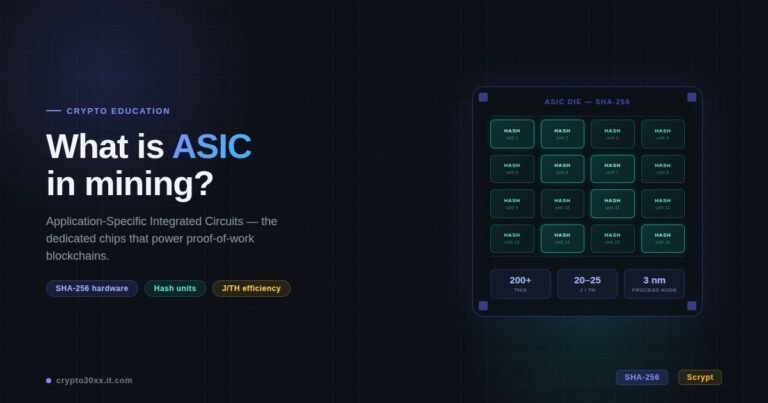
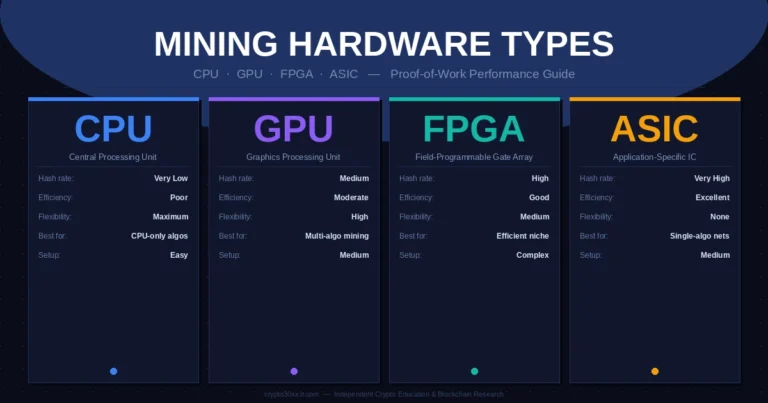
For the large majority of individual miners running a small number of ASICs or graphics cards, pool mining is the structurally rational choice. Predictable payouts enable better operational planning. Pool fee costs are typically far lower than the disruption caused by extended income gaps. Pools also remove the need to run and maintain a full node, provide monitoring and reporting tools, and carry substantially lower orphan rates than solo setups.
For miners at the smallest scale, expected solo block intervals on major networks stretch into years or decades. Pool participation converts that probabilistic lottery into a steady income stream calibrated precisely to hash rate contribution.
FAQs
What is the core solo vs pool mining difference? Solo mining means a single operator competes independently for the entire block reward. Pool mining combines many miners’ hash rate to find blocks collectively, then splits rewards proportionally. The core difference is variance: solo miners face rare, large payouts, while pool miners receive frequent, smaller, more predictable ones.
Can a miner with limited hardware succeed at solo mining? Mathematically, any hardware can find a block; the process is purely probabilistic. In practice, a miner holding a tiny fraction of a major network’s hash rate faces expected solo block intervals measured in years or decades. Most small-scale hardware deployments cannot sustain operations through waiting periods of that length.
How do pool fees actually affect total earnings? Pool fees, typically 1% to 4% of gross payouts, reduce total earnings by a fixed percentage on every distribution. A 2% fee on 1,000 units of annual earnings costs 20 units per year. Solo miners avoid this cost but carry variance as an implicit substitute, which has its own operational cost when revenue is absent for extended periods.
What is an orphaned block and why does it matter for solo miners? An orphaned block is a valid block rejected by the network because another miner found a competing block at the same height slightly earlier, and the network chose the other chain. Solo miners with slower node connections face higher orphan exposure. Pool infrastructure reduces this risk through redundant, geographically distributed relay networks.
What is a solo pool and how does it differ from standard pool mining? A solo pool routes a miner’s work through pool infrastructure without sharing rewards. If the miner finds a block, they keep the full reward; if not, they earn nothing. Solo pool mode preserves the high-variance reward profile of true solo mining while providing better node connectivity and lower orphan exposure than a self-operated setup.
Which payout method suits small miners better: PPS or PPLNS? PPS offers consistent per-share payments regardless of pool luck, making income more predictable at a slightly higher fee. PPLNS links payouts to rolling pool luck, producing variable but potentially cheaper results. Small miners with limited ability to absorb income gaps typically favor PPS for its stability.
Does pool mining concentrate blockchain power in problematic ways? It can create concentration. When a few large pools control a significant fraction of hash rate, they gain disproportionate influence over block production timing and transaction inclusion. This does not automatically compromise consensus security, but it introduces structural risks inconsistent with the decentralization goals proof-of-work is designed to achieve.
Disclaimer
This article is produced for educational and research purposes only. Nothing in this content constitutes financial, investment, or tax advice. Cryptocurrency mining involves significant financial risk, including potential loss of capital invested in hardware and ongoing electricity costs. Readers should conduct independent research and consult qualified professionals before making any decisions related to cryptocurrency mining.
The solo vs pool mining difference ultimately comes down to how risk and reward are distributed over time. Solo mining offers the entire block reward with no fee drag, but demands sufficient hash rate to produce income reliably and exposes operators to long, unpredictable gaps between payouts. Pool mining converts that all-or-nothing structure into steady proportional earnings at the cost of a small ongoing fee. Understanding reward mechanics, payout models, variance math, and orphan block dynamics is foundational for any serious analysis of proof-of-work mining economics.
Your strongest version starts with the right knowledge—find it in our self-growth posts.