How crypto leverage works for beginners: a complete guide
How crypto leverage works for beginners: Crypto leverage lets a trader control a position larger than their actual capital by borrowing funds from an exchange. If a trader deposits $100 and applies 10× leverage, they hold a $1,000 position. Any price move now affects that full $1,000 — not just the $100. That amplification works in both directions: a 5% gain becomes a 50% gain on the deposit, and a 5% loss wipes out half of it. Understanding this mechanic is the starting point for anyone studying leveraged crypto markets.
What is crypto leverage?
Crypto leverage is a borrowing mechanism that allows a market participant to open a position larger than their deposited capital. The deposit — called the margin — acts as collateral. The exchange or platform extends the difference.
The ratio is written as a multiplier: 2×, 5×, 10×, 50×, 100×. A 20× position means the trader controls twenty times what they deposited. A $500 deposit at 20× controls a $10,000 position.
How the margin deposit works
The margin is the portion of the total position value that the trader provides themselves. Exchanges require it as security. If the trade moves against the trader, losses are deducted from the margin. When losses consume enough of that margin, the exchange closes the position automatically — this is liquidation.
Margin percentage = (1 ÷ leverage ratio) × 100. At 10×, the required margin is 10% of the position size. At 50×, it drops to 2%.
Isolated margin vs. cross margin
Two standard margin modes govern how that collateral is applied:
| Mode | What it uses as collateral | Max loss |
|---|---|---|
| Isolated margin | Only the margin assigned to that position | Capped at that deposit |
| Cross margin | All available funds in the account | Can exceed the single trade’s margin |
Isolated margin limits risk to a defined amount per trade. Cross margin prevents one position from being liquidated early because the whole account absorbs the loss — but it means a bad trade can drain the entire balance.
How does crypto leverage actually work?
Two main instruments carry this mechanism: perpetual futures contracts and margin trading on spot markets. Both achieve the same amplification effect through different mechanics.
Perpetual futures contracts
Perpetual futures are derivative contracts with no expiry date. A trader does not own the underlying crypto — they hold a contract that tracks its price. Exchanges net the gains and losses between participants who hold long positions (betting on price rising) and short positions (betting on price falling).
To keep the perpetual contract price anchored to the spot price, exchanges apply a funding rate: a periodic payment exchanged between long and short holders. When the contract trades above the spot price, long holders pay shorts. When it trades below, short holders pay longs. Funding rates accumulate over time and can erode a position even when the price barely moves.
Margin trading on spot pairs
Spot margin trading lets a trader borrow actual crypto or stablecoins to buy or sell an asset they do not fully hold. A trader might deposit USDT as collateral and borrow BTC to sell short. If the price falls, they buy BTC back cheaper, repay the borrowed amount, and keep the difference. Interest accrues on borrowed funds throughout the duration of the trade.
A worked example with round numbers
A trader deposits $1,000 and opens a 10× long position on a crypto asset. The total position size is $10,000.
- The asset rises 8%: position value reaches $10,800. Profit is $800 on a $1,000 deposit — an 80% return on margin.
- The asset falls 8%: position value drops to $9,200. Loss is $800 — an 80% loss on margin.
- The asset falls 10%: position value drops to $9,000. The full $1,000 margin is consumed. Liquidation occurs before or at this point.
The math confirms the basic rule: at N× leverage, a 1/N percentage move in the wrong direction eliminates the entire margin.
What is liquidation and how does it trigger?
Liquidation is the automatic closure of a leveraged position by an exchange when the margin balance falls below a required threshold. It is the exchange protecting its own loan, not a penalty.
Maintenance margin and liquidation price
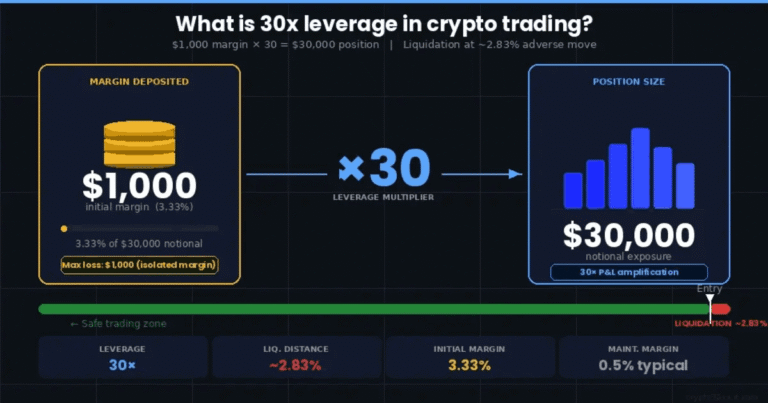
Exchanges set a maintenance margin — a minimum balance that must remain in the account to keep the position open. This is always lower than the initial margin. When the account equity falls to the maintenance margin level, the system triggers liquidation.
The liquidation price is calculable before entering any trade:
- Long position liquidation price ≈ Entry price × (1 − 1/leverage + maintenance margin rate)
- Short position liquidation price ≈ Entry price × (1 + 1/leverage − maintenance margin rate)
At 20× leverage with a 0.5% maintenance margin rate, a long entered at $1,000 liquidates near $954. The actual threshold varies by exchange, but the principle is consistent.
The liquidation sequence
- Position equity approaches the maintenance margin threshold.
- Exchange systems trigger a partial liquidation or margin call (some platforms warn the trader first).
- If equity continues to fall, the position is closed at market price.
- Any remaining margin after covering the debt is returned. If the market moves faster than the liquidation engine can execute, the remaining margin may be zero.
Insurance funds and auto-deleveraging
Major exchanges maintain an insurance fund — capital reserved from past liquidations where the exchange recovered more than the debt. If a position is liquidated at a price that covers the full loan, the surplus goes to the insurance fund. If the market moves so fast that the position closes at a loss beyond the margin, the insurance fund covers the deficit.
When insurance funds run out in extreme conditions, exchanges use auto-deleveraging (ADL): they close the most profitable counter-positions to absorb the loss. ADL is rare but happens during extreme volatility.
Risks of crypto leverage: what the mechanics actually mean
Leverage does not change the probability of a price move. It only changes the financial impact of every move that does happen. This section covers the structural risks that apply regardless of market direction.
Amplified losses, not just amplified gains
The same calculation that turns a 5% price gain into a 50% margin gain also turns a 5% price drop into a 50% margin loss. There is no asymmetry. Traders who focus on the upside scenario without modeling the downside are misreading the instrument.
At 50× leverage, the math is stark: a 2% adverse price move liquidates the position. Crypto assets routinely move 2% in minutes. Wick spikes — brief price extremes during low-liquidity periods — can trigger liquidations even when the asset quickly recovers.
Funding rate drag on long-held positions
Perpetual contracts are not cost-free to hold. Funding rates paid every eight hours (on most exchanges) accumulate. In sustained trending markets, funding rates can run persistently positive or negative for days. A position held for a week in a high-funding environment loses capital even when the price stays flat.
Volatility and the gap risk
Crypto markets operate continuously with no circuit breakers equivalent to regulated equity exchanges. Sharp moves during low-liquidity hours can close positions at prices far worse than the stated liquidation level — a phenomenon called slippage. The liquidation price is a threshold, not a guaranteed exit.
Psychological pressure and position management
Watching a leveraged position requires different attention than holding a spot asset. A 1% move at 20× creates the same emotional and financial pressure as a 20% move in a spot position. Traders unfamiliar with this pressure tend to make reactive decisions — adding to a losing position, reducing leverage too late, or closing a profitable trade too early.
Common misconceptions about leverage
“Higher leverage means higher profits from the same move.” Technically true but misleading. Higher leverage also means a smaller adverse move causes liquidation. A 100× position and a 2× position on the same asset do not have the same probability of staying open through normal market noise.
“Using a stop-loss eliminates liquidation risk.” A stop-loss order is a conditional order that closes the position at or near a set price. It does not guarantee execution at that exact price in fast-moving markets. A stop-loss reduces liquidation risk but does not eliminate it.
“I can recover losses by increasing leverage.” This is the most operationally dangerous misconception. Increasing leverage after a loss shrinks the distance to the next liquidation. The margin available for the next trade is already smaller. The two effects combine.
Comparing leverage levels: risk vs. position control
The table below shows how leverage ratio, liquidation distance, and required margin interact on a $1,000 deposit opening a position in a hypothetical asset:
| Leverage | Position size | Required margin | Price drop to liquidation* |
|---|---|---|---|
| 2× | $2,000 | 50% | ~45% |
| 5× | $5,000 | 20% | ~17% |
| 10× | $10,000 | 10% | ~9% |
| 20× | $20,000 | 5% | ~4.5% |
| 50× | $50,000 | 2% | ~1.8% |
| 100× | $100,000 | 1% | ~0.9% |
*Approximate, excluding maintenance margin thresholds and fees. Actual liquidation prices vary by exchange.
The right-hand column is the critical figure. At 100×, normal intraday volatility is sufficient to trigger liquidation. At 2×, only a significant directional move eliminates the margin.
What role does position sizing play?
Position sizing is the decision about how much capital to risk per trade, independent of the leverage ratio. These are two separate decisions that traders sometimes conflate.
The difference between leverage and position size
A trader with $5,000 who opens a 10× position using the entire balance has $50,000 of exposure. The same trader could open a 10× position using $200 of their balance, giving $2,000 of exposure. Same leverage ratio, very different actual risk.
Prudent position sizing caps the loss on any single trade to a fraction of total capital. Leverage determines the efficiency of margin use. Used together deliberately, position sizing limits the damage a liquidation can do even when the leverage ratio is high.
Stop-loss placement relative to leverage
A stop-loss should be placed at a level that reflects where the trade idea has failed, not at the liquidation price. With 10× leverage, setting a stop-loss at 5% below entry means the margin loss is 50% on that position. With appropriate position sizing, that stop-loss represents a defined total capital loss.
The order of decisions: first set the stop-loss at the technically appropriate level, then calculate the position size that limits total capital risk, then choose a leverage ratio that makes the margin requirement work. Many beginners do this in the wrong order.
Types of leveraged crypto products
Leverage in crypto markets appears in several different product structures:
- Perpetual futures contracts: No expiry, continuous funding rate, most common product on major derivatives exchanges.
- Quarterly futures contracts: Fixed expiry date, no funding rate, price converges to spot at expiry. Used for longer-horizon positions.
- Options contracts: Provide asymmetric exposure — buyers have defined maximum loss (the premium paid), sellers have unlimited theoretical loss. Options pricing involves implied volatility, time decay, and strike selection, making them structurally different from futures.
- Leveraged tokens: ERC-20 or similar tokens that automatically maintain a target leverage ratio through daily or periodic rebalancing. Convenient but subject to volatility decay, which erodes value in sideways or choppy markets.
- Spot margin accounts: Borrowing actual crypto from an exchange or lending pool to establish a leveraged spot position. Simpler than futures, interest accrues on borrowed funds.
Each product has different mechanics for how leverage is applied, maintained, and closed. Understanding which product is being traded matters before applying any leverage analysis.
FAQs
What does 10× leverage mean in crypto? At 10× leverage, a trader controls a position ten times their actual deposit. A $500 deposit opens a $5,000 position. Every 1% move in the underlying asset gains or loses 10% of the deposit. A 10% adverse move against the position wipes out the entire margin.
Can you lose more than you deposit with a leveraged position? On most exchanges using isolated margin, the maximum loss is capped at the initial margin. With cross margin or in exceptional market conditions that outpace liquidation engines, losses can exceed the deposit. The exchange’s insurance fund typically covers the deficit, though this is not guaranteed.
What is a liquidation price? The liquidation price is the asset price at which an exchange automatically closes a leveraged position to protect itself from losses exceeding the trader’s margin. It is determined by the leverage ratio, entry price, and maintenance margin requirement. Most platforms display it when a position is opened.
How does funding rate affect a leveraged position? On perpetual futures, a funding rate is exchanged between long and short position holders at regular intervals — typically every eight hours. When the market is bullish and contracts trade above spot, longs pay shorts. This periodic payment accumulates and can meaningfully reduce a position’s profitability over days or weeks.
What is the difference between isolated and cross margin? Isolated margin limits potential loss to the specific amount deposited for one trade. Cross margin uses the entire account balance as collateral, which reduces the chance of premature liquidation but means a bad trade can drain all available funds.
Is leveraged trading suitable for beginners? Leverage amplifies both gains and losses, and the speed of liquidation in volatile markets leaves little time to react. Most educational resources, including this one, recommend that those new to crypto markets study spot market mechanics, liquidation math, and position sizing thoroughly before approaching leveraged products.
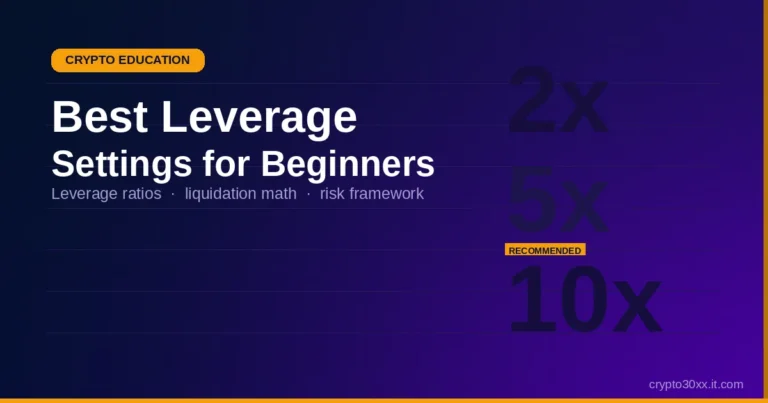
What leverage do most professional traders use? There is no single answer, and any specific claim would be anecdotal. Professional traders in futures markets often prefer lower multiples — 2× to 5× in many documented strategies — to reduce liquidation risk and allow positions to breathe through normal market noise.
What is auto-deleveraging (ADL)? ADL is a mechanism exchanges use when the insurance fund cannot cover a liquidated position’s deficit. The exchange automatically closes opposing profitable positions — highest-leverage, highest-profit first — to absorb the loss. It is a last-resort backstop, not a routine occurrence.
Disclaimer
This article is written for educational purposes only by an independent research and analysis site. Nothing in this article constitutes financial advice, investment guidance, or a recommendation to buy, sell, or hold any asset. Leveraged trading carries a high risk of loss, and many participants lose their entire margin. Readers should research applicable regulations in their jurisdiction and consult a qualified financial professional before making any financial decisions.
Leverage is a tool that changes the financial weight of every price movement — nothing more. A position at 20× does not move differently from a spot position in the same asset; it simply costs more when it moves against the trader and pays more when it moves in their favor. The mechanics are deterministic: margin, liquidation price, funding rate, position size. Each one is calculable before a position opens. The risk in leveraged crypto trading is not that the mechanics are opaque — it is that the speed of crypto markets means those mechanics play out faster than many traders expect.
Our tender guidance is ready to meet you wherever you stand on your quiet journey right now.