Best leverage settings for beginners: a clear guide
Leverage is a mechanism that amplifies the size of a trading position beyond what available capital alone could support. For a new crypto trader, selecting a leverage setting without understanding its mechanics is one of the most consistent paths to rapid capital loss. The best leverage settings for beginners are those that keep the liquidation threshold well away from the entry price, allow room for normal market volatility, and match any potential loss to what the trader can realistically absorb. This guide explains how leverage ratios work, what liquidation mathematics mean at different settings, and why the 2x–5x range is where most beginners should start. The reason is arithmetic, not prohibition.
What leverage actually does in a crypto position
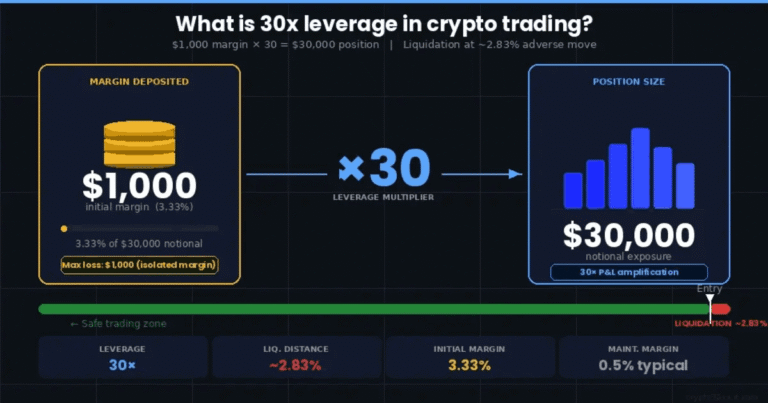
Leverage allows a trader to control a position larger than their deposited collateral. At 5x, a $200 deposit controls a $1,000 position. The exchange funds the $800 difference, using the trader’s deposit as collateral. It then calculates all profits and losses on the full $1,000, not on the $200.
How the multiplier applies symmetrically
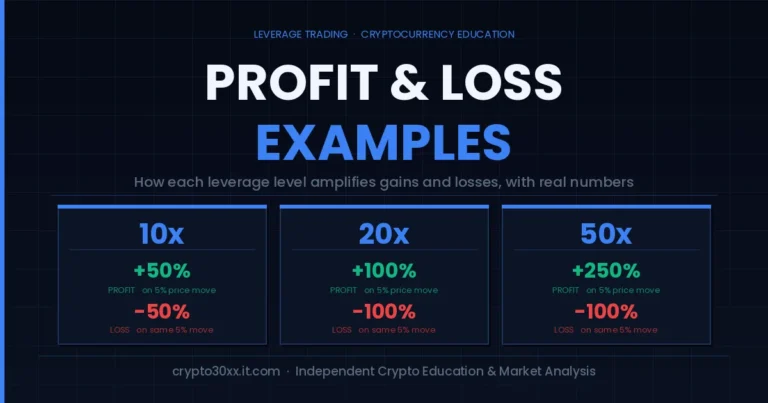
A 10% price increase on a $1,000 position returns $100. On a $200 deposit, that is a 50% gain. A 10% decrease costs the same $100, erasing half the deposit. The multiplier applies at an equal rate in both directions.
Many beginners concentrate on what a favorable move could return. The loss side of the calculation is identical.
What the ratio number represents
A leverage ratio describes how many times larger the controlled position is than the posted collateral. At 1x, no leverage is applied. At 10x, a $100 deposit controls a $1,000 position. The “x” represents the multiplication factor applied to every price movement in either direction.
The ratio also determines how far price must move before the exchange forces liquidation. Lower leverage gives a position more distance from that threshold.
Why most beginners choose the wrong settings
Exchanges display default leverage options ranging from 20x to 125x prominently, and new users see these numbers first. Understanding why those defaults exist, and why they are generally inappropriate for beginners, requires examining exchange design rather than relying on the numbers at face value.
The pull of high multipliers
High leverage compresses the capital required to enter a trade. At 50x, a $50 deposit controls a $2,500 position. A 2% adverse move eliminates the entire $50.
The psychological effect is that beginners evaluate the gain scenario without applying the same scrutiny to the loss scenario. Leverage amplifies both outcomes at the same rate.
How position size interacts with leverage
Leverage and position size together determine actual market exposure. A trader using 10x leverage on 10% of their capital carries less total risk than a trader using 2x leverage on 100% of their capital.
Beginners sometimes use higher leverage as a substitute for increasing position size, without recognizing that the two mechanisms produce different risk profiles. The correct starting point is to define an acceptable loss in dollar terms, then work backward to the position size and leverage ratio that produce it.
Best leverage settings for beginners: the numbers
The best leverage settings for beginners sit between 2x and 5x. This range provides meaningful exposure to price movements while keeping the liquidation price far enough from the entry point that normal volatility does not immediately threaten the position. These numbers are not arbitrary: they follow directly from how liquidation thresholds are calculated.
The 2x–5x range: what the math shows
At 2x leverage, price must move roughly 50% against the position before liquidation occurs, excluding fees and maintenance margin. At 5x, that buffer narrows to approximately 20%. The table below shows how this shifts across common leverage levels.
| Leverage | Approx. move to liquidation | Practical fit |
|---|---|---|
| 2x | ~50% | Complete beginners |
| 3x | ~33% | Beginners with some experience |
| 5x | ~20% | Beginners ready for more exposure |
| 10x | ~10% | Intermediate traders only |
| 20x | ~5% | Experienced traders |
| 50x+ | ~2% | Professional or algorithmic contexts |
Actual liquidation points vary by exchange, include maintenance margin requirements, and are affected by funding rates. The figures above are illustrative approximations.
When 10x becomes relevant, and when it doesn’t
Some educational resources list 10x as a workable beginner setting. The liquidation math does not support that claim for traders new to leveraged products. A 10% adverse price move is routine for most crypto assets, and that is all it takes to liquidate a 10x position. Beginners rarely have the stop-loss discipline to exit consistently before reaching that level.
Traders who already understand position sizing, liquidation calculations, and stop placement may experiment with 10x on small positions. That prerequisite does not exist for most beginners.
What “best” means in this context
“Best” does not mean the setting with the highest theoretical return. It means the setting that keeps a trader in positions long enough to observe the market, respond to movement, and build practical experience. Repeated liquidations produce losses, not learning.
The best leverage settings for beginners are those that survive normal market volatility without requiring perfectly timed entries on every trade.
How liquidation price changes with leverage
Liquidation occurs when accumulated losses consume the posted collateral. The exchange closes the position automatically to prevent debt from exceeding the deposit. Knowing where that threshold sits is a foundational requirement, not something to estimate after a position is already open.
Calculating the liquidation threshold
A simplified formula for long positions:
Liquidation price ≈ Entry price × (1 − 1 / leverage ratio)
At 5x leverage with a $1,000 entry: Liquidation ≈ $1,000 × (1 − 0.20) = $800: price must fall 20%.
At 20x with the same entry: Liquidation ≈ $1,000 × (1 − 0.05) = $950: price must fall 5%.
For short positions, the calculation inverts; liquidation approaches from above the entry price. In both cases, higher leverage brings the liquidation level closer to where the trade was placed.
Isolated margin vs cross margin: a practical distinction
Two margin modes determine how liquidation behaves in practice.
Isolated margin: The trader assigns a fixed amount of collateral to a specific position. Losses are capped at that amount. If the position liquidates, only the assigned margin is consumed.
Cross margin: The entire account balance functions as collateral. Positions can tolerate larger adverse moves before liquidation, but a single losing trade can draw down funds intended for other purposes.
For beginners, isolated margin creates a defined ceiling on what any single position can cost. Cross margin gives positions more room but exposes a larger portion of the account to one outcome.
Building a risk framework before using leverage
Understanding leverage settings conceptually is separate from having a working risk framework. The framework must come first. Without it, even a 2x setting produces inconsistent results because position size, stop placement, and acceptable loss are all undefined before the trade opens.
Define the maximum loss per trade
Structured risk approaches generally suggest limiting exposure to 1%–2% of total capital per position. At 1% risk, twenty consecutive losing trades consume roughly 18% of the account. At 10% per trade, five losses consume over 40%.
The lower percentage survives extended losing streaks. The math on this is arithmetic, not philosophy.
Set the stop-loss before the trade opens
A stop-loss order exits a position automatically when price reaches a defined level. The level must be chosen before the trade is placed, not revised after the position starts moving against the trader.
For leveraged positions, the stop must sit above the liquidation threshold. Exiting at the liquidation level returns zero capital. A stop placed at a meaningful price level exits with partial capital intact.
Calculate position size from risk, not from available margin
The correct sequence for sizing any leveraged trade:
- Define the maximum acceptable loss in dollars: for example, $20 on a $2,000 account represents 1%.
- Choose a stop-loss distance based on market structure: for example, 5% below the entry price.
- Calculate position size: $20 loss ÷ 5% stop distance = $400 total position.
- Determine the required leverage: a $400 position on a $100 margin deposit uses 4x leverage.
Starting from a leverage number and working backward to position size is the sequence that produces systematic losses. Starting from an acceptable loss and working forward to leverage produces defined, manageable outcomes.
Common misconceptions about leverage in early trading
Several assumptions beginners carry into leveraged trading are mathematically incorrect. These errors don’t produce isolated bad trades; they produce systematic losses because the underlying decision-making model is wrong from the start. Correcting them before trading begins is more useful than selecting any specific leverage number.
Higher leverage does not affect the probability of being right
Leverage amplifies outcomes. It does not influence price direction. A trader with no reliable edge on price will lose at 2x at the same underlying rate as at 1x, just faster. If the trade idea is wrong, higher leverage makes it wrong more expensively.
Funding rates create a holding cost that accumulates
Perpetual futures, the most common leveraged product in crypto, use a funding rate mechanism to keep contract prices aligned with spot prices. Funding transfers between long and short holders occur roughly every eight hours on most exchanges, based on which side carries more weight.
When long positions dominate, longs pay shorts. When short positions dominate, the direction reverses. For positions held across multiple funding periods, this cost accumulates. A position that appears profitable on paper may break even or lose once funding payments are factored in.
Small leverage on a large position is riskier than high leverage on a small one
A $10,000 position at 2x carries $10,000 in market exposure. A $100 position at 20x carries $100 in market exposure. The leverage multiple does not determine absolute risk. Total position size in dollar terms determines how much can be lost. Ignoring this relationship leads to significant underestimation of actual exposure.
FAQs
What is the safest leverage setting for a beginner in crypto? The safest range for beginners is 2x to 5x. At 2x, price must move 50% against the position before liquidation, leaving room for normal market fluctuations. Starting at 2x and increasing only after understanding how liquidation calculations work is a standard recommendation across educational resources.
Can I lose more than my initial deposit when using leverage? Most retail exchanges use automated liquidation to prevent negative account balances, so losses are generally capped at the posted margin. In extreme market conditions where price moves faster than the liquidation engine can execute, slippage may cause losses that slightly exceed the margin. Reading the exchange’s specific liquidation policy before trading is essential.
Is 10x leverage appropriate for beginners? For most beginners, no. At 10x, a 10% adverse price move triggers liquidation. Crypto assets routinely move 10% or more within a single session, making 10x highly sensitive to ordinary volatility. Consistent stop-loss discipline is required to manage these positions, and most beginners have not yet developed it.
What is the difference between isolated and cross margin? Isolated margin limits losses to the collateral assigned to a single position. Cross margin uses the entire account balance as collateral, giving positions more room before liquidation but exposing more capital to any one trade. Beginners are generally better served by isolated margin because it creates a defined cap on what any individual position can cost.
Does higher leverage increase profit potential? Yes, and it increases loss potential equally. At 5x, a 10% favorable move produces a 50% return on the posted collateral. A 10% unfavorable move produces a 50% loss on the same collateral. The multiplier applies at the same rate in both directions.
Should I use the maximum leverage my exchange offers? No. Maximum leverage settings, sometimes 100x or 125x on certain exchanges, reduce the price move required for liquidation to under 1%. Routine market fluctuations can eliminate the position before any response is possible. These settings are not appropriate for beginners and are rarely appropriate for most discretionary traders.
How do funding rates affect my leveraged position? On perpetual futures, funding is a periodic transfer between long and short holders that keeps the contract price close to spot. On most exchanges, this recurs approximately every eight hours. When long positions dominate, longs pay shorts. Over multi-day or multi-week holds, funding payments compound and can reduce or eliminate what appears profitable on paper.
Can I practice leverage trading without risking real capital? Yes. Many exchanges offer paper trading environments or testnet accounts using simulated funds. Practicing liquidation threshold calculations, stop-loss placement, and position sizing in a simulated setting before committing real capital is standard preparation for leveraged trading.
Disclaimer
This article is published for educational and informational purposes only by crypto30xx.it.com, an independent cryptocurrency education and research blog. Nothing in this content constitutes financial or investment advice, and no part should be read as a recommendation to buy, sell, or hold any asset. Leveraged trading carries substantial risk of loss, including the complete loss of deposited capital. Readers should conduct independent research and consult a qualified financial professional before engaging in margin or leveraged trading of any kind.
Choosing a leverage setting is, in structural terms, an arithmetic problem. The 2x–5x range works for beginners because the liquidation math at those levels tolerates the price fluctuations crypto markets routinely produce. A 2x position survives a 50% adverse move; a 20x position does not survive a 5% one.
The best leverage settings for beginners are those that keep positions alive long enough to observe, adjust, and build understanding, not those that maximize what a hypothetical winning trade could return. Build the risk framework first. Calculate the liquidation threshold before entering any trade. Use isolated margin until cross margin is fully understood. The leverage ratio follows from that foundation.
Our peaceful teachings are written for those who want truth delivered with gentle care always.