How to spot fake NFT collections: verification guide
Fake NFT collections are fraudulent digital asset sets that either copy existing artwork without the creator’s authorization, impersonate established projects using different smart contract addresses, or launch with deliberate intent to exit with funds before delivering any promised value. Knowing how to spot fake NFT collections requires examining four layers: the smart contract, the creator’s identity, the transaction history, and the project’s off-chain behavior. This guide explains each layer in plain terms, with specific checks you can run before committing any funds.
What makes an NFT “fake” in the first place?
A non-fungible token is, at its technical core, a record on a public blockchain. The token points to a contract address, a token ID, and metadata — typically a JSON file with an image link and trait data. “Fake” is a broad term, but in practice it covers three distinct types of fraud, and each requires a different detection approach.
Type 1: Counterfeit copies
A scammer downloads artwork from an established project and re-mints it under a new contract. The images are identical, but the contract address is different. This is arguably the most common form of NFT fraud, and it’s also the easiest to catch — once you know what to check.
Type 2: Impersonation collections
These collections don’t copy existing art. They pose as a well-known brand, artist, or upcoming project. The name, imagery, and social presence are crafted to look official. The contract may even be freshly deployed on the same blockchain as the real project. The difference is visible on the blockchain, but not to the naked eye in a marketplace listing.
Type 3: Rug pulls and exit scams
Here the project may be entirely original. The artwork is real, the contract is new, and the team is promoting hard. The fraud happens after launch. <cite index=”4-1″>Developers build hype, drive up the price, and then suddenly shut off communication — abandoning the project and leaving collectors with worthless NFTs.</cite> This is a rug pull. It is harder to detect in advance because there is no prior fraud to compare against, but there are measurable pre-launch warning signs that separate likely exits from legitimate projects.
How to verify the contract address: the single most reliable check
Every authentic NFT collection exists at one specific smart contract address, deployed once, by the creator. <cite index=”28-1″>A genuine collection lives at one specific contract; anything sharing the artwork under a different address is a counterfeit, no matter how polished the listing looks.</cite>
Step 1: Find the official contract from a verified source
The project’s own website, their verified Twitter/X account, or their official Discord should display the contract address publicly. If none of these sources publish it, that absence alone is a warning signal.
Do not take the contract address from a marketplace listing without cross-referencing it. Scammers can list under a name that looks identical to the real project.
Step 2: Check the contract on a blockchain explorer
<cite index=”12-1″>On Ethereum and other EVM-compatible networks such as Polygon, BNB Smart Chain, and Base, the ERC-721 ownerOf function and Transfer events are authoritative. To check ownership and origin, paste the contract address into Etherscan (for Ethereum), BscScan (for BNB Chain), or Polygonscan.</cite>
Look for these on the explorer page:
- A “Contract Verified” badge, which means the source code matches the deployed bytecode
- The deployment date — fake collections are often freshly deployed days before the scam listing appears
- The transaction count — a two-week-old contract with 4,000 sales transactions is consistent with a real secondary market; 3 transactions is not
Step 3: Check whether the metadata is immutable
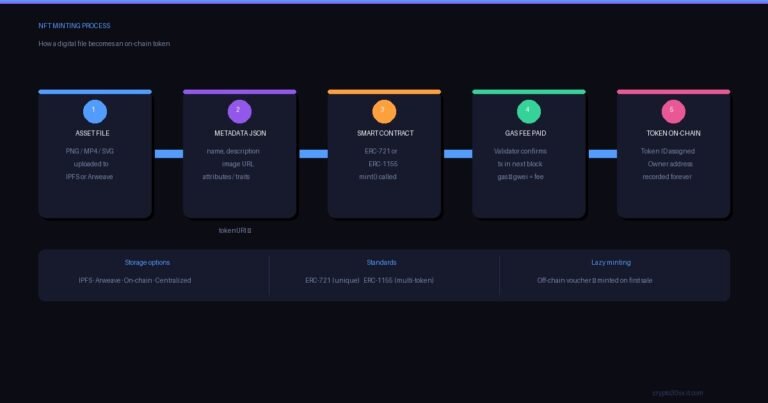
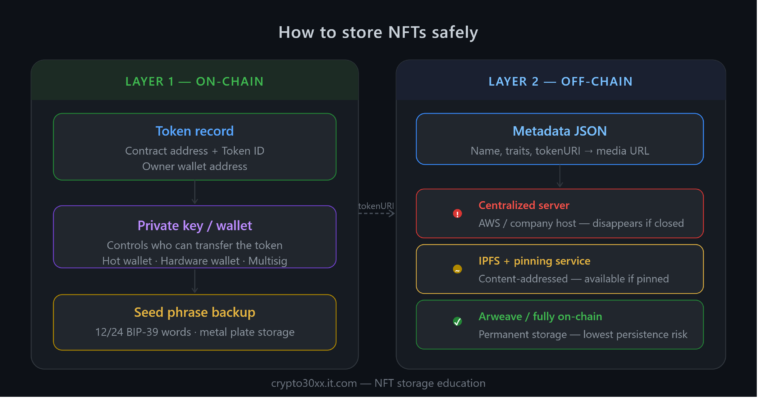
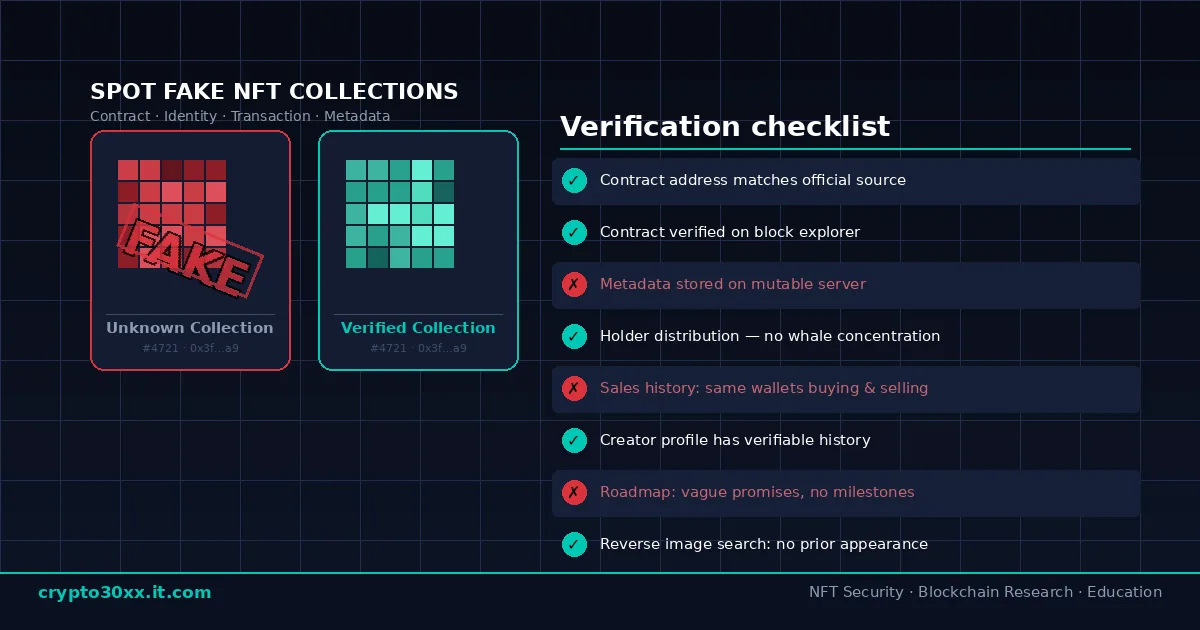
<cite index=”31-1″>Each token has two pieces of identifying information: a contract address, which identifies the collection, and a Token ID, which identifies the specific item. Together they act as the NFT’s fingerprint.</cite> The metadata file linked by the token should ideally be stored on IPFS or Arweave — decentralized storage systems where content cannot be quietly changed after the sale. <cite index=”33-1″>If the metadata is hosted on a mutable private server, the image and traits could change after you buy.</cite> On most marketplaces, the Details panel will tell you the metadata URL. A link beginning with ipfs:// is more reliable than one pointing to a private domain.
How to evaluate the creator’s identity and social proof
Smart contract verification tells you the token is real. It does not tell you the creator is trustworthy. These checks run parallel to the contract check.
Look for creator verification on the marketplace
Major NFT marketplaces display a blue or colored verification badge on creator profiles that have passed identity checks. The absence of a badge does not automatically mean a project is fraudulent, but its presence is meaningful. <cite index=”9-1″>If a profile was created recently but claims to represent a famous brand or artist, verify ownership by cross-referencing the artist’s official website or social media handles.</cite>
Check account age and post history
A legitimate artist building a collection will have some traceable history. Look at the creator’s marketplace profile creation date. Check their Twitter, Instagram, or personal website. Scam accounts are typically new, with sparse or inconsistent history and bio information.
Reverse image search the artwork
<cite index=”8-1″>If the NFT is part of a popular collection but doesn’t link back to it, it’s most likely fraudulent.</cite> A reverse image search on Google Images or TinEye can confirm whether the artwork has appeared elsewhere before. If the image matches an existing collection but the contract doesn’t, you are looking at a counterfeit.
How to read transaction history for manipulation signals
Even when the contract is genuine and the creator checks out, the sales history can reveal coordinated manipulation that inflates the appearance of demand.
What is wash trading?
<cite index=”21-1″>Wash trading is when sellers transfer NFTs back and forth between wallets they control, creating a false impression of high demand and volume.</cite> A project claiming high sales volume that turns out to be circular trading between the same wallets has manufactured rather than earned its apparent popularity.
To check for this on a blockchain explorer:
- Open the NFT’s transaction history
- Compare wallet addresses across multiple sale events
- Look for the same two or three addresses appearing repeatedly as buyer and seller
<cite index=”32-1″>Double-check the activity history to ensure transactions don’t feature the same wallet addresses repeatedly.</cite>
What do abnormal price patterns signal?
<cite index=”23-1″>Sudden, extreme price spikes followed by sharp crashes can indicate manipulation. This pattern often results from coordinated buying to attract investors, followed by mass selling from insiders.</cite>
A natural secondary market shows organic price variation: gradual appreciation, some dips, and a spread of buyer and seller addresses. An artificial chart shows a steep climb followed by a cliff. Neither pattern guarantees what happens next, but the cliff pattern deserves serious caution.
Check wallet concentration
<cite index=”24-1″>A Pareto chart of token holder distribution instantly shows whether a few wallets own most of the supply. When one address holds a disproportionate share of the tokens, a rug pull could be brewing.</cite> On a blockchain explorer, navigate to the token contract’s “Holders” tab. If two or three wallets hold the majority of a collection, any decision by those holders to sell will hit remaining buyers hard.
Red flags checklist: rug pull warning signs
This table summarizes the signals that separate legitimate projects from likely exits. No single signal is conclusive. Multiple flags in the same project should prompt a hard stop.
| Signal | Low-risk indicator | High-risk indicator |
|---|---|---|
| Team identity | Named, verifiable individuals | Fully anonymous, no prior history |
| Contract audit | Third-party audit published | Unverified or unaudited contract |
| Roadmap | Specific, dated milestones | Vague promises, no accountability |
| Social media age | Active accounts with history | New accounts, few posts before launch |
| Token/NFT concentration | Distributed across many wallets | 1-3 wallets hold majority of supply |
| Metadata storage | IPFS or Arweave | Mutable private server |
| Sales history | Diverse wallet participation | Circular wallet transfers |
| Community moderation | Open Q&A, transparent responses | Evasion, bans for questioning the team |
| Price chart shape | Organic variation | Spike-and-cliff pattern |
| Website quality | Technical depth, working links | Minimal info, broken sections |
Anonymous teams are not automatically fraudulent
Many legitimate projects launched with pseudonymous or anonymous founders. The key distinction is accountability structure. <cite index=”19-1″>Common warning signs include contracts that are unverified or unaudited, concentrated token supply in a few wallets, liquidity that can be removed at any time, admin keys that allow privileged changes after launch, and promises of guaranteed returns.</cite> An anonymous team with a verified contract, a published audit, and locked liquidity presents a lower risk profile than a named team with none of those structural safeguards.
How phishing and fake marketplace sites steal from collectors
Contract verification protects you from counterfeit NFTs. It does not protect your wallet from phishing attacks. These are distinct threats that require separate awareness.
Fake marketplace websites
<cite index=”4-1″>Fake NFT marketplaces mimic the design and layout of popular platforms. Once you connect your wallet and make a purchase, the scammers disappear with your funds, leaving you with a worthless token.</cite>
Before connecting a wallet to any site:
- Check the URL character by character against the official domain
- Look for HTTPS in the browser bar
- Bookmark the legitimate site and use the bookmark, not search results or links in DMs
Malicious wallet permissions
<cite index=”9-1″>Malicious smart contracts can sometimes be granted permission to sell your NFTs without limit. Revoking unused permissions periodically using tools like Revoke.cash keeps your exposure low.</cite> When connecting a wallet to any NFT platform, review what permissions you are granting. An “unlimited” access request from a site you don’t recognize is a hard stop condition.
Unsolicited airdrops
An NFT appearing in your wallet without you minting or buying it may carry a malicious contract. Interacting with it — listing it, trying to transfer it, or visiting the URL inside the metadata — can trigger a drain of other assets in the wallet. The safest response to an unsolicited NFT is to not interact with it at all.
Practical verification workflow: step by step
Use this sequence before any NFT purchase. It takes roughly five minutes and applies to any collection on any EVM-compatible chain.
- Find the official contract address from the project’s own website or verified social account
- Paste it into Etherscan (or the relevant chain’s explorer) and confirm the “Contract Verified” label
- Check the deployment date — compare it to when the project claims to have launched
- Open the Holders tab and look at wallet concentration
- Scan the transaction history for the same wallet addresses appearing as both buyer and seller
- Check the metadata URL in the token’s Details panel — prefer IPFS or Arweave over a private domain
- Run a reverse image search on the artwork to check for prior appearances
- Cross-reference the creator’s profile with their official website and social media
FAQs
What is the fastest way to spot a fake NFT collection? Check the contract address. Find it on the project’s official website or verified social profile, then paste it into a blockchain explorer and confirm it matches the listing. An image can be copied in seconds; a contract address cannot be faked if you’re checking the right source.
Can a verified contract guarantee an NFT is legitimate? No. Contract verification confirms the source code is public and matches what’s deployed on-chain. It does not confirm the creator is acting in good faith. A team can deploy a verified, clean contract and still run an exit scam. Contract verification is necessary but not sufficient on its own.
What is a rug pull in the context of NFTs? A rug pull is when the creators of an NFT project build public interest, collect funds from sales or minting, and then abandon the project without delivering promised utilities. The collectors are left holding tokens with no development, support, or community. The primary warning signs are anonymous teams, unaudited contracts, and vague or missing roadmaps.
How do I check if an NFT’s artwork has been stolen from another artist? Use a reverse image search through Google Images, TinEye, or a similar tool. Paste or upload the NFT’s image and look for identical results on other platforms. If the same artwork appears in a different, older collection, the item you’re examining is a counterfeit.
What is wash trading in NFT markets? Wash trading is when one entity controls multiple wallets and trades an NFT between them repeatedly to inflate the visible sales volume and price history. It creates the appearance of genuine demand. To detect it, examine whether the same wallet addresses appear as both buyer and seller across multiple transactions in the collection’s history.
Is it safe to connect my wallet to a new NFT marketplace? With caution. Verify the URL matches the legitimate domain exactly. Review the permissions being requested before approving any transaction. Avoid granting unlimited token approvals. Periodically check and revoke wallet permissions you no longer need using tools like Revoke.cash.
Why do some legitimate NFT projects have anonymous teams? Pseudonymity has a long history in crypto development, and anonymity alone does not indicate fraud. The risk assessment shifts to structural accountability: whether the contract is audited, whether liquidity is locked, and whether the team has a verifiable track record of prior projects, regardless of name.
What should I do if I receive an NFT I didn’t purchase? Do not interact with it. Do not click any links in the metadata, list it for sale, or try to burn it without understanding the contract. Unsolicited NFTs can contain malicious instructions that drain wallet assets when triggered. If you are uncertain, ask in a trusted community or leave the token untouched until you have more information.
Disclaimer
This article is written for educational and research purposes. Nothing in this guide constitutes financial, investment, or legal advice. NFT markets carry substantial risk of loss, including total loss of funds. All examples used here are illustrative. Readers should conduct their own due diligence and consult qualified professionals before making financial decisions.
The core principle behind every check in this guide is the same: the blockchain is public. Every transaction, every contract, every wallet — it is all readable without permission. Scams survive because most buyers don’t look. The verification process described above is not complicated. The contract address check alone eliminates the majority of counterfeit collections. The transaction history analysis catches manipulation that marketplace listings never show. Taken together, these checks shift the information balance toward the buyer, which is exactly where it belongs.
Push past your comfort zone with our boundary-breaking expert articles.