How XRP cross-border payments work: a complete guide
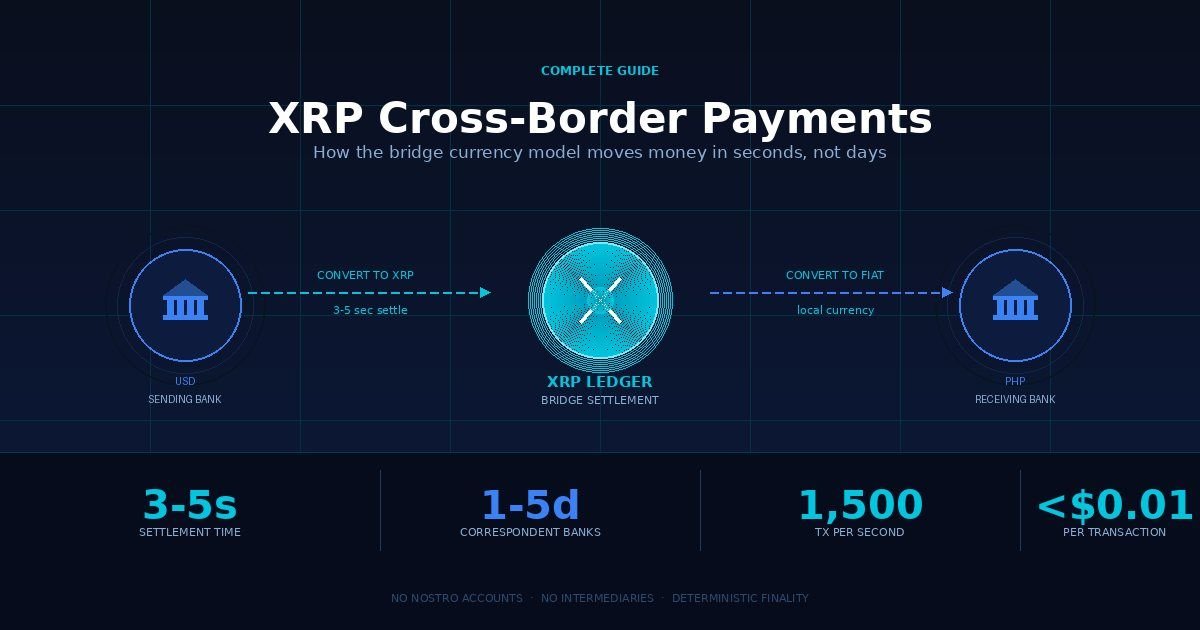
How XRP cross-border payments work: XRP cross-border payments work by using XRP as a digital bridge currency that converts between two fiat currencies in seconds, eliminating the need for pre-funded foreign bank accounts. A sending institution exchanges local currency into XRP, the XRP Ledger settles the transfer in three to five seconds, and a receiving institution converts the arrived XRP into the destination currency. The full sequence takes under ten seconds. This mechanism targets a specific structural problem in global finance: trillions of dollars parked in idle correspondent bank accounts just to keep international money moving. This guide covers how the XRP Ledger functions, how the bridge currency model works in practice, what Ripple’s On-Demand Liquidity product does, and where the model’s genuine structural limits lie.
What problem does XRP solve in cross-border payments?
The traditional international payment system routes money through chains of correspondent banks, each holding pre-funded accounts in foreign currencies. A payment from Brazil to Vietnam may pass through three or four intermediary institutions before arriving, with each hop adding fees, cut-off times, and compliance checks. The deeper issue is capital inefficiency: financial institutions collectively maintain enormous balances in foreign-currency accounts kept funded purely so that transfers can clear.
What nostro and vostro accounts actually are
A nostro account is an account held by a domestic bank at a foreign bank, denominated in the foreign bank’s local currency. The term comes from the Latin for “our account held at yours.” The foreign bank’s mirror view of the same account is its vostro, meaning “your account held at ours.”
Both must remain adequately funded for payments to flow between the two institutions. A US bank offering dollar-to-yen transfers must maintain a standing yen balance at a Japanese correspondent. Maintaining dozens of such relationships across dozens of currencies ties up capital that earns nothing while it sits.
Why the correspondent chain adds days, not just hours
Each bank in the payment chain independently queues, verifies, and forwards the transaction. Cut-off times vary by institution and time zone. Anti-money-laundering reviews happen at every hop, not just at origin. The result is that cross-border payments often take one to five business days to settle, not because international infrastructure lacks the technical capacity to move faster, but because the operational model has not historically required it to.
XRP was designed as a neutral bridge asset that any two parties can use to settle value in seconds without pre-funded foreign accounts. Instead of holding idle yen in Tokyo to facilitate future payments, an institution using XRP-based infrastructure purchases XRP when payment initiates, settles across the XRP Ledger, and the recipient converts XRP into local currency, all within one transaction.
How the XRP Ledger processes transactions
The XRP Ledger (XRPL) is an open-source, decentralized blockchain that settles transactions using the XRP Ledger Consensus Protocol. This is distinct from proof-of-work and from proof-of-stake. No miners compete for block rewards on the XRPL. No stakers bond assets to earn validation rights.
Instead, a set of independent validators each maintains a Unique Node List (UNL): a curated set of other validators it considers trustworthy. During each consensus round, validators propose candidate transaction sets, exchange those proposals, and converge until a supermajority of 80% agrees on a common ledger state. That state then commits as final.
Settlement finality: deterministic, not probabilistic
The consensus process takes three to five seconds. Once a transaction is committed, it is final in a strict sense. There is no waiting for additional confirmations to increase certainty, as with Bitcoin, where six confirmations over roughly 60 minutes establish practical irreversibility. On the XRPL, the transaction is either committed or it is not. There is no middle state.
This distinction matters for payment applications. A financial institution processing thousands of transfers per day needs to know definitively whether a transaction cleared, not with growing probability, but with certainty.
Transaction costs and the burn mechanism
Every XRPL transaction requires a small fee paid in XRP, typically a fraction of a cent at standard conditions. That fee is permanently destroyed (burned) rather than paid to validators. Validators receive no direct compensation for their work; they operate as a public service or as an institutional function. Over time, the burn mechanism reduces the total XRP supply incrementally with each transaction.
XRPL performance vs. other settlement networks
| Feature | XRPL | Bitcoin | Ethereum |
|---|---|---|---|
| Finality time | 3-5 seconds | ~60 minutes (6 confirmations) | ~15 minutes (32 checkpoints) |
| Finality type | Deterministic | Probabilistic | Probabilistic |
| Typical transaction cost | Less than $0.01 | Variable, often $1-$50+ | Variable, often $1-$30+ |
| Energy model | Negligible (no mining) | Proof-of-work | Proof-of-stake |
| Throughput capacity | ~1,500 transactions per second | ~7 TPS | ~15 TPS (base layer) |
For payment settlement applications where speed, cost predictability, and finality certainty matter equally, the XRPL’s profile fits the use case more directly than most general-purpose blockchains.
How the XRP bridge currency model works
The bridge currency model is the core mechanism behind XRP cross-border payments. It connects two fiat currencies using XRP as the transit asset, removing the requirement for pre-funded nostro accounts at each end of the corridor. Both conversion legs happen in the open market, on demand, for each transaction.
The sequence runs in three stages:
- Conversion in: The sending institution, or its liquidity provider, exchanges source fiat currency into XRP on a local exchange at the prevailing market rate.
- Transfer: XRP moves across the XRP Ledger from the sending wallet to the receiving wallet. This step settles in three to five seconds and costs a fraction of a cent.
- Conversion out: The receiving institution converts the arrived XRP into the destination currency on a local exchange at that market’s current rate.
The sender transmits local currency. The recipient receives foreign currency. XRP is held for seconds and then fully liquidated at the destination end.
What On-Demand Liquidity does for institutions
On-Demand Liquidity (ODL) is Ripple’s commercial product that automates all three stages for financial institutions. Rather than managing XRP inventory themselves, ODL clients instruct the system to source XRP from the open market at transaction time, execute the sending-side conversion, settle across the XRPL, and complete the receiving-side conversion, all without the institution actively trading or holding XRP.
From an operations perspective, an ODL user sends local currency and a recipient gets destination currency. The XRP bridge runs entirely in the background.
ODL vs. traditional correspondent banking: a structural comparison
| Dimension | SWIFT + correspondent banking | XRP / ODL |
|---|---|---|
| Funding model | Pre-funded nostro accounts | On-demand open-market sourcing |
| Intermediary hops | 2-4 correspondent banks | None (direct XRPL settlement) |
| Settlement time | 1-5 business days | 3-5 seconds |
| Fee structure | Per-hop charges plus FX spread at each bank | Single FX conversion plus minimal XRPL fee |
| Capital requirement | High, permanently tied up | Low, no pre-funding needed |
| Transaction traceability | Opaque between intermediaries | Full on-ledger audit trail |
How RippleNet connects to XRP payments
RippleNet is Ripple’s business payment network, the institutional layer that connects banks, remittance companies, and payment processors through standardized messaging and settlement infrastructure. It is a separate system from the XRP Ledger, and that distinction has practical consequences: some RippleNet payments use XRP for settlement while others use traditional fiat channels entirely, with no XRP involved.
RippleNet members choose how to settle each payment. Those using ODL settle on the XRPL using XRP as the bridge asset, gaining the speed and cost advantages described above. Those preferring traditional rails use RippleNet’s messaging infrastructure for faster routing and improved tracking while settling through conventional correspondent channels, without XRP entering the transaction at all.
When XRP is and is not involved
XRP is optional within RippleNet. ODL specifically requires it. Institutions choose based on corridor availability, regulatory context, and their own operational preferences. A bank in a jurisdiction where XRP’s regulatory status is unsettled may use RippleNet’s fiat rails while waiting for clearer rules, then switch to ODL once the legal framework stabilizes.
What determines whether a corridor can use ODL
ODL performs efficiently where liquid XRP markets exist on exchanges in both the source and destination country. The conversion legs require sufficient market depth (enough buyers and sellers) to process meaningful payment volumes without large price impact. Established corridors serving major currency pairs have developed this depth over time. Smaller, newer corridors with thinner exchange markets can produce slippage during conversions, reducing the cost advantage.
A step-by-step walkthrough of an XRP cross-border payment
Consider a US-based remittance company sending $500 to a recipient in the Philippines. Tracing both the traditional path and the XRP path for the same payment illustrates the structural differences in concrete terms, from settlement time and intermediary hops to how liquidity is sourced and where fees accumulate. Round numbers are used throughout.
Traditional correspondent banking path: The company sends USD to a US correspondent bank, that bank queues and forwards to an international correspondent, which routes to a Philippine correspondent, which credits a local bank, which credits the recipient. Time: one to four business days. Cost: fees at each institutional hop, plus an FX spread applied at each conversion.
ODL path using XRP:
- The remittance company initiates a $500 USD payment through ODL.
- ODL sources XRP at the prevailing USD/XRP market rate. For illustration: 1,000 XRP.
- Those 1,000 XRP transmit across the XRPL to a wallet connected to a Philippine exchange.
- The Philippine exchange converts 1,000 XRP into PHP at the current PHP/XRP rate.
- PHP credits the recipient’s account or mobile wallet. Total elapsed time: under 10 seconds.
The remittance company never holds XRP directly. ODL handles both conversion legs automatically through open-market execution.
The foreign exchange risk window
XRP has a market-determined price that fluctuates. During the three-to-five-second transit window, a price shift could change how much PHP the recipient receives. ODL minimizes this by executing both conversion legs as close to simultaneously as the architecture permits, and individual transaction volumes are typically small relative to total exchange depth. In practice, the exposure window is narrow. Under extreme market volatility, slippage risk increases meaningfully — this is a real structural consideration, not a theoretical one.
Risks and limitations of the XRP payment model
Evaluating XRP-based cross-border settlement accurately means understanding where the model has genuine structural constraints, not only where it performs well. No payment infrastructure operates without tradeoffs. The five areas below cover the most significant limits inherent in the bridge currency approach, from exchange liquidity dependency to the uneven state of institutional adoption.
Dependence on exchange liquidity
ODL requires active, deep XRP markets in both the source and destination currency. Thin markets produce slippage: the actual rate achieved deviates from the quoted rate, which can make a transfer more expensive than anticipated and erode the cost advantage over correspondent banking. Liquidity is not uniform across all currency pairs or geographies.
Regulatory classification varies by jurisdiction
The legal status of XRP differs across countries. In the United States, Ripple Labs faced a multi-year proceeding with the Securities and Exchange Commission over whether XRP constitutes a security. That case produced rulings distinguishing between categories of XRP sales, but the regulatory treatment of XRP continues to develop across multiple jurisdictions. Institutions considering ODL must navigate these differences on a country-by-country basis.
Exchange counterparty risk
The bridge model depends on exchanges functioning reliably at both ends of a corridor. An exchange outage, insolvency, or regulatory closure in either country could disrupt the payment route even if the XRPL itself operates normally. This type of counterparty dependency does not exist in the same form under traditional correspondent banking, where central bank infrastructure provides a settlement backstop.
ODL is wholesale infrastructure, not a retail product
Financial institutions, payment processors, and remittance companies use ODL. Individual consumers do not access it directly. End users encounter XRP-based payments through apps and services that have integrated Ripple’s infrastructure on the backend. The XRP bridge is typically invisible to the retail customer.
Adoption remains concentrated in select corridors
ODL adoption is strongest where exchange infrastructure is mature and regulatory treatment is clearer. Many large financial institutions remain in traditional correspondent banking networks, held there by existing long-term contracts, integration costs, compliance requirements, or operational inertia. Switching settlement infrastructure is not a trivial project for a major bank.
XRP cross-border payments vs. SWIFT: key distinctions
SWIFT is not itself a settlement system; it is a messaging network that transmits payment instructions between financial institutions. The actual movement of money still depends on correspondent banking relationships and pre-funded accounts, and can take days. Comparing XRP directly to SWIFT conflates the messaging layer with the settlement layer, so the distinction matters.
| Dimension | SWIFT + correspondent banking | XRP Ledger + ODL |
|---|---|---|
| Core function | Messaging (payment instructions only) | Settlement (direct asset transfer) |
| Settlement asset | Fiat via pre-funded accounts | XRP, converted to fiat at both endpoints |
| Settlement time | 1-5 business days | 3-5 seconds |
| Mid-chain visibility | Limited, opaque between intermediaries | Full on-ledger audit trail |
| Cost model | Multi-hop fees plus FX spread at each institution | Single FX conversion plus minimal XRPL fee |
| Capital requirement | High pre-funding | No pre-funding |
| Network reach | 11,000+ member institutions globally | Growing, concentrated in established corridors |
| Institutional track record | Decades of global operation | Emerging adoption |
SWIFT has responded with its own gpi (global payments innovation) service, improving real-time tracking and reducing settlement times for participating institutions. The comparison is not purely technical; it involves institutional trust, existing relationships, regulatory comfort, and the operational cost of migration.
FAQs
Does XRP hold the payment value while it is in transit? Yes, for the three-to-five-second duration of the XRPL settlement. Both conversion legs (fiat to XRP at origin, and XRP to fiat at destination) are executed as close to simultaneously as the architecture allows. The sender transmits local currency; the recipient receives destination currency. XRP is the transit mechanism, not a holding asset.
Can individuals send XRP cross-border payments without a bank? Technically, yes. Anyone can transfer XRP wallet-to-wallet on the XRP Ledger without an intermediary, and the transfer settles in seconds. The practical challenge is handling the fiat-to-XRP conversion at origin and the XRP-to-fiat conversion at destination, both of which require exchange access in each country. ODL automates this for institutions; individual users must manage conversions themselves.
Is XRP the same thing as Ripple? No. XRP is a digital asset that exists on the XRP Ledger, an open-source blockchain not controlled by any single entity. Ripple Labs is a private company that built commercial products (including ODL and RippleNet) using the XRPL. Ripple does not own the ledger, and XRP’s legal and operational status is independent of Ripple’s corporate structure.
How does XRP compare to stablecoins for cross-border settlement? Stablecoins maintain a fixed value relative to a reference asset (typically USD), eliminating FX risk during transit. XRP has a market-determined price, creating a brief exposure window at the conversion legs. XRP generally offers higher exchange liquidity and faster finality than most stablecoins, which matters for high-volume institutional corridors where execution speed and depth are practical constraints. The tradeoff is price stability versus liquidity depth.
What happens if XRP’s price drops sharply mid-transaction? The three-to-five-second settlement window limits the exposure. ODL executes both conversion legs as simultaneously as possible, and individual transaction volumes are small relative to total exchange depth in established corridors. During extreme volatility, slippage risk increases. Institutions and ODL providers account for this in operational parameters, including acceptable slippage thresholds.
Do all RippleNet payments use XRP? No. RippleNet supports XRP-based settlement via ODL and traditional fiat settlement through correspondent banking channels. Institutions choose based on corridor availability, regulatory environment, and preference. XRP only enters the process when ODL is specifically activated for a given payment route.
Why haven’t more banks switched to XRP-based settlement? Regulatory uncertainty in multiple jurisdictions, long-term contracts with correspondent institutions, compliance requirements, integration costs, and the need for mature local exchange markets all create friction. For many institutions, the operational cost of switching exceeds the efficiency gain available in their specific corridors, until exchange liquidity deepens and regulatory frameworks clarify further.
Disclaimer
This article is published for educational and research purposes only. It does not constitute financial advice, investment guidance, or a recommendation to buy, sell, or hold XRP or any other digital asset. Cryptocurrency markets involve substantial risk, including the potential for complete loss of capital. Readers should conduct independent research and consult qualified financial and legal professionals before making any financial decisions.
XRP cross-border payments address one specific structural inefficiency: the capital cost and settlement delay of correspondent banking. The bridge currency model works by replacing permanently pre-funded foreign accounts with real-time XRPL settlement, converting through the open XRP market on demand. Whether that model reaches the scale its technical properties allow depends on exchange liquidity in target corridors, regulatory clarity across jurisdictions, and how quickly institutions choose to migrate from infrastructure that, inefficient as it is, has functioned reliably for decades. Understanding the mechanics precisely is the starting point for evaluating all of those questions with any rigor.
Become unstoppable with insights from our power-packed featured content.