Layer 1 vs layer 2 blockchain explained: full guide
Layer 1 vs layer 2 blockchain explained: Blockchain networks operate across two distinct structural tiers. A layer 1 blockchain is the base network responsible for consensus, security, and final settlement. A layer 2 blockchain is a secondary network built on top of a layer 1 that processes transactions off-chain for speed and then posts results back to the base layer. Understanding layer 1 vs layer 2 blockchain architecture is essential for anyone studying how major networks function, why they have throughput limits, and why scaling projects are built on top of existing chains rather than independently. This guide examines both tiers in structural terms, contrasts them across the dimensions that matter most, and identifies the trade-offs each design introduces. It is written for learners and researchers studying blockchain infrastructure, not as investment advice or a product endorsement.
What is a layer 1 blockchain?
A layer 1 blockchain is a base-level network that handles transaction validation, consensus, data storage, and finality without relying on any external chain. Every block confirmed on it is final under the network’s own rules, with no outside system needed to guarantee validity. Bitcoin, Ethereum, Solana, and Avalanche are widely studied examples, each with different consensus mechanisms and throughput characteristics.
Core functions of a layer 1 network
Every layer 1 performs three structural functions:
- Consensus: Independent nodes agree on which transactions are valid and in what sequence they occurred. Bitcoin uses proof of work; Ethereum uses proof of stake following its consensus transition.
- Data storage: The full transaction history is replicated across distributed nodes, making retroactive alteration extremely difficult without controlling a majority of network participants.
- Settlement finality: Once a transaction clears its required number of confirmations, the network treats it as irreversible under the protocol’s own rules, with no external authority needed to confirm it.
These three functions create a trust-minimized record-keeping environment. They also create a hard ceiling on throughput: every participating node must process and store each transaction, which limits how many the network can handle per unit of time.
Layer 1 throughput constraints
Bitcoin processes roughly 7 transactions per second under its current block parameters. Ethereum’s base layer handles between 12 and 30 transactions per second after its proof-of-stake transition. Large payment networks, by contrast, routinely process thousands of transactions per second at peak demand.
This throughput gap is not a flaw of outdated technology. It reflects a deliberate design trade-off: block size, block time, and validator requirements are all constrained in ways that keep node operation accessible to a broad range of participants.
From a network design perspective, the ceiling is the result of optimizing for different goals than a payment processor would. Decentralization requires that many independent actors can verify the chain; security requires that rewriting history is prohibitively expensive. Throughput is the variable that gets compressed when the other two are prioritized. The layer architecture exists because blockchain engineers chose to address the throughput problem at a different level rather than at the expense of the base layer’s foundational properties.
What is a layer 2 blockchain?
A layer 2 blockchain is a secondary network that processes transactions off its base chain, then settles the final state back to a layer 1 for security. It does not run its own independent consensus in the same way a layer 1 does; instead, it borrows the security guarantees of the underlying chain while handling far more transactions per second than the base layer can manage on its own.
How layer 2 inherits layer 1 security
The core design principle is that not every transaction needs to be individually recorded on the base chain. A batch of hundreds or thousands of transactions can be processed off-chain, compressed into a single proof or summary, and submitted to the layer 1 as one entry. The base chain does not re-execute each transaction; it only verifies the submitted result.
If anything in that batch is fraudulent or computationally incorrect, the layer 1 serves as the final adjudicator. This relationship distinguishes genuine layer 2 solutions from independent blockchains that simply bridge assets between networks. A true layer 2’s security model depends entirely on the integrity of the layer 1 beneath it.
Types of layer 2 solutions
Three architectural approaches are widely studied and deployed:
- Rollups: Transactions execute off-chain, then are compressed and posted to the layer 1. Two main variants exist: optimistic rollups (which assume validity and allow a fraud-proof challenge window) and zero-knowledge rollups (which submit a cryptographic proof of correctness with every batch).
- State channels: Parties open a direct off-chain channel, transact freely between themselves, and only broadcast the final net balance to the layer 1 when closing the channel. Bitcoin’s Lightning Network operates on this model.
- Sidechains: Separate chains with their own consensus run alongside a layer 1 and connect via a two-way bridge. Because sidechains typically maintain their own security rather than fully inheriting it from the base chain, they occupy a distinct category between genuine L2s and fully independent networks.
Layer 1 vs layer 2 blockchain: key differences
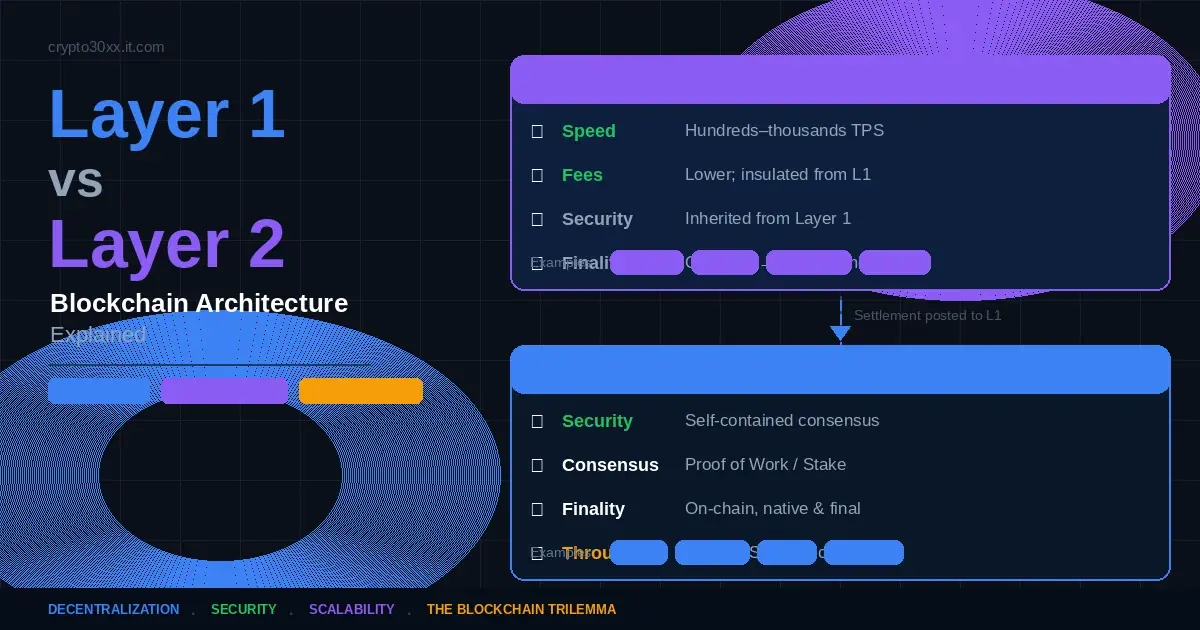
The most meaningful differences between layer 1 vs layer 2 blockchain networks emerge across four dimensions: where security originates, how many transactions the network can process, what fees look like under congestion, and where transaction finality actually occurs. The table below maps those dimensions directly.
| Dimension | Layer 1 | Layer 2 |
|---|---|---|
| Security source | Self-contained (own consensus) | Derived from the underlying L1 |
| Throughput | Low to moderate (typically 7–30 TPS for major chains) | High to very high (hundreds to thousands TPS) |
| Transaction fees | Rises sharply under network congestion | Generally lower; partially insulated from L1 congestion |
| Finality location | On-chain, native to the network | Off-chain processing, with periodic L1 batch settlement |
| Decentralization | Typically high (broad validator participation) | Varies; some implementations rely on centralized sequencers |
| Smart contract support | Depends on the L1 protocol | Inherits or extends L1 capability |
| Common examples | Bitcoin, Ethereum, Solana, Avalanche | Lightning Network, Optimism, Arbitrum, zkSync Era |
The central trade-off: layer 2 solutions give up some decentralization or design simplicity in exchange for dramatically higher throughput, while keeping the ultimate security anchor at the layer 1.
The blockchain trilemma and why it drives the L1/L2 split
The blockchain trilemma is the principle that no public blockchain can simultaneously maximize decentralization, security, and scalability. Engineering gains in any two of these three properties tend to reduce the third. This constraint, widely associated with Ethereum’s foundational research community, explains the architectural divide between base-layer networks and their supplementary scaling tiers.
Why L1 networks prioritize security and decentralization
A layer 1 designed for maximum decentralization must allow low-cost hardware to participate in validation. That means smaller blocks, less frequent finality, and lower throughput. Bitcoin’s block parameters explicitly prioritize keeping node operation accessible to participants with ordinary hardware, treating throughput as a secondary concern.
Raising on-chain capacity would require one of three concessions: larger blocks (higher storage demands per node), faster block times (higher network bandwidth demands), or fewer validators (reduced decentralization). Any of these moves the network along the trilemma. The designers of major L1 networks generally concluded that preserving decentralization and security was worth accepting a throughput ceiling.
How layer 2 resolves the constraint without altering the L1
Rather than changing L1 protocol rules, layer 2 moves computation off-chain while keeping settlement on-chain. The base chain processes only the compressed result of thousands of off-chain transactions. The L1 can continue prioritizing security and decentralization, while the L2 absorbs the throughput demand that end users generate.
ZK-rollups illustrate this elegantly: a single cryptographic proof submitted to the L1 can confirm the correctness of thousands of off-chain computations. The base chain verifies one proof rather than thousands of individual transactions, yet the final state recorded on-chain carries the same authority as any natively executed transaction.
How the major layer 2 architectures work
The three principal layer 2 architectures (rollups, state channels, and sidechains) each process off-chain transactions differently and carry distinct security assumptions. Understanding how each interacts with the layer 1, and whether it fully inherits that layer’s security model, is central to any rigorous evaluation of an L2 protocol.
Optimistic rollups
Optimistic rollups process transactions off-chain and post a batch summary to the layer 1 without an immediate proof of correctness. They operate on an assumption of validity: the submitted state is treated as correct unless someone submits a fraud proof within the challenge window, typically around seven days.
If a valid challenge is submitted during that window, the fraudulent batch is rejected and the sequencer responsible faces a financial penalty. Optimism and Arbitrum are among the most studied implementations of this design. The practical trade-off: withdrawing assets from an optimistic rollup to the L1 requires waiting out the full challenge period, which imposes a liquidity cost on users who need rapid access to their funds on the base layer.
Zero-knowledge rollups
Zero-knowledge rollups attach a cryptographic validity proof to every batch submitted to the layer 1. This proof mathematically demonstrates that the off-chain computation was executed correctly. The base chain does not re-execute the transactions; it only verifies the proof, which takes a fraction of the computational effort.
This design offers faster final settlement on the L1 and requires no challenge window. The engineering challenge is proof generation, which demands significant computational resources and is complex to implement for arbitrary smart contract logic. zkSync Era and StarkNet are among the most analyzed ZK-rollup implementations, each using different underlying proof systems with distinct performance and security characteristics.
State channels
State channels work through a different mechanism altogether. Two or more parties lock collateral on the L1, open a direct off-chain channel, and transact at any speed between themselves without touching the base chain. When the channel closes, the final net balance is broadcast to the L1 for settlement.
This model is well-suited to repeated bilateral transactions between fixed participants. A key operational constraint is the liveness requirement: participants or their monitoring services must be available to respond if one party attempts to submit an outdated channel state. Bitcoin’s Lightning Network applies this architecture specifically for payments, with watchtower services used to monitor channels on behalf of offline participants.
The Lightning Network extends the bilateral model into a network by allowing payments to route through intermediate nodes. If Alice has an open channel with Bob, and Bob has an open channel with Carol, Alice can pay Carol by routing through Bob without opening a direct channel with her. This routing capability allows a relatively small number of well-connected nodes to facilitate payments across large participant networks, though it introduces routing complexity and intermediate node availability as additional considerations.
Risks and limitations to understand
Neither layer 1 nor layer 2 blockchain networks operate without meaningful structural risk. Layer 1 risks center on throughput limits and consensus vulnerabilities; layer 2 risks are more varied, spanning sequencer centralization, bridge exploits, settlement delays, and the complexity of cryptographic proving systems.
Layer 1 risk factors
- Throughput ceiling and fee pressure: High demand forces transactions to compete for limited block space. In periods of significant network congestion, base-layer fees can rise to levels that make small-value transactions economically unviable.
- Consensus attack exposure: A 51% attack, where a single entity controls a majority of mining power or staked value, could theoretically enable double-spending. On large networks this is extremely expensive in practice, but it remains a structural consideration rather than a solved problem.
- Governance rigidity: Modifying L1 protocol rules requires broad consensus across node operators, developers, and validators. This makes upgrades slow — a feature for stability, but a limitation for adaptability when technical demands shift.
Layer 2 risk factors
- Sequencer centralization: Many rollup implementations rely on a single entity to order off-chain transactions. An offline or dishonest sequencer can cause transaction delays or censorship until decentralized sequencer mechanisms are in place.
- Bridge exploit risk: Moving assets between an L1 and an L2 involves bridge smart contracts. Bridge code has been a historically significant attack vector, with exploits accounting for substantial fund losses across the blockchain space.
- Fraud window delays: Optimistic rollup users who want to withdraw to the L1 must wait through the full challenge period. This is a built-in security feature, not a malfunction, but it carries real liquidity costs.
- Proof system vulnerability: ZK-rollup proving circuits are mathematically sophisticated. A bug in the circuit could, in principle, allow an invalid state transition to pass L1 verification, representing a critical failure mode specific to this architecture.
- Liquidity fragmentation: Assets distributed across multiple L2 networks may not be directly interoperable. Moving value between L2s often requires routing through the L1 or using cross-chain bridges, each step adding complexity and potential risk exposure.
FAQs
Is a layer 2 the same as an altcoin? Not by definition. Some layer 2 networks have native tokens, but having a token does not make something an L2. The defining characteristic is that the network settles transactions back to a layer 1 for security. Many L2s have no native token at all, and many altcoins are fully independent layer 1 networks with their own consensus mechanisms.
Can a layer 2 exist without an underlying layer 1? No. A layer 2’s security model depends entirely on the existence and integrity of its underlying layer 1. If the base layer is compromised or ceases to function, the layer 2 loses its settlement anchor. The two tiers are structurally interdependent by design.
Do Ethereum layer 2s use ETH for transaction fees? Most Ethereum-based layer 2s denominate fees in ETH or a wrapped equivalent, since ETH covers L1 settlement costs when batches are posted. Specific fee structures vary by implementation. Some networks incorporate their own governance token for certain operations while retaining ETH as the primary cost asset for base-layer settlement.
What happens to funds on an L2 if the L2 operator shuts down? Well-designed rollup systems include escape-hatch mechanisms that allow users to withdraw funds directly to the L1 without the operator’s involvement. The reliability and accessibility of these exit mechanisms vary significantly across implementations and are a key factor in any technical assessment of an L2’s safety properties.
Is layer 2 always faster than layer 1? In terms of transaction throughput and user-facing latency, L2 networks process transactions far faster than the base L1. Final settlement of batched results on the L1 still follows the L1’s own block confirmation times, but this does not affect the speed at which users experience transactions on the L2 itself.
Which tier achieves higher decentralization? Layer 1 networks typically sustain higher decentralization because their consensus requires participation from a broad set of independent validators or miners. Many L2 implementations in earlier deployment phases rely on centralized sequencers, making them more operationally centralized in practice. Most rollup roadmaps include progressive steps toward decentralizing the sequencer set over time.
Can a chain function as both an L1 and an L2? A given chain operates at one level relative to another: either as a base layer or as a settlement-dependent secondary layer. However, a network that acts as an L2 relative to Ethereum can simultaneously serve as the base layer for its own secondary networks, creating nested scaling architectures sometimes described as layer 3, or L3, systems.
Disclaimer
This article is an independent educational resource written for learners and researchers studying blockchain infrastructure. Nothing in this guide constitutes financial advice, investment advice, or a recommendation to buy, sell, or hold any digital asset. Blockchain networks carry technical, financial, and operational risks. Conduct your own research before making any decisions involving digital assets.
The structural split between layer 1 and layer 2 blockchain networks is an engineering response to a genuine constraint in distributed systems design. Layer 1 networks anchor security and decentralization at the cost of throughput. Layer 2 networks extend throughput by processing off-chain while settling final state back to the base layer. Neither tier removes risk; each redistributes it across different protocol components, participants, and failure modes. Grasping where those risks sit, and how the two tiers were designed to complement each other, is the starting point for any serious analysis of blockchain scaling infrastructure.
Your success story begins with the right content—find it in our story-shaping posts.