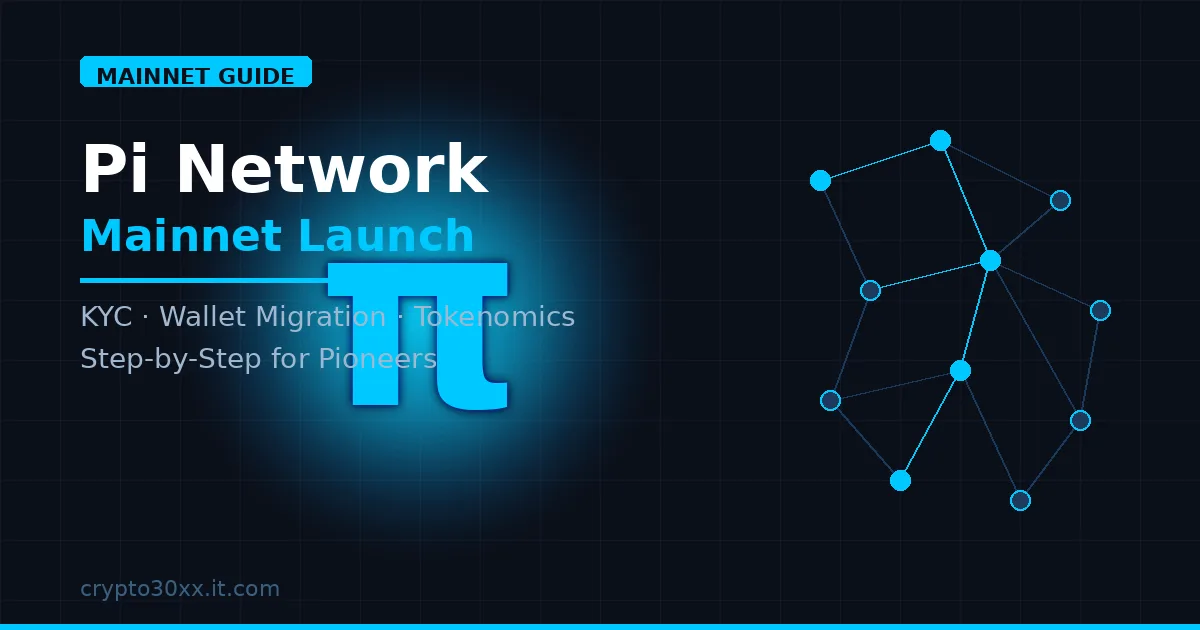
Pi Network Mainnet Launch Guide: Complete Step-by-Step
Pi Network Mainnet Launch Guide: Pi Network spent six years as a mobile mining app before its blockchain went live. The Open Mainnet launched on February 20, 2025, making PI externally transferable and exchange-tradable for the first time. A second major milestone — the community-phase mainnet — followed on March 14, 2026. Despite these milestones, millions of Pioneers are still working through KYC verification and wallet migration. This guide is written for learners and researchers who want a clear, factual picture of what the Pi Network mainnet is, how the migration process works, what the tokenomics look like, and what structural risks exist.
What the Pi Network mainnet actually is
The Pi Network mainnet is the live, public blockchain layer where PI tokens exist as real on-chain assets. Before mainnet, PI balances were internal app records with no blockchain backing and no external transferability.
Pi Network progressed through three distinct phases to reach this point. The mobile mining phase ran from March 2019 and allowed users called Pioneers to accumulate PI by opening the app daily. The Enclosed Mainnet launched in December 2021 — a live blockchain, but with a firewall preventing external access. The Open Mainnet phase began February 20, 2025, removing that firewall and allowing external wallet transfers and exchange listings.
A broader community-phase mainnet milestone followed on March 14, 2026, expanding ecosystem access and triggering a second migration wave. The focus in 2026 is no longer on whether the mainnet will launch. It is on how the live network performs, how liquidity develops, and whether ecosystem utility grows fast enough to support a 100-billion-token supply structure.
The Stellar Consensus Protocol underneath Pi
Pi Network does not use proof-of-work or proof-of-stake. It runs a modified version of the Stellar Consensus Protocol (SCP), where trust is established through user-created Security Circles — small groups of 3–5 trusted contacts each Pioneer adds to their account. These circles form a federated trust graph that validates transactions without requiring expensive mining hardware.
Node operators handle the technical layer, processing blockchain consensus and transaction data. The Pi Core Team has been running mandatory protocol upgrades throughout 2026. Protocol v23 replaced v19 as a required update for all node operators, bringing improvements to network throughput, security parameters, and smart contract capabilities. This upgrade was framed as a stress test for decentralization: if a large proportion of nodes failed to update, it would reveal vulnerabilities in the consensus mechanism.
Pi Network mainnet timeline: phase by phase
Understanding the mainnet requires understanding the full launch arc, not just a single date.
| Phase | Date | What changed |
|---|---|---|
| Beta app launch | March 2019 | Mobile mining begins; no blockchain |
| 1M users milestone | March 2020 | Mining rate first halved |
| 10M users milestone | 2021 | Mining rate halved again |
| Enclosed Mainnet | December 2021 | Live blockchain; firewall blocks external access |
| Open Mainnet | February 20, 2025 | External transfers and exchange listings enabled |
| Protocol v23 upgrade | Q1–Q2 2026 | Node operators required to update |
| Community-phase mainnet | March 14, 2026 | Second migration wave; broader ecosystem access |
| Developer SDK launch | January 2026 | Third-party apps can accept PI payments |
The mining rate follows a declining emission model loosely modeled on Bitcoin’s halving schedule. The base rate has dropped at user-count milestones — first at 1 million users, again at 10 million, and continuing as the network scaled. A Pioneer joining today earns a fraction of what early participants earned.
How KYC verification works and why it controls migration
KYC verification is the mandatory gateway to mainnet migration. Without it, a Pioneer’s app balance stays locked — it cannot move to the on-chain wallet and cannot be transferred or traded.
Pi Network introduced KYC to confirm that each account belongs to a unique real person. The network’s Security Circle model relies on human participants. Without identity verification, bots and duplicate accounts could accumulate large PI balances and undermine the distribution model. KYC serves as the mechanism for filtering out fake accounts before PI reaches the public blockchain.
The verification system uses AI-assisted fraud detection combined with human reviewer panels. Users submit government-issued identification and complete facial recognition steps. As of April 2026, the Pi Core Team reported crossing 18 million identity-verified users. Around Pi Day 2026 (March 14), approximately 16.5 million KYC-approved users had also completed migration.
KYC scam warnings
KYC delays are common, especially during high-volume processing periods. Malicious actors exploit this uncertainty. Community channels and the Pi Core Team have issued repeated warnings: there are no legitimate third-party services that can accelerate KYC approval or resolve pending status. Any external platform claiming to offer KYC assistance is either a phishing attempt or a data-theft operation. Pioneers should only use the official Pi app and official channels for all verification steps.
Step-by-step: how to migrate PI to mainnet
Migrating PI from app balance to mainnet is a multi-step process. Each step must be completed in sequence, and none can be skipped.
- Update the Pi app — Install the latest version of the Pi Network app. Migration features and checklist prompts are only accessible on updated builds.
- Complete KYC verification — Navigate to the KYC section inside the app, submit required identification documents, complete facial verification if prompted, and wait for approval. Processing times vary based on application volume.
- Set up the Pi Wallet — Open the Pi Browser app and create a non-custodial wallet. The app generates a mnemonic recovery phrase (a set of words). Store this phrase offline in a secure location. It is the only way to recover wallet access. Losing it means permanent loss of access to the wallet.
- Enable wallet 2FA — Following the second migration wave (launched after Pi Day 2026), Mainnet Checklist Step 3 now requires wallet two-factor authentication. Users must link a trusted email address and verify it before migration can proceed.
- Open the Mainnet Checklist — Inside the Pi app, navigate to the Mainnet menu and select Mainnet Checklist. If KYC is complete and migration criteria are met, the “Transfer to Mainnet” option becomes available.
- Sign the acknowledgement — Read and sign the migration agreement, which outlines the terms of transfer and the pending period rules.
- Initiate the transfer — Trigger the transfer. Migrated PI does not become immediately spendable. A mandatory 14-day security buffer applies. During this period, network nodes audit the balance. After the buffer expires, the user must manually move PI from “Pending” to “Available” inside the wallet.
The network also runs an automatic migration mechanism for eligible users who meet all checklist requirements. The second migration wave, which launched after Pi Day 2026, expanded eligibility to include referral mining bonuses — but only where the referred team members have also passed KYC.
What types of balances can migrate
Not all PI balances migrate at the same time or under the same rules.
| Balance type | Migration status |
|---|---|
| Base mined PI (KYC complete) | Eligible in first migration wave |
| Referral bonuses | Eligible in second wave if referred users also completed KYC |
| Node operator rewards | Subject to separate validator reward schedule |
| Locked PI (voluntary lockup) | Migrates but remains locked until chosen lockup period ends |
Pi Network tokenomics: what the supply structure looks like
Pi Network has a hard cap of 100 billion PI tokens. Understanding this structure is important for anyone analyzing the project.
The allocation breaks down as follows:
| Allocation | Amount | Purpose |
|---|---|---|
| Community mining rewards | 65 billion PI | Distributed to Pioneers via mining |
| Core Team | 20 billion PI | Unlocks proportionally over time |
| Foundation reserves | 10 billion PI | Ecosystem and organizational use |
| Liquidity pools | 5 billion PI | Exchange and ecosystem liquidity |
As of May 2026, approximately 60.41 billion PI had been migrated to mainnet — technically in the on-chain system. However, more than 58 billion of that remains off-market, locked by individual Pioneers who have not yet completed the steps required to make it available for exchange trading. Less than 5% of total supply was liquid on exchanges at that point.
The supply pressure question
The 100-billion token cap creates a structural challenge. Reaching a $1 market price would require a fully diluted market cap larger than most established Layer 1 blockchains carry today. Monthly unlocks — from continued mining, migration of previously mined balances, and expiry of voluntary lockups — create continuous supply entering the market.
PI has no burn mechanism. The Pi Core Team has stated that burning tokens would contradict the project’s fairness principle, since every token was earned by real participants. The practical consequence is that there is no supply-side deflationary pressure. The only mechanism that can support valuation is demand growth outpacing the unlock schedule.
Voluntary lockups allow Pioneers to lock PI for periods ranging from 2 weeks to 3 years, receiving a mining rate multiplier in return. These lockups reduce near-term liquid supply but do not eliminate eventual market entry of those tokens.
Pi Network ecosystem: what exists beyond the token
The mainnet is not just a token — Pi Network has been building application infrastructure around it.
The Developer SDK launched in January 2026, enabling third-party developers to build applications that accept PI payments. The SDK supports payment settlement under 10 minutes, positioning PI as a potential medium of exchange within the ecosystem rather than purely a speculative asset.
The Ecosystem Directory Staking feature allows Pioneers to stake PI to support apps inside the Pi ecosystem, giving apps visibility and helping developers reach users. This is not protocol-level staking and does not offer yield rewards — it is a discovery mechanism, not an income mechanism.
The Pi App Studio enables ecosystem application development within the Pi Browser environment. Pi Network also launched a MiCA (Markets in Crypto-Assets) whitepaper filing with EU regulators in late 2025. MiCA compliance could eventually open Pi Network to regulated trading venues across Europe.
The broader 2026 roadmap mentions PiDAO governance and Pi DeFi initiatives, though the Pi Core Team has not published confirmed timelines for these features.
Structural risks and criticism
This article explains the concept and structure of Pi Network. It does not make assessments of whether PI is appropriate for any individual’s situation.
Supply risk: A 100-billion token cap with no burn mechanism and monthly unlocks means continuous sell-side pressure. Demand must grow at a pace that absorbs that supply for price to remain stable or increase.
Centralization concerns: Pi Network uses the Stellar Consensus Protocol, but reports from security researchers and critics suggest the Core Team retains significant influence over validator nodes. The extent of genuine decentralization is a recurring debate in the research community.
KYC and privacy trade-offs: Mainnet migration requires submitting government-issued identification and biometric data to a centralized corporate entity. This is a significant privacy trade-off. Users who are uncomfortable with centralized biometric data storage face a structural barrier to migration.
Data transparency gaps: Community participants have repeatedly requested transparency regarding ad revenue generated through millions of daily app impressions. These requests have not been publicly addressed by the Pi Core Team. A federal class-action lawsuit was filed in the United States in October 2025 raising concerns related to this and other structural issues.
Ecosystem utility gap: Transaction volume increased after the Open Mainnet launch, but analysis suggests a significant portion of that activity represents wallet migrations and test transactions rather than genuine economic exchange. Real-world merchant adoption and app engagement remain early-stage.
Phishing and wallet scam risk: Recovery phrase phishing is a documented threat to Pi Wallet users. Any party claiming to need a user’s mnemonic recovery phrase is attempting theft. Legitimate recovery phrases are never entered into third-party platforms or shared with support personnel.
FAQs
What is the Pi Network mainnet launch date? The Pi Network Open Mainnet launched on February 20, 2025. A community-phase mainnet milestone followed on March 14, 2026. The mainnet is live and operational.
Is Pi Network KYC mandatory? Yes. KYC verification is required before any PI balance can migrate from the app to the on-chain mainnet wallet. Without KYC completion, a Pioneer’s balance remains locked inside the app with no external transferability.
How long does the 14-day pending period last? After a migration transfer is initiated, migrated PI enters a mandatory 14-day security buffer. Network nodes audit the balance during this period. After it expires, the user must manually move the balance from “Pending” to “Available” inside the wallet interface.
What is the Pi Network total supply? Pi Network has a hard cap of 100 billion PI tokens. As of May 2026, roughly 60.41 billion had migrated to mainnet, but more than 58 billion of that remains off-market and locked.
Can PI mined before mainnet be migrated? Yes, but under specific conditions. Base mined PI becomes eligible after KYC completion. Referral bonuses became eligible in the second migration wave, which launched after Pi Day 2026, and require the referred user to have also completed KYC.
Where can migrated PI be traded? Migrated PI can be traded on exchanges that list the token, including OKX, Bitget, MEXC, and others. Access varies by region. Exchange availability does not guarantee liquidity depth or ease of exit.
What is Ecosystem Directory Staking in Pi Network? It is a feature that lets Pioneers stake PI to support apps inside the Pi ecosystem. It functions as an app discovery mechanism and does not offer protocol-level staking rewards or yield.
What happens if I lose my Pi Wallet recovery phrase? The recovery phrase is the sole means of wallet access recovery. Losing it means permanent, unrecoverable loss of access to the wallet and all PI held in it. Pi Network cannot restore wallet access without the phrase.
Disclaimer
This article is produced by crypto30xx.it.com, an independent cryptocurrency education and blockchain research blog. It is not financial advice, investment advice, or a recommendation to buy, sell, or hold any asset. Cryptocurrency markets carry significant risk, including total loss of capital. Pi Network, PI tokens, and all related products involve risks specific to mobile-mined assets, including supply pressure from a 100-billion token cap, KYC and privacy trade-offs, uncertain ecosystem utility, and centralization concerns. Readers should conduct independent research and consult qualified financial and legal professionals before making any decisions. This guide is written for educational and research purposes only.
Conclusion
The Pi Network mainnet is operational. The Open Mainnet launched in February 2025, and the community-phase milestone in March 2026 extended migration access further. For Pioneers working through the process, the path is clear: complete KYC through official channels only, set up the non-custodial Pi Wallet in Pi Browser, secure the recovery phrase offline, enable wallet 2FA, and follow the Mainnet Checklist inside the app.
The structural picture is more complex. A 100-billion token supply with no burn mechanism, ongoing monthly unlocks, centralization questions, and an ecosystem still building toward genuine utility means the gap between community size and proven network value remains wide. Researchers and analysts studying Pi Network in 2026 are watching whether demand growth — through developer adoption, merchant payments, and dApp engagement — can absorb the supply entering the market from continuous migration and mining rewards.
The best version of you reads our life-upgrading expert articles every single day.