What is blockchain in simple words explained clearly
A blockchain is a shared database that stores information in linked groups called blocks, distributes identical copies across a network of independent computers, and makes confirmed records practically impossible to alter without the agreement of that network. Unlike a standard database managed by one authority, blockchain has no central controller. The protocol’s rules are enforced collectively by the participating computers. This guide explains how that structure works, what each component does, where the technology has been applied, and what its real constraints are.
What is blockchain in simple words?
Blockchain is a method of recording information so that it becomes practically impossible to alter, manipulate, or erase without the network’s consent. Data is grouped into blocks, each cryptographically linked to the one before it, and the entire chain is stored across a distributed network of computers, not on a single server under one organization’s control.
The defining property is that no single participant can change the historical record unilaterally. The network reaches agreement through a process called consensus, and records confirmed by that process are, for all practical purposes, permanent.
The meaning of “block” and “chain”
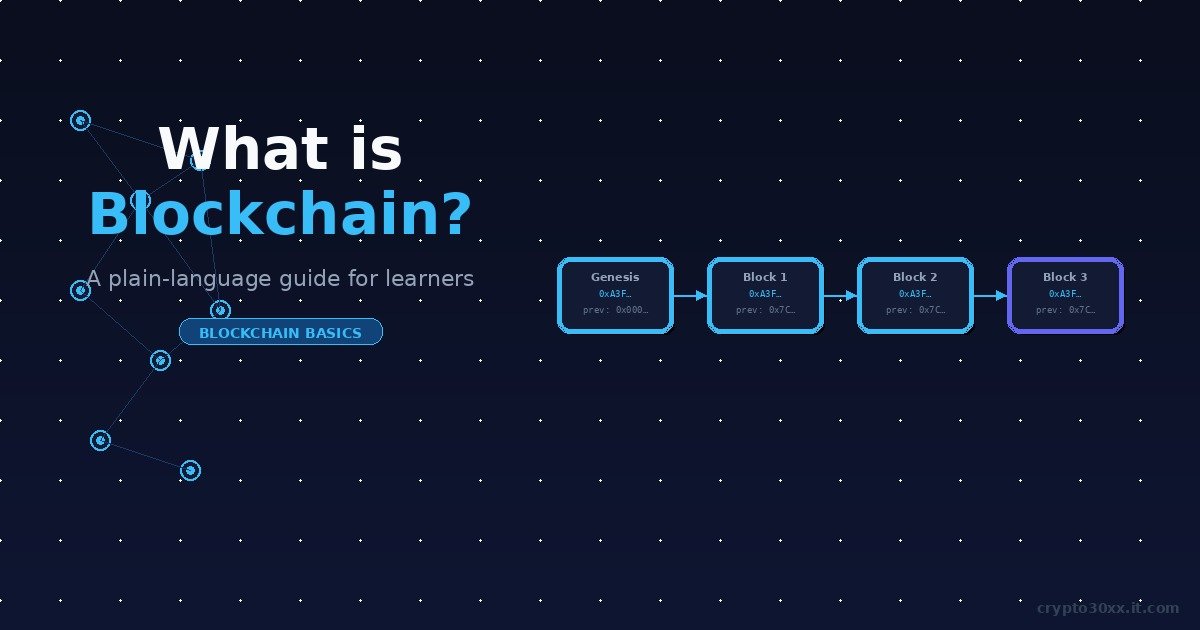
The name is structural, not metaphorical. A block is a data container that holds a set of records. In cryptocurrency networks, those records are typically transactions. Alongside the transaction data, each block contains a hash: a unique fingerprint generated from its own contents.
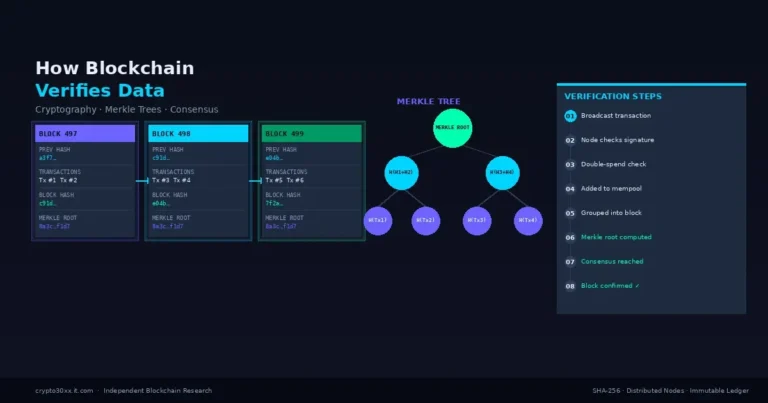
Crucially, each block also stores the hash of the block immediately before it. This backward reference creates a mathematical link. Alter the data in any block and its hash changes, which invalidates the reference in the next block and breaks the chain from that point forward. Repairing the break would require recalculating the proof-of-work or equivalent consensus mechanism for every block that followed. On any large network, that task is computationally prohibitive.
The chain is the ordered sequence of these linked blocks, extending back to the genesis block created when the network first launched.
Three core properties of blockchain
Most descriptions of blockchain cluster its defining characteristics into three properties:
- Decentralization: No single server, company, or government holds or controls the ledger. The complete record is stored on every participating node in the network.
- Immutability: Once a block is confirmed and added to the chain, altering it without detection is computationally impractical at any meaningful network size. The historical record is durable.
- Transparency: On public blockchains, any participant can view the complete ledger. Identities are typically pseudonymous — wallet addresses are visible, but are not inherently tied to real-world identities unless linked by other means.
These three properties do not apply equally to every type of blockchain. Private and consortium blockchains trade some decentralization and transparency for faster performance and controlled access.
How blockchain actually records information
Blockchains do not store data passively. A defined sequence of events governs how new information gets recorded, validated, and confirmed onto the chain. Each record passes through a broadcast, a validation check by the network’s nodes, and a consensus process before it becomes part of the permanent ledger.
What goes inside a block
Each block contains three main elements:
- Data: The records being stored, such as transactions, contract states, identity credentials, or other application-specific information.
- Hash: A fixed-length string generated by a cryptographic hash function. The hash is derived from all of the block’s contents. Change one character of the data, and the hash changes completely.
- Previous hash: The hash of the block immediately before this one in the chain. This is the linking mechanism.
Together, these three elements create the chain’s tamper-evident structure. Every block carries mathematical proof of everything that came before it.
How blocks link to form a chain
Picture a written ledger where each new page includes not only fresh records but also a summarized fingerprint of every preceding page. If someone quietly altered page twelve, the fingerprint on page thirteen would no longer match, and the inconsistency would propagate through every subsequent page.
Blockchain operates on the same principle, enforced by cryptographic math rather than human review. When a new block is created, its hash is calculated from its own data combined with the previous block’s hash. That calculation means the new block mathematically encodes the full history of the chain. Altering past records is not just difficult; the computational work required grows with every block added since the target.
The role of nodes and consensus
A node is any computer participating in the blockchain network by maintaining a copy of the ledger and validating new blocks. On large public networks, thousands of nodes operate independently, each following the same protocol rules.
When a new block is proposed, it is broadcast to the network. Nodes independently verify that the block is valid: that the transactions inside are legitimate, that the hash is correctly calculated, that no funds are being double-spent. Only when enough nodes agree does the block get added to the chain.
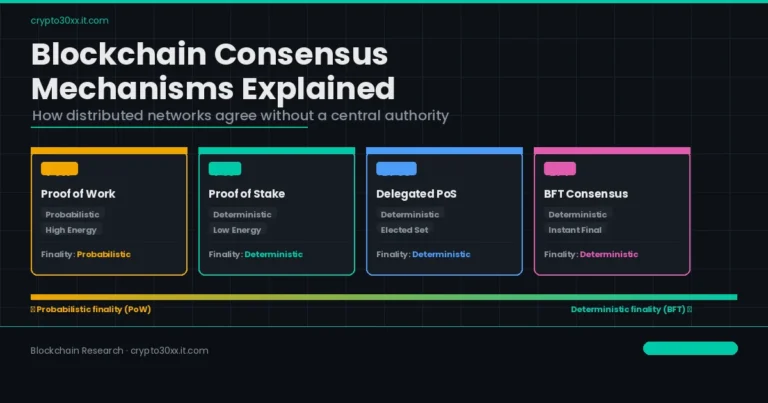
This agreement process is consensus. Different blockchains use different mechanisms. Proof-of-work requires nodes to solve computationally expensive puzzles. Proof-of-stake requires nodes to commit funds as collateral. Both serve the same function: making fraudulent additions expensive and making honest participation the economically rational choice.
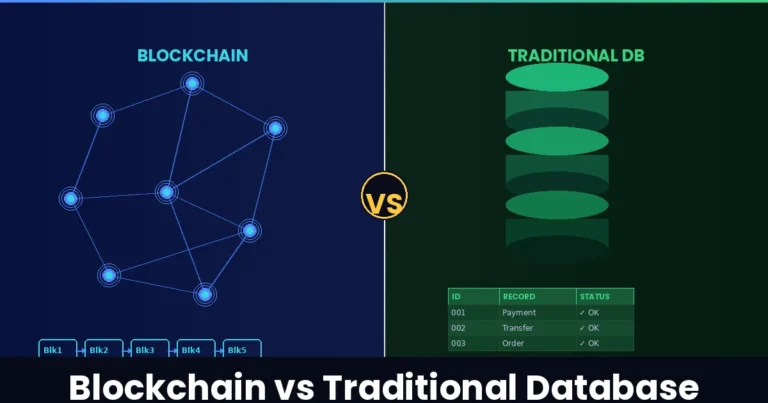
Blockchain compared to a traditional database
Most people interact with centralized databases daily, through banking apps, healthcare portals, and social media platforms. The structural differences between those systems and a blockchain are worth examining precisely, rather than dismissing one as outdated or praising the other as universally superior.
| Feature | Traditional database | Blockchain |
|---|---|---|
| Control | Single authority (company, government) | Distributed across participating nodes |
| Data modification | Administrator can edit or delete records | Requires network consensus; alters all subsequent hashes |
| Transparency | Restricted to authorized users | Public: fully open. Private: permissioned |
| Speed | Fast, with a single write authority | Slower, consensus across many nodes takes time |
| Trust model | Trust the institution operating it | Trust the protocol and cryptographic proofs |
| Single point of failure | Yes | No, copies exist across many nodes |
| Operational cost | Lower for standard use cases | Higher due to consensus and replication overhead |
Neither architecture is universally better. Traditional databases are faster, cheaper to operate, and appropriate for most data management tasks where one trusted organization controls the data. Blockchains are more suitable when multiple parties who do not trust each other need to share a record without relying on any single intermediary to manage it honestly.
Types of blockchain networks
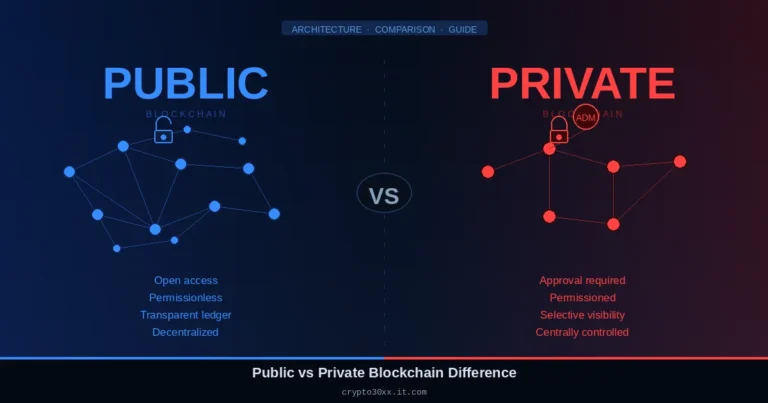
Blockchain networks are not all structured the same way. The key variable is who can participate, whether as a node, a validator, or a reader of the data, and that distinction shapes how the network functions, who bears the costs of running it, and how much trust the design actually requires.
| Type | Who can join as a node | Who can read the data | Common use case |
|---|---|---|---|
| Public | Anyone | Anyone | Cryptocurrency, open finance |
| Private | Approved participants only | Restricted to members | Internal enterprise record-keeping |
| Consortium | Pre-approved organizations | Varies by governance | Industry-wide shared ledgers |
Public blockchains
On a public blockchain, participation is entirely open. Anyone can operate a node, submit transactions, and inspect the full ledger. Bitcoin and Ethereum are the two most widely referenced examples. Transactions are pseudonymous: the addresses sending and receiving value are visible to anyone, but linking those addresses to real-world identities requires additional information beyond what is on the chain.
The trade-off is performance. Reaching consensus across thousands of anonymous nodes is resource-intensive, and transaction throughput on most public blockchains is lower than what centralized payment systems handle.
Private blockchains
A private blockchain restricts who can participate. A single organization typically governs access, approves nodes, and sets the validation rules. Private blockchains retain some structural properties of the architecture, such as an append-only record structure and an audit trail, while giving up decentralization.
The direct criticism is worth stating plainly: a private blockchain controlled by a single organization offers few structural advantages over a well-designed relational database. The debate is genuine, and whether a private blockchain makes sense depends on the specific requirements of the use case.
Consortium blockchains
Consortium blockchains distribute governance among a defined group of organizations. Multiple companies, often competitors in the same industry, share control of the network without any single member holding central authority. A consortium of logistics firms might maintain a shared shipment ledger that no individual member can alter unilaterally. Governance rules determine which organizations validate transactions and which data is visible to whom.
Where blockchain is applied beyond cryptocurrency
The most widely known application of blockchain is cryptocurrency. The same underlying architecture has been applied to other fields, with varying degrees of maturity and adoption. Some implementations are in active commercial use; others remain in early deployment or at the research stage.
Cross-border payments and settlements
International money transfers traditionally pass through multiple correspondent banks, each introducing delay and fees. Blockchain-based payment rails can reduce the number of intermediaries by providing a shared record that all parties accept as definitive. In some implementations, settlement times have dropped from multiple business days to well under an hour. The degree of improvement depends on the network’s transaction speed, the participating institutions, and the regulatory environment.
Supply chain tracking
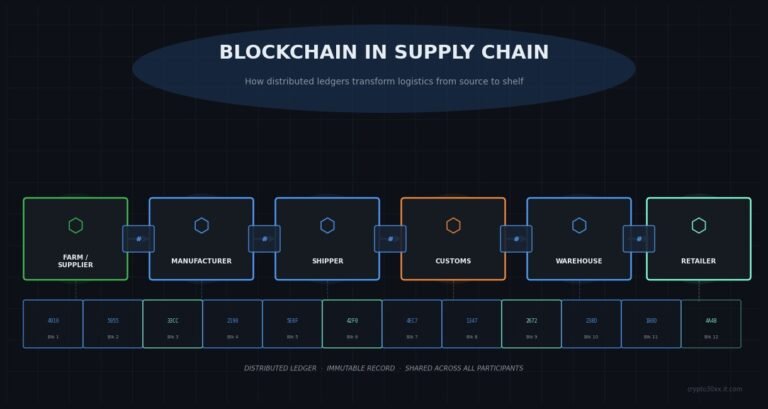
When a product moves through a global supply chain, from manufacturer through logistics carriers to customs authorities and retailers, each step involves different organizations and separate record-keeping systems. A shared blockchain ledger provides a sequential, verifiable record of what happened to a product, who handled it, and when. Practical applications include food safety tracing, pharmaceutical verification, and provenance tracking for high-value goods.
Digital identity and credentials
Several governments and institutions are exploring blockchain as a substrate for storing verified identity data, academic credentials, and professional licenses in a form that individuals control directly. A third party could verify a credential by checking the chain without needing to contact the issuing institution. The technical architecture supports this use case. The practical barriers, including regulatory alignment, interoperability standards, and broad adoption, are substantial and remain unresolved in most jurisdictions.
Smart contracts
Smart contracts are programs stored on certain blockchains that execute automatically when predefined conditions are met. They run on the network’s nodes and produce outputs recorded on the chain. A basic example: a contract that releases payment to a supplier once a delivery confirmation is recorded. The contract code executes without either party needing to trust the other, or a third-party intermediary. The code itself becomes the mechanism of enforcement.
Limitations and common misconceptions
Understanding blockchain accurately requires applying the same scrutiny used for any other technology. Several persistent misunderstandings cloud practical discussions of where and when to apply it, and addressing them directly is more useful than a uniformly positive account.
Blockchain is not the same as Bitcoin
Bitcoin is one application built on one specific public blockchain. The two are regularly conflated in public discussion, but they are distinct things. Blockchain is the underlying record-keeping architecture. Bitcoin is a cryptocurrency network that uses a blockchain as its ledger. Many blockchains exist with no connection to Bitcoin, and many applications of blockchain technology have nothing to do with digital currency.
Blockchain records are not automatically accurate
The immutability of blockchain applies to records after they are confirmed. It does not guarantee those records were correct when submitted. If wrong data enters a blockchain (an incorrect measurement, a fabricated event, a fraudulent transaction that passed initial validation), that inaccurate record becomes just as permanent as a correct one.
Data originating outside the blockchain, called oracle data, requires separate verification systems before it can be relied upon. The chain is only as trustworthy as the inputs it receives.
Decentralization has genuine costs
Distributing the ledger across thousands of nodes makes unauthorized alteration difficult, but it also creates overhead. Every node stores the full ledger. Reaching consensus among many participants takes time. Throughput on major public blockchains is constrained compared to centralized processing systems.
Scalability solutions, including layer-2 protocols, sharding, and alternative consensus mechanisms, address parts of this trade-off. Each introduces its own complexity and assumptions, and these remain active areas of protocol engineering.
Anonymity and privacy are limited
Public blockchain transactions are pseudonymous, not anonymous. The complete transaction history tied to any wallet address is visible to anyone who inspects the chain. Sophisticated analysis can often link addresses to real-world identities through transaction patterns, exchange records, or other on-chain activity. Privacy-focused blockchains use additional cryptographic techniques to obscure transaction details, but these are not the default on most public networks.
FAQs
The following questions address common points of confusion about blockchain, including how it differs from related concepts and where its limits lie.
Is blockchain the same as cryptocurrency? No. Cryptocurrency is one application built on blockchain. Blockchain is the underlying data structure: a distributed, cryptographically linked record of information. Many blockchain deployments have no native cryptocurrency at all, and many are designed purely for data integrity rather than digital payments.
Can data on a blockchain ever be changed? In practice, confirmed data on large public blockchains cannot be changed without the network detecting and rejecting the attempt. Altering a past block changes its hash, breaking the link to every subsequent block and requiring an enormous amount of computation to repair. On small or poorly secured networks, this guarantee is considerably weaker.
Who controls a public blockchain? No single entity controls a public blockchain. The protocol rules are embedded in software, the ledger is maintained collectively by nodes, and changes to core rules require broad consensus among participants. There is no central server to contact and no governing authority in the conventional sense.
What is the difference between blockchain and distributed ledger technology? Blockchain is one specific type of distributed ledger technology (DLT). All blockchains are distributed ledgers, but not all distributed ledgers are blockchains. Some DLT systems use different data structures, such as a directed acyclic graph (DAG), rather than a linear, back-linked chain of blocks. The terms are sometimes used interchangeably but are not equivalent.
How does a cryptographic hash protect the chain? A cryptographic hash function takes any input and produces a fixed-length output. The same input always produces the same output, but changing even one character produces a completely different result. In blockchain, each block’s hash is derived from its data and the previous block’s hash. Alter any block, and its hash changes, which invalidates every subsequent block’s backward reference.
Are private blockchains secure? Private blockchains face different security assumptions than public ones. With fewer nodes, the computational cost of gaining majority control is lower, which is why private blockchains use permission-based access rather than open consensus. Security depends on the governance model, the access controls in place, and the integrity of the approved node operators. Insider threats are a more realistic concern than external attacks.
Disclaimer
This article is written for educational and research purposes only. Nothing on this site constitutes financial, investment, or legal advice. Cryptocurrency and blockchain-related activities carry significant risk, including the possible loss of principal. Readers should conduct independent research and consult a qualified professional before making any financial decisions.
Blockchain is, at its structural foundation, a method for recording information that replaces centralized authority with distributed consensus. The blocks, the hashes, the nodes, the consensus mechanism — each element serves a specific engineering function in making that work without requiring a trusted intermediary. Understanding the mechanics is straightforward once the vocabulary is clear. Evaluating whether that structure is the right solution for any particular problem is more demanding and rarely has a simple answer. The architecture is a tool, and whether it fits depends entirely on the problem.
Seeking inspiration? Our featured light brings fresh hope on heavy mornings.