Blockchain in supply chain: how it works and key benefits
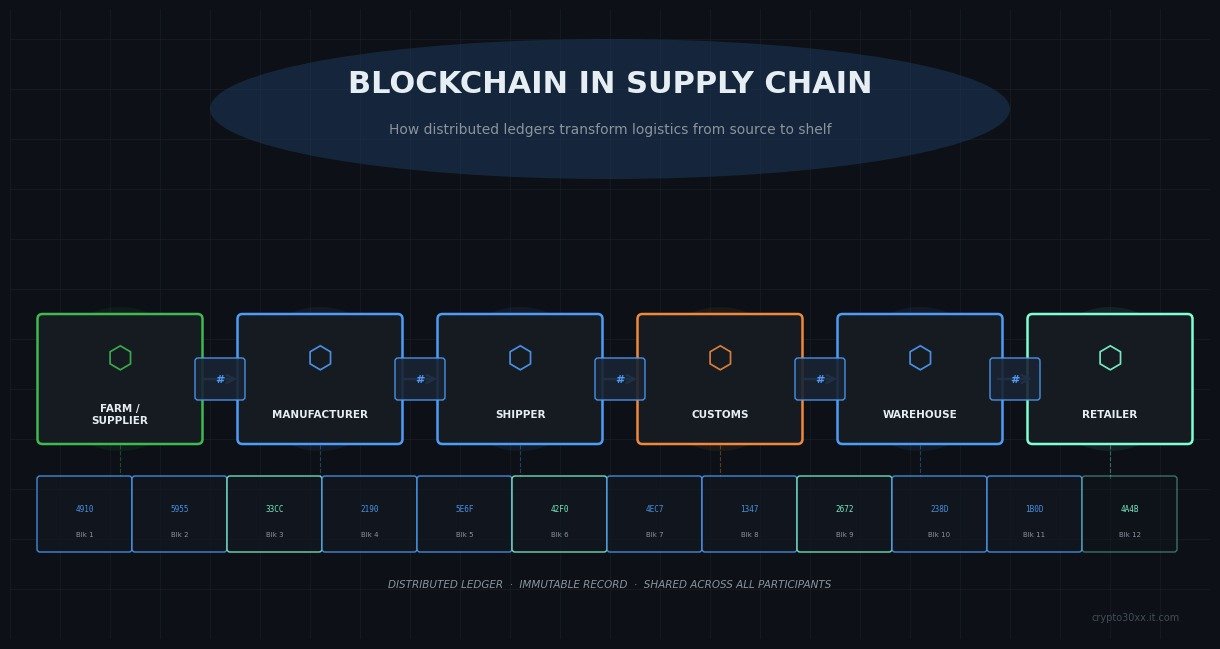
Blockchain in supply chain refers to the use of a distributed ledger to record, verify, and share data about goods as they move from origin to end consumer. Every participant in the network writes to and reads from the same record: manufacturers, freight carriers, customs authorities, warehouses, and retailers. No single entity controls this record, and no party can alter it without network consensus. The result is a cryptographically linked audit trail that belongs to the network, not to any one company’s private database.
Supply chains are among the most data-intensive operations in global commerce, yet they have historically run on siloed records and manually exchanged documents. The gaps this creates are measurable: counterfeit goods, untraceable contamination events, and payment disputes that resolve over weeks. This article explains the mechanics, real-world deployments, and honest limitations of blockchain in supply chain, written for researchers and learners approaching the topic analytically.
What is blockchain in supply chain?
Blockchain in supply chain is a shared digital ledger where every authorized participant records and reads product events in real time from one append-only data source. No single company controls the data, and once a transaction is confirmed, it cannot be changed without invalidating every subsequent entry. This architecture creates a permanent, auditable chain of custody that any authorized party can access at any time.
The structural problem in traditional supply chains
A finished product moving from raw material to consumer might cross twenty or thirty separate organizations. Each keeps its own records. Those records rarely communicate in real time, and reconciliation is manual, slow, and prone to error.
The consequences are structural, not incidental. Tracing a food contamination event through five supplier tiers requires collecting documents from five separate, often incompatible database systems. Counterfeit goods enter wherever provenance cannot be independently confirmed. Payment disputes between shippers and consignees drag on because each party holds its own version of the same events.
How distributed ledgers address it
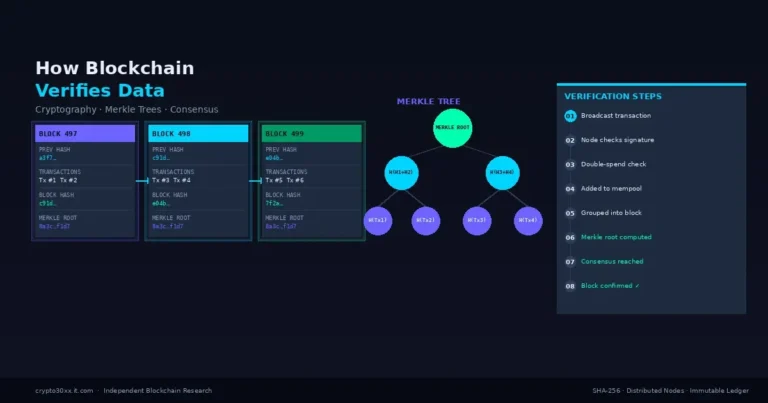
Each transaction is written to a block. That block is cryptographically hashed and linked to the previous one. Altering any past record requires recalculating every subsequent block and gaining consensus from the majority of network participants — a task that is computationally infeasible in a properly designed system.
When a retailer reads a shipment, they are accessing the same ledger the manufacturer, freight carrier, and customs authority already wrote to. There is no reconciliation step because there is only one record.
How blockchain technology works in a supply chain
A supply chain blockchain is a distributed ledger that records asset transfers as immutable, sequenced transactions, validated through network consensus and enforced through self-executing code. Three underlying layers combine to produce its defining properties: shared access to a single data record, cryptographic verifiability of every entry, and automatic enforcement of agreed-upon rules.
Distributed ledger mechanics
Every node in the network holds a full or partial copy of the ledger. When a warehouse worker scans a shipment and marks it received, that action is broadcast to the network as a proposed transaction. The consensus mechanism validates it before writing it permanently to all copies.
The defining property is immutability. A confirmed transaction cannot be deleted or modified. A correction must be written as a new transaction, which itself becomes part of the record. The full chain of custody is therefore auditable at any point, without relying on any single company’s records.
From a network design perspective, each ledger copy also serves as a backup. There is no central server whose failure takes down the system. This fault tolerance matters in logistics contexts: a shipping network connecting ports across different continents operates in an environment where individual nodes go offline regularly, and the ledger’s distributed nature means those outages do not cause data loss.
Smart contracts and automated compliance
Smart contracts are programs stored on the blockchain that execute automatically when predefined conditions are met. In supply chain applications, a smart contract might release payment to a supplier the moment a verified delivery scan is recorded: no invoice, no manual approval, no accounts-payable delay.
The same mechanism handles compliance. If an IoT sensor records that a refrigerated shipment exceeded a maximum temperature threshold, a smart contract can flag the batch, notify the buyer, halt further transfers, and log the event, all without human intervention. The rule fires the moment the condition is true.
Consensus mechanisms in enterprise networks
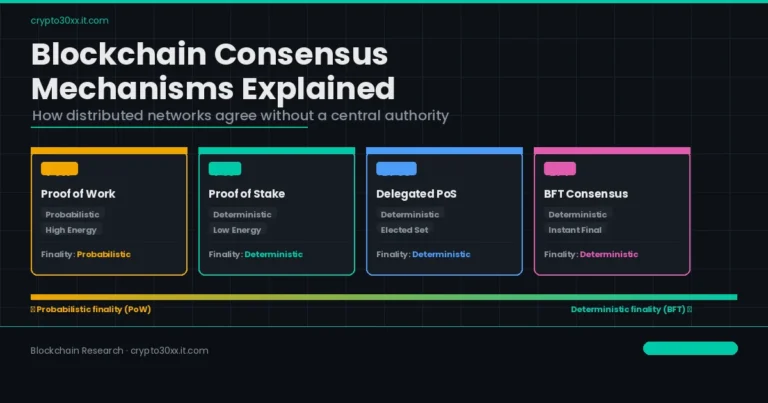
Public blockchains like Bitcoin use Proof of Work, producing block finality in roughly 10 minutes at significant energy cost. Supply chain networks require faster throughput and lower consumption.
Enterprise deployments use permissioned blockchains with Proof of Authority (PoA) or Practical Byzantine Fault Tolerance (PBFT) consensus. PoA assigns validation rights to a defined set of trusted participants, such as a consortium of manufacturers, carriers, and retailers, rather than anonymous miners. Block finality in PoA systems typically occurs in seconds. For a logistics network processing thousands of scan events per hour, that difference is decisive.
Key benefits for supply chain management
Using blockchain in supply chain management creates verifiable, shared records that reduce disputes, accelerate traceability, and enable automated compliance enforcement. These advantages scale with participation: a ledger adopted by only one tier of a six-tier network delivers limited benefit, because a shared record is only as good as the number of parties sharing it.
Traceability and provenance
Provenance is the documented origin and custody history of a product. For a pharmaceutical distributor, provenance means knowing every handler in a drug’s path from API synthesis to pharmacy shelf. For a food retailer, it means knowing which farm, which harvest batch, which cold storage facility handled the goods.
Each on-chain transfer record typically includes a timestamp, the identifier of the transferring party, the receiving party, the asset identifier, and relevant condition data from IoT sensors. This granularity means a supply chain audit does not just confirm that a product moved from point A to point B — it documents who handled it, under what conditions, and precisely when.
IBM Food Trust, built on the Hyperledger Fabric framework, demonstrated in pilots with major grocery retailers that tracing a food item to its farm origin dropped from approximately seven days to under three seconds. That compression matters most during a recall: identifying the contaminated batch and clearing unaffected inventory are both faster and more precise when all participants read from one record.
Counterfeit prevention
When a unit is manufactured, a unique identifier is written to the on-chain record. Every subsequent transfer updates that record. A buyer receiving goods can verify whether the on-chain history matches the physical item and flag any discrepancy that suggests diversion, substitution, or repackaging.
This mechanism is most valuable in pharmaceuticals and high-value goods, where counterfeits carry direct risks to patient health or significant financial losses. Blockchain makes undetected counterfeiting substantially harder, not impossible. Physical inspection and honest data entry at origin still matter.
Settlement speed and documentation reduction
A standard ocean freight shipment can involve more than 30 organizations and hundreds of document touchpoints: bills of lading, letters of credit, customs declarations, phytosanitary certificates, and insurance records. These have historically moved by fax and email, creating version-control failures and payment delays measured in weeks.
A shared blockchain ledger reduces this to one document set updated in real time. When all parties read from the same record, payment release, customs clearance, and quality approval can happen in parallel rather than in sequence.
Supplier accountability and audit integrity
When certifications and compliance records are written to a shared ledger by the certifying body, suppliers cannot present different documents to different buyers. A sustainability certification on-chain is the same record the brand owner, retailer, and consumer access. This shifts supply chain management from trust-based to verification-based.
Real-world applications and case studies
Operational deployments span several industries, each driven by specific problems the technology addresses better than existing alternatives. Food traceability, pharmaceutical serialization, and shipping documentation have attracted the largest and most documented implementations, producing enough real-world data to draw clear conclusions about where the technology performs well.
Food safety and agriculture
Food recalls require rapid identification of the contaminated batch and equally rapid clearance of safe stock. Manual traceability across siloed systems makes both tasks slow and expensive.
IBM Food Trust’s deployment with Walmart for leafy greens suppliers is one of the most-cited implementations: trace time dropped from approximately seven days to under three seconds. Similar programs have been tested in seafood (tracking fish from catch to consumer), cocoa (verifying child-labor-free sourcing), and coffee (validating direct-trade origin claims from specific farms).
Pharmaceutical tracking
Drug supply chain security regulations in multiple jurisdictions require serialization and verifiable chain of custody from manufacturer to dispensing pharmacy. Counterfeit pharmaceuticals present direct patient safety risks and significant losses to legitimate manufacturers.
Blockchain extends serialization by embedding unique drug identifiers in an immutable shared ledger. Each transfer point, from API manufacturer to finished-dose producer to wholesale distributor to pharmacy, is recorded and verifiable by any authorized party. The Drug Supply Chain Security Act (DSCSA) in the United States established phased requirements for electronic, interoperable drug tracing, and similar frameworks exist in the European Union’s Falsified Medicines Directive. These regulatory mandates have driven substantial investment in blockchain-based track-and-trace, though most frameworks allow multiple technical approaches.
Shipping and freight
International shipping routinely involves dozens of organizations across multiple countries: carriers, port authorities, customs agencies, banks, and insurers, each operating under different regulatory regimes.
Blockchain-based bills of lading allow all parties to work from one document, with sequential updates and access controlled by smart contract. Maersk and IBM developed TradeLens, a blockchain-based shipping platform that operated for several years before being discontinued. The stated reason was that too few competing shipping lines joined the consortium to generate useful network effects. That case is addressed directly in the limitations section below.
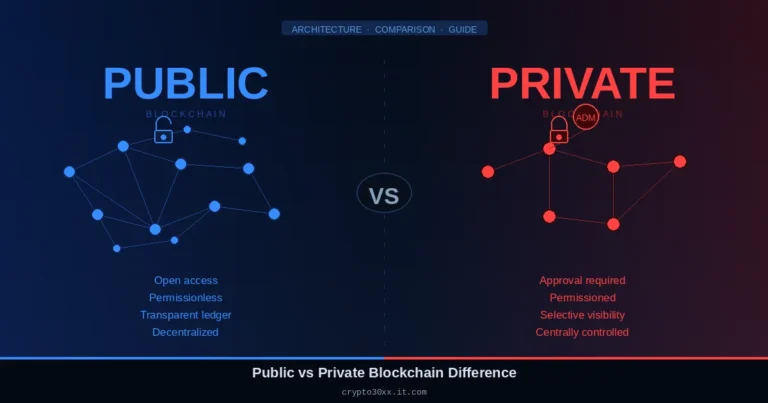
Permissioned vs permissionless blockchains for supply chain use
Selecting the right blockchain architecture is one of the first decisions in any supply chain deployment. The choice between permissioned and permissionless systems affects transaction speed, cost, data privacy, and governance: four properties that directly determine whether a blockchain network can meet operational requirements.
| Feature | Permissioned blockchain | Permissionless blockchain |
|---|---|---|
| Access control | Invited participants only | Open to anyone |
| Consensus speed | Seconds (PoA, PBFT) | Minutes (PoW/PoS) |
| Transaction cost | Low or fixed (consortium model) | Variable gas fees |
| Privacy | Configurable channel-level privacy | Pseudonymous, public data |
| Governance | Consortium or operator-controlled | Protocol-based, decentralized |
| Common examples | Hyperledger Fabric, Corda, Quorum | Ethereum mainnet, public chains |
| Typical supply chain use | Enterprise logistics, compliance | Token-based provenance, DeFi rails |
Permissioned blockchains dominate enterprise supply chain deployments. Faster block finality, predictable transaction costs, and configurable data access make them the practical choice for logistics event logging. Permissionless blockchains offer genuine advantages in cross-border settlement and tokenized commodity trading, where public interoperability matters, but variable fees and unpredictable throughput make them impractical for high-volume operations.
Limitations and challenges in deployment
Blockchain in supply chain is not a universal solution. The technology controls only the data layer it manages and cannot solve problems that originate in the physical world, in organizational competition, or in integration complexity. Four documented constraints shape where the technology delivers value and where it falls short.
The oracle problem
Blockchain’s immutability applies only to data that is already on the ledger. It cannot verify that physical reality matches what was entered. If a supplier records a false certification claim, the blockchain stores it as faithfully as a true one.
This is the oracle problem: the mechanism that moves real-world information onto the ledger is a trust point the blockchain cannot secure. IoT sensors and independent inspections reduce exposure but do not eliminate it. Fraud or error at the data-entry point defeats the system regardless of how well the ledger is designed.
Interoperability between platforms
A manufacturer might interact with logistics partners on one blockchain platform, retailers on a second, and overseas suppliers on a third. The blockchain itself does not ensure these networks can communicate.
Industry groups including GS1 and various consortia are developing interoperability standards, but no single approach has taken hold. A supply chain participant may need to interface with several incompatible blockchain networks at once, which partially undermines the single shared record that makes the technology compelling in the first place.
The adoption threshold problem
TradeLens operated for several years before Maersk and IBM discontinued it. The stated reason: too few competing shipping lines joined the consortium to generate useful network effects. A blockchain’s value scales with the number and diversity of participants writing to it. A ledger with one major participant is not, functionally, a shared ledger.
This is the adoption threshold problem in concrete form. Industries where participants compete for the same customers are structurally reluctant to share infrastructure with rivals. Reaching critical mass in fragmented markets requires either regulatory mandate or coordination mechanisms that the technology itself cannot provide.
Cost and integration complexity
Implementation costs depend heavily on how many existing systems require integration. Legacy ERP software needs custom middleware to connect to blockchain layers. Suppliers in smaller markets or with limited technical infrastructure may lack the capability to participate at all, creating a tiered supply chain where blockchain tracking applies only to certain tiers.
The per-transaction cost model also varies. Some permissioned consortium blockchains are effectively free for members; others use token-based fee models that introduce unpredictable costs at scale.
FAQs
What is blockchain in supply chain in simple terms? It is a shared digital ledger that all participants in a product’s journey, from manufacturers to retailers, can write to and read from. No single company controls it, and entries cannot be changed after confirmation. This creates a permanent, auditable chain of custody from source to consumer.
How does blockchain improve traceability in logistics? Each transfer or verification event is recorded as a timestamped transaction on the ledger. Any authorized participant can trace a product’s full history from raw material to finished good in seconds, rather than spending days gathering incompatible records from separate organizations.
What is the oracle problem in blockchain supply chain systems? The oracle problem is the gap between what is recorded on the blockchain and what is actually true in the physical world. Blockchain records exactly what it is told. A fraudulent or incorrect entry at the data-capture point is stored as faithfully as an accurate one, and the ledger cannot independently verify physical reality.
What is the difference between permissioned and permissionless blockchains in supply chain? Permissioned blockchains restrict participation to invited parties and use fast, low-cost consensus mechanisms. Permissionless blockchains are open to anyone but are slower and subject to variable transaction fees. Enterprise supply chain deployments almost exclusively use permissioned blockchains for speed, privacy control, and cost predictability.
Can smart contracts replace traditional trade finance documents? Smart contracts can automate many trade finance functions: triggering payment on verified delivery, releasing letters of credit when defined conditions are met, flagging noncompliance events automatically. They cannot resolve genuinely disputed facts or substitute for legal instruments in contested situations, and they depend entirely on accurate inputs from the data sources feeding them.
Why did TradeLens fail? Maersk and IBM discontinued TradeLens because insufficient competing shipping lines joined the consortium to generate useful network effects. The platform’s value depended on broad, industry-wide participation. Limited adoption made the network too small to justify the cost. The case illustrates that blockchain supply chain success requires critical mass, which market fragmentation makes difficult to achieve without external coordination.
Is blockchain practical for small businesses in supply chains? For small operations with few participants and simple logistics flows, blockchain adds implementation complexity and cost without proportionate benefit. The technology delivers the most value in complex, multi-tier, multi-party supply chains where audit friction and data silos are genuine operational bottlenecks.
Which sectors use blockchain in supply chain management most actively? Food and agriculture, pharmaceuticals, luxury goods, and international container shipping have seen the most active deployment. These sectors share high regulatory requirements for traceability, meaningful counterfeit risk, or severe consequences when provenance fails.
Disclaimer
This article is written for educational and research purposes only and does not constitute financial, investment, legal, or operational advice. Blockchain technology implementations vary significantly by provider, platform, and regulatory jurisdiction. Organizations evaluating blockchain for supply chain operations should consult qualified technology and legal advisors appropriate to their specific circumstances.
Blockchain in supply chain addresses a real structural problem: globally distributed operations generate incompatible, siloed records, and no traditional system has solved that at scale. When deployed across a sufficiently broad participant network, with accurate data inputs and well-designed smart contracts, distributed ledger technology creates a shared, verifiable record that conventional supply chain software has not managed to deliver.
The limitations are real and documented. The technology controls the data layer, not the physical world. Adoption is harder than implementation, and the TradeLens case demonstrates that good technology with insufficient participation fails in practice. The oracle problem means no blockchain can prevent fraud at the point of data entry.
For researchers and analysts evaluating this technology, the most useful question is not whether the ledger works. It does, within its domain. The question is whether the participants in a given supply chain can coordinate well enough to use it.
Stay on top of the latest trends—find ease with our most human recommendations.