Bitcoin halving explained: a complete beginner’s guide
Bitcoin halving explained: The bitcoin halving is a scheduled, automatic event built into Bitcoin’s code that cuts the reward miners receive for adding new blocks to the blockchain by exactly 50%. It occurs roughly every four years — specifically after every 210,000 blocks are mined — and gradually reduces the rate at which new bitcoin enters circulation. Designed by Bitcoin’s creator Satoshi Nakamoto, the halving is the primary mechanism behind Bitcoin’s fixed supply cap of 21 million coins. For anyone learning about Bitcoin, understanding the halving is essential because it shapes the asset’s monetary policy, issuance schedule, and long-term scarcity in ways that no central authority can override.
What is the bitcoin halving?
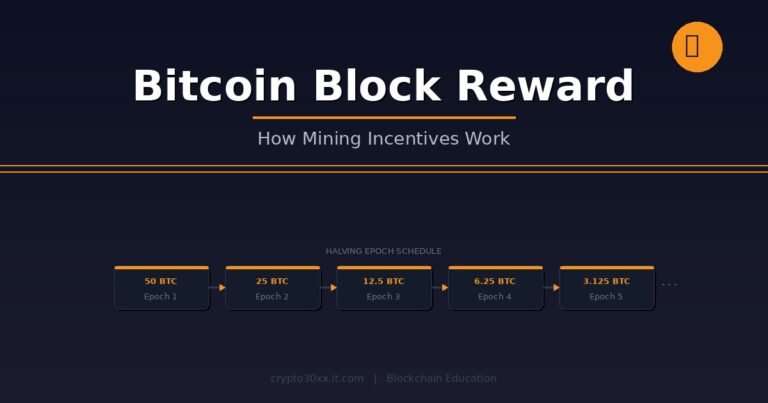
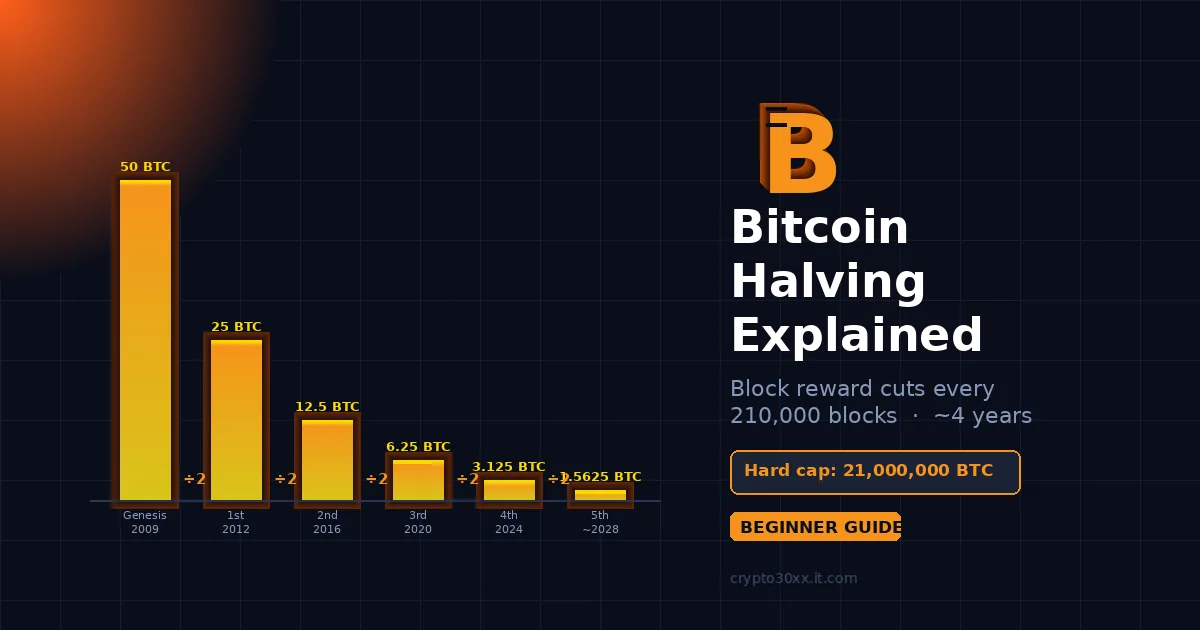
The bitcoin halving is an event programmed into Bitcoin’s protocol that reduces the block reward — the amount of new bitcoin paid to miners — by 50% every time 210,000 blocks are successfully added to the blockchain. Since one block is produced approximately every 10 minutes, this interval translates to roughly four years between halvings.
At Bitcoin’s launch in January 2009, miners received 50 BTC for each block they mined. That original reward has now been cut four times. After the most recent halving in April 2024, the block reward stands at 3.125 BTC per block. The pattern continues until roughly the year 2140, when the reward approaches zero and all 21 million bitcoin will have been issued.
The word “halving” describes the mechanism precisely: each event cuts the reward in half. Nothing more complex than that — but the downstream effects on supply, miner economics, and market structure are substantial.
Who controls the halving schedule?
No individual, company, or government controls the halving. The schedule is written into Bitcoin’s open-source code and enforced automatically by the network. Every participant — miners, nodes, wallet software — runs the same rule. To change the schedule would require agreement across the majority of the network, which, in practice, has never happened and would undermine Bitcoin’s core value proposition as a predictable, rules-based system.
How does bitcoin mining work — and why does it matter for halvings?
To understand the halving, you first need a basic picture of Bitcoin mining, because halvings directly affect miner compensation.
The mining process
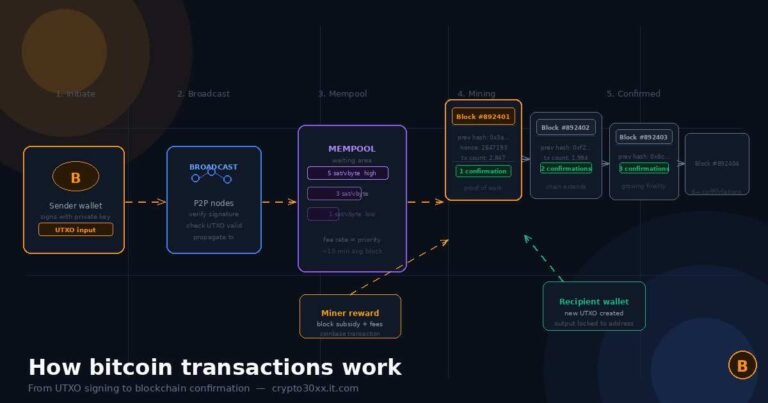
Bitcoin transactions are not processed by a central server. Instead, a global network of computers called miners compete to bundle recent transactions into a new “block” and attach that block to the growing chain of previous blocks — the blockchain.
To win the right to add a block, a miner must solve a computationally intensive mathematical puzzle called proof-of-work. The first miner to solve it broadcasts the new block to the network, and if valid, that block is accepted. As a reward, the winning miner receives newly created bitcoin plus any transaction fees included in the block.
The two components of a block reward
A miner’s total earnings from each block consist of:
- Block subsidy: The fixed amount of newly minted bitcoin specified by the protocol. This is the component that halves every 210,000 blocks.
- Transaction fees: Fees paid by users who want their transactions included in the block. These fees do not halve — they fluctuate with network demand.
The halving affects only the block subsidy. As that subsidy decreases over time, transaction fees become an increasingly important part of miner revenue. After the final bitcoin is mined around 2140, fees will be the only compensation miners receive.
What is difficulty adjustment?
Every 2,016 blocks (roughly two weeks), Bitcoin’s protocol automatically adjusts how hard the mining puzzle is. If blocks are being produced faster than the 10-minute target, difficulty rises; if slower, it drops. This mechanism keeps block production stable regardless of how many miners join or leave the network. It is separate from the halving but interacts with it: when a halving makes mining less profitable, some miners may exit, which triggers a difficulty decrease to rebalance the system.
The complete history of bitcoin halvings
Four halvings have occurred since Bitcoin’s genesis block in January 2009. Each one cut the block subsidy in half, slowing the flow of new supply.
| Halving | Date | Block height | Reward before | Reward after |
|---|---|---|---|---|
| 1st | November 28, 2012 | 210,000 | 50 BTC | 25 BTC |
| 2nd | July 9, 2016 | 420,000 | 25 BTC | 12.5 BTC |
| 3rd | May 11, 2020 | 630,000 | 12.5 BTC | 6.25 BTC |
| 4th | April 19, 2024 | 840,000 | 6.25 BTC | 3.125 BTC |
| 5th (projected) | ~April 2028 | 1,050,000 | 3.125 BTC | 1.5625 BTC |
First halving — November 2012
The inaugural halving dropped the block reward from 50 BTC to 25 BTC. At the time, Bitcoin was primarily known within technical communities, and the total market capitalization was well under $200 million. The halving received little mainstream attention but established the cycle for all subsequent events.
Second halving — July 2016
By the second halving, developer, investor, and public interest had grown considerably. The reward dropped from 25 BTC to 12.5 BTC at block 420,000. Bitcoin had recovered from the 2014–2015 bear market and was trading near $650 on halving day. In the period that followed, a sustained bull market developed, culminating in a peak near $20,000 in December 2017 — roughly 17 months after the event.
Third halving — May 2020
The third halving cut rewards from 12.5 BTC to 6.25 BTC at block 630,000. It took place during the early phase of the COVID-19 pandemic, shortly after a sharp market downturn that had brought prices down significantly in March of that year. Despite concerns about mining profitability given the immediate supply reduction, the network absorbed the change without disruption. A significant bull market followed over the subsequent 18 months.
Fourth halving — April 2024
The most recent halving at block 840,000 reduced the block subsidy from 6.25 BTC to 3.125 BTC. This event occurred after spot Bitcoin ETFs had been approved in the United States, marking the first halving under conditions of substantial institutional participation. Daily issuance dropped from approximately 900 BTC to approximately 450 BTC.
Why the halving matters: supply mechanics and scarcity
Bitcoin’s fixed supply cap
Bitcoin has a hard cap of 21 million coins. No more can ever be created. This ceiling is enforced not by a board or central bank, but by code. The halving is the mechanism that gets Bitcoin there gradually, spreading issuance over more than a century rather than releasing all coins at once.
The math is straightforward. If you started at 50 BTC per block and the number of halvings is finite (64 in total), the sum of all bitcoin that will ever exist converges to approximately 21 million — technically to 20,999,999.9769 BTC due to rounding in the protocol.
How halving affects daily issuance
The practical effect on supply is significant. Before the first halving, roughly 7,200 BTC was issued every day (144 blocks × 50 BTC). After the fourth halving, that figure dropped to approximately 450 BTC per day (144 blocks × 3.125 BTC). Each successive halving compresses the daily supply further.
A useful way to think about this is in terms of the annual issuance rate. Before the first halving, Bitcoin had an inflation rate comparable to some fiat currencies. After each halving, that rate drops. By the time the block subsidy reaches fractional amounts, the rate of new supply entering the market is negligible.
Comparing bitcoin’s supply schedule to gold
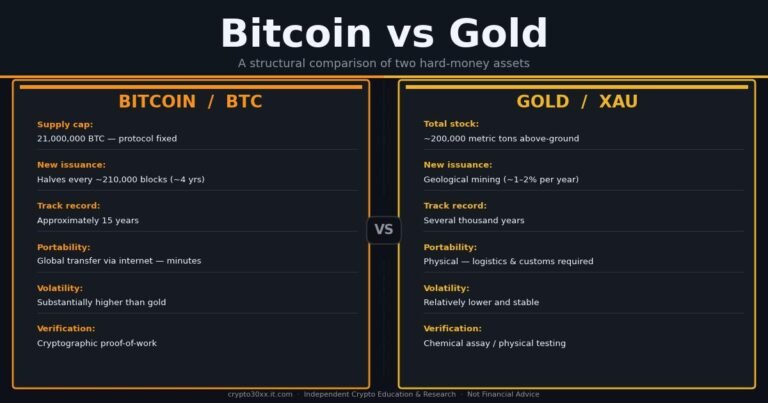
Bitcoin is sometimes described as “digital gold” partly because its supply model is fixed and transparent in a way that gold’s is not. With gold, supply depends on geological discovery and mining technology — both variable and unpredictable. With Bitcoin, the supply schedule is written in code, public, and immutable. Satoshi Nakamoto specifically designed Bitcoin to simulate a scarce commodity, where the total amount is known and new issuance slows over time.
The table below compares the key supply characteristics:
| Property | Bitcoin | Gold | Fiat currency |
|---|---|---|---|
| Total supply cap | 21 million BTC (hard cap) | Unknown (geological) | No cap — adjustable |
| Issuance authority | Protocol code (automatic) | Mining output | Central bank |
| Supply growth rate | Decreasing on schedule | Roughly 1–2% annually | Policy-dependent |
| Schedule transparency | Fully public and fixed | Not predictable | Not fixed |
How halvings affect miners and network security
The miner profitability challenge
Each halving immediately cuts a miner’s subsidy income in half. If bitcoin’s market value does not rise proportionally to compensate, mining becomes less profitable. Miners with higher operating costs — typically older hardware or expensive electricity — may switch off their machines. When enough miners exit, Bitcoin’s difficulty adjustment mechanism lowers the puzzle difficulty, allowing remaining miners to find blocks at the intended 10-minute pace.
This self-correcting mechanism means halvings do not break the network, but they can cause temporary shifts in the mining landscape. The hashrate — the total computing power pointed at the network — may dip briefly after a halving before stabilizing.
The long-term security question
The most debated long-term implication of repeated halvings is network security. As the block subsidy continues to decline toward zero, miners will rely increasingly on transaction fees. Whether fee revenue alone can adequately incentivize miners to secure the network is one of the genuinely open questions in Bitcoin research. Proponents argue that growing adoption will drive higher transaction volumes and fees. Critics argue that fee revenue is inherently variable and may not provide the consistent incentive the block subsidy supplies in its present form.
This is not a near-term concern — the block subsidy will remain meaningful for decades. But it is worth understanding as part of any complete picture of Bitcoin’s long-run design.
The miner sell-pressure theory
One hypothesis that circulates around halvings is that they reduce “sell pressure” from miners. The reasoning is that miners must cover operating costs (hardware, electricity, facilities) in local currency, so they routinely sell a portion of their bitcoin rewards. If the subsidy is halved, miners receive fewer new coins to sell, which reduces ongoing selling activity in the market. How significant this effect is compared to other market factors is debated and not measurable with precision, but the mechanism itself is logically coherent.
Halvings and price: what the historical record actually shows
This section explains what has historically occurred. It is not a prediction and should not be read as investment guidance.
The lag pattern
Across all four halvings, price increases — where they occurred — did not happen immediately on the halving date. The historical pattern shows price responses unfolding over a period of months, typically six to eighteen months after the event. This lag exists because the supply reduction is small relative to the existing supply in any given month, and market conditions, sentiment, and external factors all influence how prices respond.
What history does not guarantee
Each cycle occurs in different conditions: different regulatory environments, different levels of institutional participation, different global economic context. The mining industry is more mature with each halving. Spot ETFs, derivatives markets, and custody infrastructure have changed the participant base substantially compared to earlier cycles. Historical correlation between halvings and bull markets does not establish causation, and past cycles are not a reliable template for future ones.
The “pre-priced-in” argument
A common counterargument to halving-driven price narratives is that halvings are fully transparent and scheduled years in advance, so rational market participants would already factor the supply reduction into prices long before the event. Whether markets fully discount scheduled supply changes is a genuine debate in financial economics, and the answer is not obvious in either direction.
Common misconceptions about the bitcoin halving
Halvings are random or unpredictable. False. The schedule is fully deterministic, triggered by block count rather than calendar time. While the exact date shifts because block times vary slightly around the 10-minute average, the block milestone is known precisely years in advance.
The halving immediately doubles bitcoin’s value. False. Supply reduction is one factor among many. Price is determined by the combined behavior of buyers and sellers across global markets. No automatic price doubling is built into the protocol.
Miners stop mining after a halving. False. The difficulty adjustment ensures the network continues to function. Less profitable miners may exit, but the network does not halt. More efficient miners continue operating.
The halving reduces the number of bitcoin in circulation. False. The halving only affects the rate at which new bitcoin is created. Existing bitcoin already in circulation is unaffected.
There will be a 64th halving and then the network stops. Partially true. After approximately 64 halvings, the block subsidy rounds to zero and no new bitcoin is issued. However, the network continues: miners can still earn transaction fees, and the blockchain keeps producing blocks. The network does not “end” — it transitions to a fee-only incentive model.
FAQs
What exactly triggers a halving event? A halving is triggered automatically when the blockchain reaches a specific block height — a multiple of 210,000. It is not tied to a calendar date. Since blocks are produced on average every 10 minutes, 210,000 blocks take roughly four years to mine, but the exact timing fluctuates based on actual block production rates.
How many halving events have there been? Four halvings have occurred: in November 2012, July 2016, May 2020, and April 2024. Each one reduced the block reward by 50%.
What will the block reward be after the next halving? The next halving, projected around 2028, will reduce the block reward from 3.125 BTC to 1.5625 BTC per block. The exact date depends on how quickly blocks are produced between now and then.
When will the last bitcoin be mined? Based on the halving schedule and the 10-minute average block time, the final bitcoin is projected to be mined around the year 2140. At that point, approximately 64 halvings will have occurred, and the block subsidy will have reached a value too small to mint.
Does a halving change anything about how I send or receive bitcoin? No. The halving affects only miner compensation. For ordinary users, sending and receiving bitcoin works identically before and after a halving. The network continues producing blocks at the same average pace.
Why did Satoshi Nakamoto design the halving? Bitcoin’s creator wrote that the controlled supply schedule was intended to keep inflation in check by limiting new issuance over time. The design simulates a scarce commodity: as more is “mined,” what remains becomes harder to extract and slower to release. The halving was embedded in the genesis version of the Bitcoin code.
What happens to miners after all bitcoin is mined? After the block subsidy reaches zero around 2140, miners continue operating but earn only transaction fees. Whether fee revenue will be sufficient to secure the network at that point is an open question that researchers and economists actively debate. The transition happens gradually over many decades, not as a sudden event.
Disclaimer
This article is produced by crypto30xx.it.com for educational and informational purposes only. It is written for learners and researchers seeking to understand Bitcoin’s design and mechanics. Nothing here constitutes financial, investment, or trading advice. Cryptocurrency markets carry significant risk, including the possibility of total loss. Do not make financial decisions based on this content. Always consult a qualified financial professional before investing.
The bitcoin halving is one of the clearest examples of rules-based monetary policy in practice — a scheduled, automatic reduction in new supply that no single party can override. For beginners, the key facts are straightforward: it happens every 210,000 blocks, it cuts the block reward in half, and it will continue until roughly 2140. The deeper implications — for miners, for network security, and for how markets interpret scheduled supply changes — require ongoing analysis rather than simple answers. Understanding the mechanism is the necessary starting point.
Our curated content helps you stay grounded even when the world feels loud—find your inner stillness.