Blockchain use cases beyond crypto: a complete guide
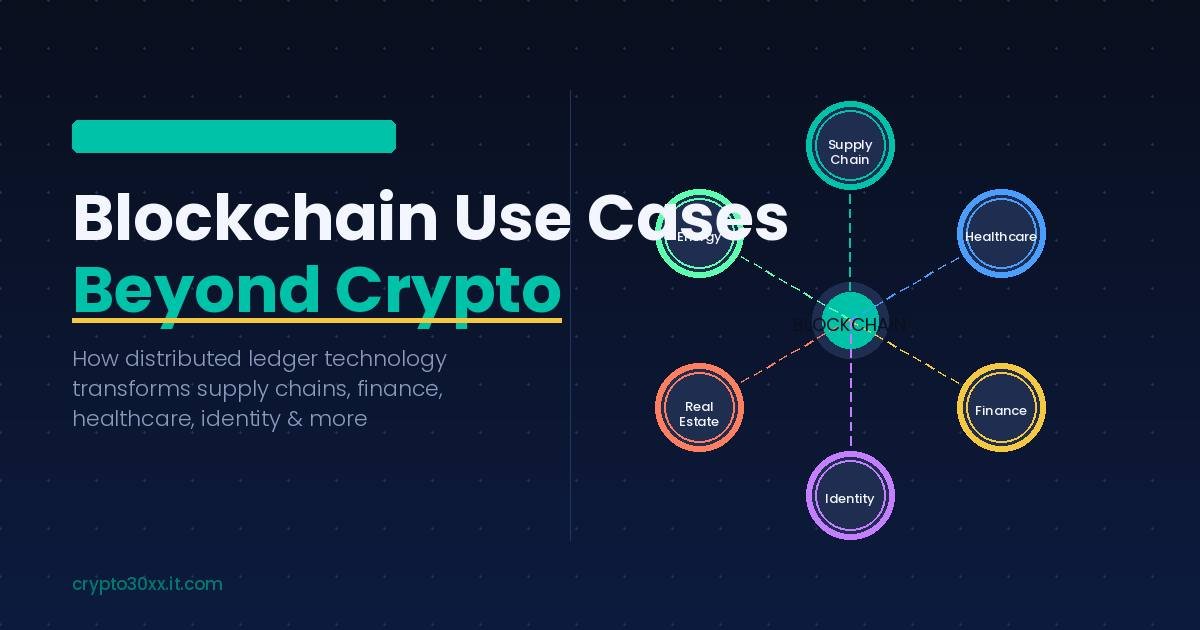
Blockchain is a distributed ledger technology that records data in cryptographically linked blocks, shared across a network of nodes, where no single party controls the record. Most people encounter it through Bitcoin or Ethereum, but the underlying architecture solves a broader problem: how do multiple parties, who do not fully trust each other, agree on a shared version of truth without a central authority? That problem exists in supply chains, hospitals, land registries, voting systems, and financial settlements. Those are precisely the domains where blockchain use cases beyond crypto are now finding real traction.
What makes blockchain useful outside of cryptocurrency?
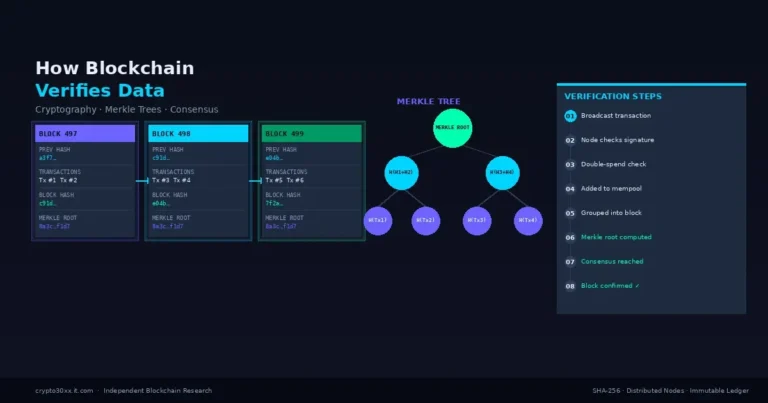
Blockchain’s value outside digital money comes down to three structural properties. First, immutability: once data is written to the chain, altering it requires rewriting every subsequent block and convincing the majority of the network to accept the change, a prohibitively expensive task on well-established networks. Second, transparency: every participant in a permissioned network (or any observer on a public chain) can verify the record independently. Third, programmability: smart contracts (self-executing code stored on the blockchain) can automate agreements the moment predefined conditions are met, without a human intermediary pressing a button.
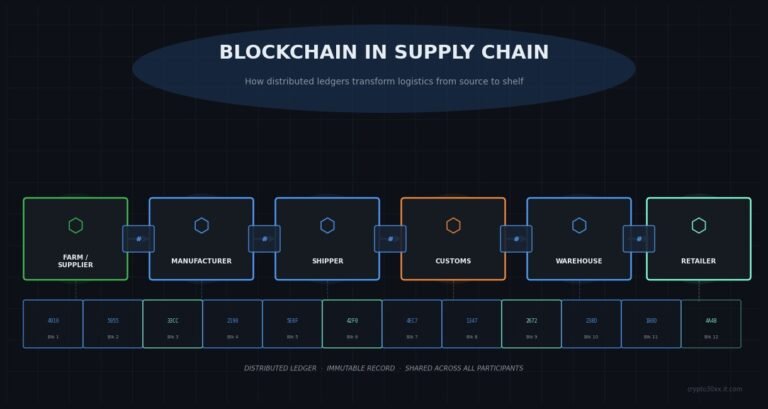
These properties matter most when multiple organizations need to share a single source of truth but have competing interests. A manufacturer, a logistics company, a customs authority, and a retailer all want to track the same shipment, but none of them wants to rely on a database the others control. A shared, tamper-resistant ledger resolves that tension structurally.
Permissioned vs. public blockchains in enterprise contexts
Not all enterprise blockchain deployments use public networks like Ethereum. Many organizations deploy permissioned blockchains, where participation is restricted to approved parties. Hyperledger Fabric, developed under the Linux Foundation umbrella, is a widely adopted permissioned framework. Participants are known, transactions can be kept confidential from non-relevant parties, and throughput is far higher than on public chains.
The distinction matters for evaluating use cases. Public blockchains offer maximal censorship resistance; permissioned blockchains offer speed, privacy, and regulatory compatibility. Most of the enterprise deployments described in this article use permissioned or hybrid architectures.
How does blockchain work in supply chain management?
In supply chain management, blockchain creates a shared, append-only record of every event a product passes through, from raw material sourcing to the point of sale. Each event (a shipment scan, a quality inspection, a customs clearance) is recorded as a transaction. The record is visible to all authorized participants and cannot be quietly changed after the fact.
The practical result is end-to-end traceability. When a contamination event occurs in a food supply chain, identifying the source traditionally takes days of document requests across multiple parties. With a blockchain-based system, the same trace can take seconds, because the provenance data is already structured, shared, and immutable.
Documented enterprise deployments
Walmart partnered with IBM to use Hyperledger Fabric for tracing leafy greens in its supply chain. The stated goal was reducing trace time from roughly seven days to under three seconds in internal tests, a figure IBM Food Trust has cited in published documentation.
De Beers developed the Tracr platform to track diamonds from mine to retailer, creating verifiable provenance records that help distinguish ethically sourced stones from conflict diamonds.
Maersk, the shipping company, collaborated with IBM on TradeLens, a platform designed to digitize global trade documentation. The project was later discontinued. It serves as a useful reminder that technical feasibility does not guarantee commercial sustainability in consortium-based blockchain projects.
Where supply chain blockchain still struggles
The dominant unsolved problem is data entry at the origin point. A blockchain record is only as accurate as the data written to it. If a supplier falsely records a shipment weight or a quality score at the point of entry, the blockchain faithfully and immutably preserves that false record. This is sometimes called the oracle problem: blockchain cannot verify the real world, only what participants report about it.
Physical verification mechanisms (IoT sensors, third-party auditors, cryptographic attestations) are being combined with blockchain to address this, but it remains an active challenge.
How is blockchain used in healthcare?
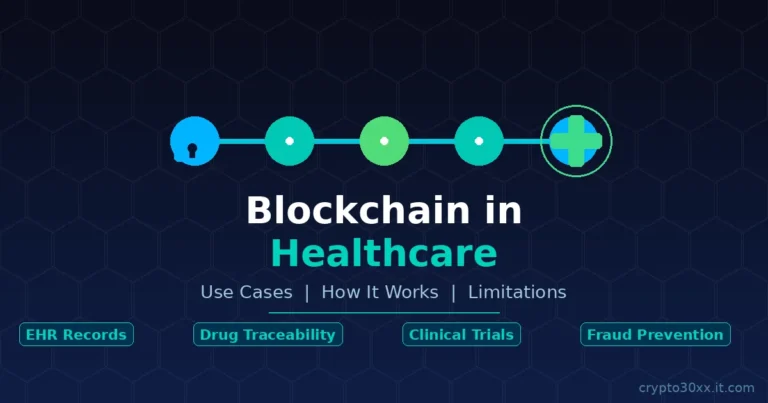
Healthcare involves some of the most sensitive data in existence, shared among parties (patients, hospitals, insurers, pharmacies, research institutions) who each have different access rights and different incentives. Blockchain addresses specific structural problems in this space.
Electronic health record management
Patient records are notoriously fragmented. A person treated at three different hospital systems often has three separate records with no automated reconciliation. A permissioned blockchain can provide a shared index, not storing the full records themselves but providing a cryptographically verified pointer to where authorized data resides and who has accessed it. The patient can control access grants and revocations, and every access event is logged immutably.
Projects like MedRec, a research initiative from MIT, explored this model. The approach does not replace existing electronic health record systems but creates a coordination layer between them.
Pharmaceutical supply chain integrity
Counterfeit medicines are a documented global problem, particularly in markets with limited regulatory oversight. Blockchain-based drug traceability systems record the chain of custody from manufacturer to distributor to pharmacy. Each handoff generates a transaction on the shared ledger. A pharmacist or patient can verify the drug’s provenance before dispensing or consuming it.
The U.S. Drug Supply Chain Security Act (DSCSA) has driven pharmaceutical companies to implement electronic traceability systems, and several have piloted blockchain-based solutions as part of compliance infrastructure.
Clinical trial data integrity
Clinical trials require that data be recorded accurately and that protocol changes be documented. Researchers have explored using blockchain to timestamp trial registrations and record amendments, making it more difficult to selectively report results (a practice known as outcome switching) after observing results. The immutability of the record provides a form of pre-commitment that journals and regulators can verify.
What are blockchain use cases in financial services?
Financial services were the first non-currency domain to seriously explore blockchain, and adoption here is the most mature. The relevant applications are distinct from cryptocurrency trading.
Cross-border payments and settlement
Traditional international wire transfers route through correspondent banking networks, adding 1–5 business days and multiple fee layers. Blockchain-based payment rails can settle transactions in minutes, with full auditability of the transfer path. Several central banks have explored or launched wholesale central bank digital currency (CBDC) infrastructure that uses distributed ledger technology for interbank settlement.
Trade finance
Letters of credit, bills of lading, and other trade finance documents are still largely paper-based in many markets. A single trade transaction can involve 20 or more organizations exchanging dozens of documents. Digitizing these on a shared ledger reduces processing time, eliminates document duplication, and speeds up financing decisions. HSBC and other major banks have conducted live trade finance transactions on blockchain platforms.
Asset tokenization
Real-world assets (real estate, private equity, bonds, commodities) can be represented as digital tokens on a blockchain. Tokenization enables fractional ownership: a commercial building worth $10 million can be divided into tokens representing $1,000 stakes, making the asset accessible to a far wider investor base. It also enables programmable compliance, where smart contracts automatically enforce transfer restrictions required by securities regulations.
The tokenization of real-world assets (RWAs) has attracted serious institutional attention. The structural question is whether the liquidity and accessibility gains outweigh the new technical and regulatory risks introduced.
How is blockchain applied to digital identity?
Identity verification involves a fundamental asymmetry: users must share personal data with organizations to prove who they are, but those organizations then hold sensitive data they can misuse, lose, or have stolen. Blockchain-based digital identity systems attempt to rebalance this by giving individuals control over their own credentials.
Self-sovereign identity (SSI)
Self-sovereign identity is a model where the individual holds their own verified credentials, issued by trusted authorities like governments or universities, and presents only the specific attributes needed for a given interaction. A blockchain serves as the trust anchor: the decentralized registry where the cryptographic identifiers (DIDs, or Decentralized Identifiers) are recorded and can be verified by anyone without contacting the original issuer.
In a practical example: instead of presenting a passport to prove age, a person would present a cryptographic proof that a trusted government authority has verified they are above a certain age, without revealing their name, date of birth, or document number. The verification happens on-chain; the sensitive data never leaves the individual’s control.
KYC and AML compliance
Financial institutions spend significant resources re-verifying customer identity for Know Your Customer (KYC) and Anti-Money Laundering (AML) compliance. If a customer’s identity has been verified once by an authorized institution and that verification is recorded on a shared ledger, other institutions could rely on it directly, reducing duplication and associated cost. Several consortium-based KYC blockchain projects have been piloted in banking, though regulatory acceptance of shared KYC infrastructure varies by jurisdiction.
Government credentials and civil registry
Estonia has built one of the most documented government blockchain deployments, using its KSI (Keyless Signature Infrastructure) blockchain to secure health records, land registry, and legislative processes. The system does not store the data on-chain but uses the blockchain to provide tamper evidence: a cryptographic hash of each record is timestamped, meaning any alteration to the underlying data is immediately detectable.
What are the real limitations of blockchain for non-crypto applications?
Understanding where blockchain fails is as analytically important as understanding where it succeeds. Several recurring structural limitations affect most non-crypto deployments.
Scalability and throughput
Public blockchain networks process transactions far more slowly than centralized systems. Bitcoin processes roughly 7 transactions per second; Ethereum’s base layer handles 20–30. Visa’s network has a stated capacity exceeding 24,000 transactions per second. Layer 2 solutions (rollups, state channels) improve throughput significantly, but they add architectural complexity and new trust assumptions.
For enterprise deployments on permissioned chains, throughput is less constrained. Hyperledger Fabric can handle thousands of transactions per second in controlled environments, but performance still degrades under load and with network scale.
Interoperability between chains
There are thousands of distinct blockchain networks, most of which cannot communicate with each other natively. An enterprise building on Hyperledger Fabric cannot easily exchange data with one building on Ethereum or a different permissioned network. This fragmentation limits the value of shared ledgers in multi-industry ecosystems. Cross-chain interoperability protocols exist but introduce their own complexity and security surface.
The oracle problem
As noted in the supply chain section, blockchain cannot verify real-world data at the point of entry. Smart contracts can only execute on data that has been written to the chain. If that data is inaccurate, the automation is accurate but wrong. Oracle networks (Chainlink being the most widely deployed) provide decentralized data feeds, but they shift rather than eliminate the trust problem.
Regulatory uncertainty
The legal status of blockchain-recorded assets, smart contracts, and tokenized securities varies significantly across jurisdictions. A property title recorded on a blockchain has legal standing in some countries and none in others. This uncertainty slows institutional adoption in regulated industries and complicates cross-border deployments.
| Limitation | Description | Mitigation approaches |
|---|---|---|
| Scalability | Low TPS on public chains | Layer 2 solutions, permissioned networks |
| Interoperability | Chains cannot natively communicate | Cross-chain protocols, standardization efforts |
| Data integrity at source | Blockchain records what it is told | IoT integration, third-party attestation |
| Regulatory uncertainty | Legal frameworks vary widely | Jurisdiction-specific legal analysis |
| Integration cost | Legacy system compatibility | Middleware layers, phased deployment |
Beyond the obvious sectors: energy, media, and governance
Energy grid and carbon credits
Energy producers using solar or wind generation can record output on a blockchain to create verifiable renewable energy certificates. Buyers of these certificates can verify the generation event independently, rather than relying on intermediaries. Several projects have also explored peer-to-peer energy trading between households with solar panels, using smart contracts to automate settlement.
Carbon credit markets have faced persistent problems with double-counting and verification fraud. Blockchain-based carbon registries provide a single, non-duplicable ledger of credit issuance and retirement.
Media rights and royalties
Content creators (musicians, writers, photographers) often struggle to receive payment when their work is used. Smart contracts can be programmed to distribute royalty payments automatically each time a piece of content is accessed or licensed, without requiring a centralized platform to process the payment. The payment logic is on-chain and executes without requiring trust in any particular intermediary.
This application is technically elegant but faces adoption friction: it requires content distribution platforms to integrate with smart contract infrastructure, which most have little commercial incentive to do.
Voting systems
Blockchain-based voting has attracted significant research attention and significant skepticism. The theoretical appeal is a tamper-resistant public record of votes, without a central authority that could manipulate the count. The practical concerns are serious: voter authentication without a trusted third party is unsolved; smart devices used for voting introduce their own attack vectors; and the privacy requirement for ballots (which must be secret) conflicts with blockchain’s transparency.
Most security researchers consider blockchain an immature solution for general elections at present, though it has been tested for limited use cases such as shareholder votes and municipal referendums in controlled contexts.
FAQs
Does blockchain require cryptocurrency to function? No. Cryptocurrency is one application of blockchain technology, not a requirement of it. Permissioned blockchains used in enterprise settings typically operate without a native currency or token. The distributed ledger and smart contract functionality can be used independently of any digital asset.
What is the difference between a public and a permissioned blockchain? A public blockchain allows anyone to participate as a node, validator, or user. Bitcoin and Ethereum are the most prominent examples. A permissioned blockchain restricts participation to approved parties. Permissioned networks are faster, more private, and more compliant with regulatory requirements, which is why most enterprise deployments use them.
Can blockchain replace existing databases? In most cases, no. Blockchain is structurally suited to multi-party environments where no single participant should control the data. For single-organization data storage, a conventional database is faster, cheaper, and simpler. The correct question is not “should we use blockchain?” but “do we have a multi-party trust problem that blockchain’s structure solves?”
What is a smart contract? A smart contract is code stored on a blockchain that executes automatically when specified conditions are met. If a shipment is recorded as delivered by a verified sensor, a smart contract can release payment without manual authorization. The code is public, auditable, and not controlled by any single party.
How does blockchain handle data privacy if it is transparent? Different techniques address this. Permissioned blockchains restrict who can see which transactions. Zero-knowledge proofs allow one party to prove a fact (such as holding a valid credential) without revealing the underlying data. Hash-based anchoring, as used in Estonia’s system, puts only a fingerprint of data on-chain rather than the data itself.
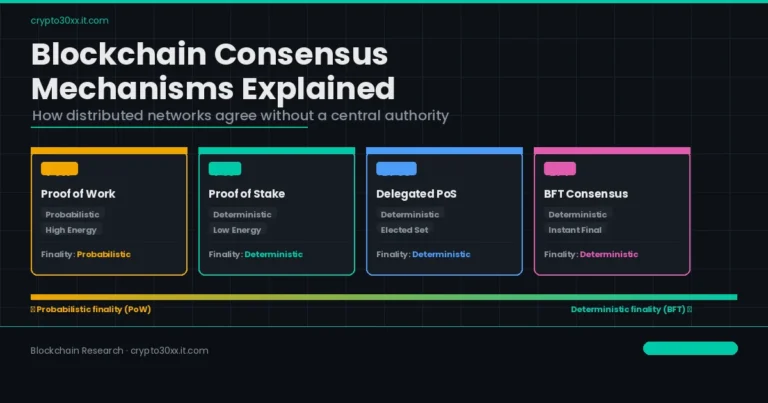
Is blockchain energy-intensive? It depends on the consensus mechanism. Bitcoin uses proof-of-work, which is computationally and therefore energetically expensive by design. Ethereum switched to proof-of-stake in 2022, reducing its energy consumption by an estimated 99.95% according to the Ethereum Foundation’s published analysis. Permissioned blockchains using consensus mechanisms like PBFT or Raft consume energy comparable to conventional distributed systems.
Are blockchain records truly permanent? On well-established public networks with many nodes, altering historical records is computationally prohibitive. On smaller networks with fewer validators, a majority attack (sometimes called a 51% attack) is theoretically possible and has occurred on smaller proof-of-work chains. Permissioned networks have different governance structures; a consortium of organizations could theoretically agree to alter records if governance rules permit it.
Disclaimer
This article is produced by crypto30xx.it.com as an independent educational resource for learners and researchers. Nothing in this guide constitutes financial, legal, or investment advice. Blockchain technology applications described here carry technical, regulatory, and operational risks that vary by jurisdiction and implementation context. Readers should consult qualified professionals before making decisions based on any technology or investment described.
The core insight running through every blockchain use case beyond crypto is the same: blockchain is not generally useful as a replacement for a database. It is specifically useful when multiple parties with different interests need to agree on a shared record, and when the cost of trusting a central intermediary is too high. Supply chains, healthcare data coordination, cross-border settlements, and identity verification all share that structure. Where that structure is absent, so is a coherent case for using blockchain at all.
The technology’s limitations (the oracle problem, interoperability gaps, regulatory uncertainty) are real and should inform any serious evaluation. The sectors making the most measurable progress are those treating blockchain as infrastructure for a specific trust problem, not as a general solution looking for a problem.
Explore expert tips that will help you solve real-world challenges—start reading our heartfelt help now.