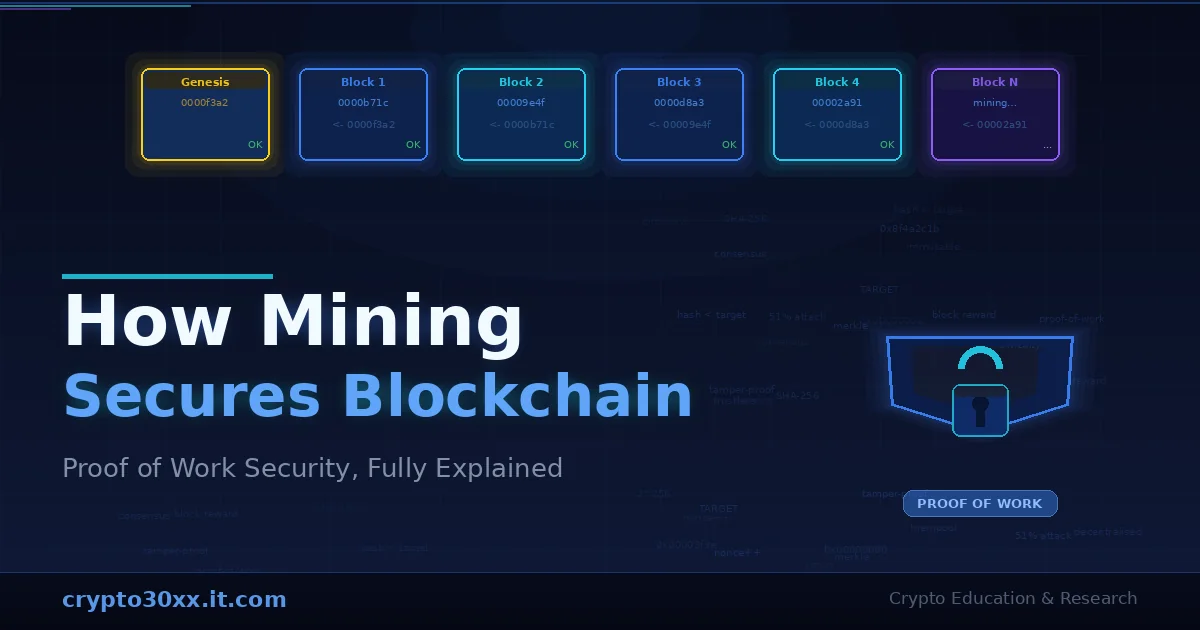
How mining secures blockchain networks: complete guide
How mining secures blockchain networks: Mining secures a blockchain by requiring every participant who wants to add a new block to prove they expended real, verifiable computational work. This work cannot be fabricated, cannot be skipped, and costs real-world energy to produce. The proof anchors each block to an irreversible expenditure of resources. Because reversing any confirmed transaction would require redoing that work for every subsequent block faster than the honest network, the economics of attack become prohibitive at meaningful scale. This guide explains the complete mechanism, from hash functions and nonces through difficulty adjustment and economic incentives, for crypto learners, analysts, and researchers who want to understand why proof-of-work blockchains resist tampering at a structural level.
What is blockchain mining?
Blockchain mining is the process by which specialized computers compete to add new transaction records to a public ledger by solving a computationally intensive mathematical puzzle. The winner earns the right to append the next block and receives a protocol-defined reward: newly issued coins plus any transaction fees included in that block. The puzzle is not useful in the conventional sense; its value is the verifiable cost it imposes, which is precisely what gives mining its security function.
The role of the miner
Miners collect unconfirmed transactions from the network’s memory pool (the mempool), bundle them into a candidate block, and race to find a valid solution to the hash puzzle for that block. The first to find a valid solution broadcasts it to the network. Other nodes independently verify the solution and, if valid, append the block and begin building on top of it.
Verification is nearly instant. Finding the solution requires billions of attempts per second. This asymmetry is the foundational security insight.
Block structure basics
Each block contains three main components:
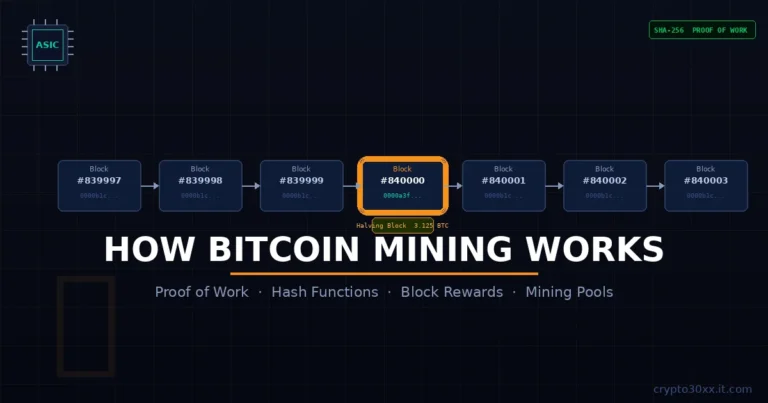
- A block header, which includes the hash of the previous block, a timestamp, a difficulty target, and a nonce
- A transaction list, recording the actual transfers confirmed in the block
- A Merkle root, a single cryptographic fingerprint summarizing every transaction in the block
The reference to the previous block’s hash is what creates the “chain” in blockchain, and it is the structural reason why mining-based security has a compounding effect over time.
How does proof of work create security?
Proof of work creates security by making block production computationally expensive and block verification trivially cheap. Producing a valid block requires enormous computation. Verifying that a block is valid takes milliseconds on any modern device. This asymmetry (expensive to produce, cheap to check) is the mechanism that transforms computational effort into structural trust, and it underlies every other security property of a mining-based network.
The hash function explained
A hash function takes any input of any length and produces a fixed-length output called a hash or digest, which appears random but is fully deterministic. Bitcoin uses SHA-256 (Secure Hash Algorithm, 256-bit), which always produces a 256-bit output regardless of input size.
Three properties make hash functions central to mining security:
- Deterministic: the same input always produces the same output
- Pre-image resistant: given a hash output, reverse-engineering the input is computationally infeasible
- Avalanche effect: changing even a single character in the input changes the output entirely and unpredictably
There is no mathematical shortcut to finding an input that produces a hash below a specific target. Miners must try billions of inputs per second until one produces a valid result.
The nonce and the difficulty target
The nonce (short for “number used once”) is a 32-bit field in the block header that miners increment with each attempt. The difficulty target is a threshold: a valid block hash must begin with a certain number of leading zeros, making the valid output space extremely small relative to all possible 256-bit outputs.
For illustration: if the protocol requires a hash beginning with 20 consecutive hexadecimal zeros, only roughly one in every 2^80 possible inputs qualifies. Miners produce trillions of hash attempts per second to find one that falls below the target.
Higher difficulty means more leading zeros required. More leading zeros means more attempts needed. More attempts means more energy consumed per valid block.
Why valid blocks are hard to fake
To insert a fraudulent block containing a fabricated transaction, an attacker must accomplish two things. First, find a valid hash for the fraudulent block, which requires the same enormous computational effort as any honest miner. Second, build enough additional valid blocks on top of the fraudulent one to outpace the honest network’s continuing chain.
Step two is where mining security truly operates. The attacker is not racing to produce one block; they are racing to produce a continuously longer chain than the entire honest network, simultaneously.
The chain of trust: why altering history is nearly impossible
Each block stores the hash of the block immediately before it. This single structural decision creates a compounding security effect: any modification to an older block changes its hash, which invalidates the hash reference in the next block, which invalidates the one after that, cascading forward through every subsequent block. The deeper in the chain a block sits, the more damage a single alteration propagates.
Merkle trees and data integrity
Transactions within a block are organized into a Merkle tree, a binary tree of hashes where each parent node is the hash of its two children. The root of this tree (the Merkle root) is stored in the block header. Changing even one transaction would change the Merkle root, which changes the block header, which changes the block hash, which breaks the reference in every block built on top.
This structure seals the entire history of a block’s transactions into a single cryptographic value that propagates through the chain.
Chain linkage and cumulative work
The deeper a block sits in the chain, the more total computational work is embedded in all the blocks built above it. An attacker hoping to rewrite a transaction confirmed 100 blocks ago must redo 100 blocks of proof of work faster than the honest network keeps adding new blocks in real time.
A widely cited observation: in Bitcoin, transactions become practically irreversible after six confirmations. Not because of a protocol rule, but because the probability of successfully reorganizing six confirmed blocks drops to negligible levels given the network’s total hash rate. The probability falls exponentially with each additional confirmation added.
Economic incentives as a security layer
The cryptographic barriers above explain the technical difficulty of attack. The economic structure explains why rational, well-resourced actors are unlikely to attempt one even if they had sufficient hardware. Mining security is not purely mathematical; it is also behavioral, shaped by the financial consequences that fall on anyone who tries to subvert the system they depend on for income.
Block rewards and transaction fees
Miners receive two income streams from each valid block they add to the chain: a block reward (newly issued coins defined by the protocol) and the sum of transaction fees from every transaction in the block. Both are only collectible if the network accepts the block as valid and honest.
A miner who produces an invalid or dishonest block collects nothing. The hardware and electricity costs are spent regardless. This alignment of financial interest is not incidental — it is a core design feature of the proof-of-work model.
The cost-of-attack calculation
The primary threat to a proof-of-work network is a 51% attack, discussed in detail below. Executing one requires controlling more than half the network’s total hash rate, which means acquiring hardware that matches or exceeds the combined investment of every honest miner on the network.
For a large network, this capital requirement can run into hundreds of millions of dollars before a single block is reorganized. The moment such an attack becomes public, the targeted asset typically loses market value, reducing or eliminating whatever gain the attacker sought. Honest mining is reliably profitable; attacking a functional network you depend on for income is not.
The difficulty adjustment: a self-regulating defense
The difficulty target is not fixed. Most proof-of-work protocols recalculate it automatically at regular intervals to maintain a consistent average block time. Bitcoin’s protocol recalibrates every 2,016 blocks, roughly every two weeks, based on how long those blocks actually took relative to the 10-minute target.
If blocks arrived faster than the target (meaning hash rate increased), the next period’s difficulty rises. If blocks arrived slower (meaning hash rate fell), difficulty drops. Block time is the stabilized variable.
This mechanism has two distinct security implications. Sudden surges in mining participation do not permanently accelerate block production, because rising difficulty normalizes the rate. An attacker flooding the network with temporarily rented hash power gains no lasting advantage, because after the adjustment window the cost structure reasserts itself. The difficulty adjustment is also why proof-of-work security scales with adoption: more miners mean higher hash rate, higher hash rate means higher attack cost, and the difficulty adjusts automatically to maintain that relationship.
How mining secures blockchain: risks and limitations
Mining-based security has genuine, well-documented strengths. It also carries structural limitations that become more significant in networks with lower total hash rate. A complete technical analysis means examining both the protections and the attack vectors that proof-of-work does not fully eliminate.
The 51% attack
A 51% attack occurs when a single entity controls the majority of a network’s hash rate. With that control, an attacker can temporarily block new transactions from confirming and double-spend coins by secretly mining an alternative chain and releasing it to overwrite recent transaction history.
What they cannot do is create coins from nothing, steal from wallets they do not control the private keys to, or reverse transactions buried many hundreds of blocks deep. The scope is real but bounded.
Smaller proof-of-work networks with low total hash rates are measurably more exposed. Several altcoins have suffered verified 51% attacks because their hash rates were low enough that renting computational power from mining rental services made the attack economically viable. Bitcoin’s aggregate hash rate makes a practical 51% attack economically impractical at any meaningful scale.
Mining pool concentration
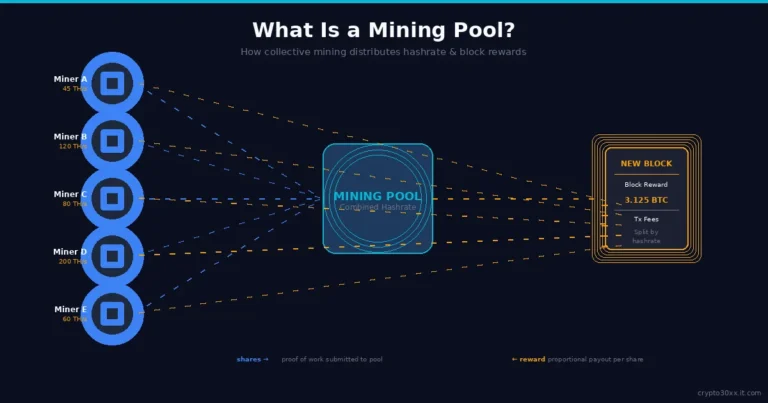
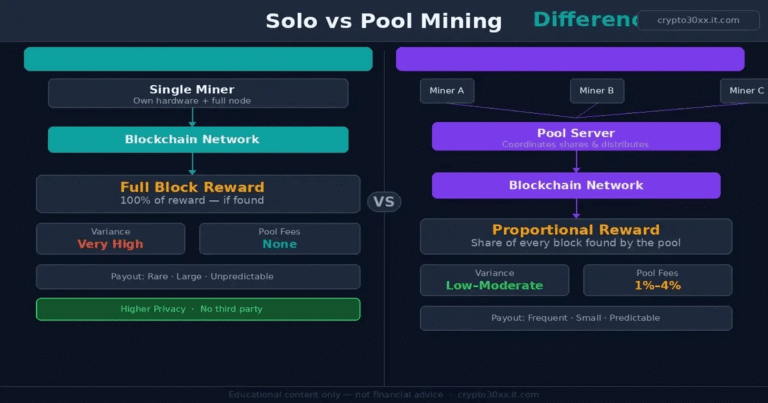
Mining pools aggregate hash rate from many individual miners to smooth out variance in block reward income. When a small number of pools collectively control a large share of total network hash rate, the theoretical proximity to 51% control becomes a structural observation worth monitoring.
In practice, pool members can redirect their hardware to a different pool at any point. Pool operators depend on trust as their primary competitive asset, which provides a strong disincentive to abuse their position.
Selfish mining
Selfish mining is a theoretical strategy in which a miner with significant hash rate withholds a found block temporarily, then releases it at a calculated moment to orphan blocks found by honest miners. If successful, the selfish miner earns a disproportionate share of block rewards without needing majority hash rate.
This strategy is difficult to execute reliably, detectable through network monitoring, and countered by the way most modern mining clients handle block propagation. It remains a relevant theoretical model but has not been demonstrated at scale on major networks.
Energy consumption and security trade-offs
The proof-of-work security model explicitly requires that real-world resources be consumed. This is both the mechanism of protection and its most persistent criticism. The energy expenditure is not a flaw; it is the cost of the security guarantee, but that does not resolve legitimate questions about scalability.
Alternative consensus mechanisms, particularly proof of stake, attempt to achieve security without physical energy expenditure, using economic stake as the deterrent instead. The trade-offs between these models are substantive and remain an active area of protocol research.
Mining vs. other consensus mechanisms
Proof of work is one approach to achieving fault-tolerant consensus in a decentralized network. Other consensus mechanisms reach the same goal through different trade-offs, each prioritizing different properties. The table below compares the primary dimensions across the three most widely deployed models.
| Feature | Proof of work (mining) | Proof of stake | Delegated PoS |
|---|---|---|---|
| Security mechanism | Computational cost | Economic stake + slashing | Elected validators + stake |
| Primary attack cost | Hardware + electricity | Acquiring majority stake | Corrupting delegate majority |
| Energy consumption | High | Low | Low |
| Decentralization risk | Pool and hardware concentration | Wealth concentration | Delegate oligopoly |
| Notable examples | Bitcoin | Ethereum (post-Merge) | EOS, Tron |
| Transaction finality | Probabilistic, depth-based | Often deterministic | Fast and deterministic |
No consensus mechanism is unconditionally superior. Each reflects a set of design trade-offs chosen based on specific security priorities and operational constraints.
FAQs
Does mining secure a blockchain permanently? Mining secures a blockchain as long as honest participants collectively hold more hash rate than any single attacker. Security is probabilistic and grows with the network’s total computational power. Transactions buried many blocks deep become practically irreversible, but the underlying model depends on sustained honest participation at sufficient scale.
What happens to blockchain security when block rewards decrease? Some proof-of-work protocols reduce block rewards on a fixed schedule. As rewards decline, security must increasingly be sustained by transaction fee revenue alone. Whether fees will reliably provide sufficient long-run miner participation is an unresolved question in protocol economics and an active area of research.
Can someone hack a blockchain by compromising a mining pool? Compromising a mining pool’s infrastructure could temporarily redirect its hash power, but would not alter the cryptographic structure of the chain itself. Pool members can switch to alternative pools immediately, and the window of potential damage is narrow compared to what a genuine majority hash rate attack could achieve.
How does mining prevent double-spending? Mining prevents double-spending by requiring that any transaction be confirmed in a block that required real computational work to produce. To reverse a confirmed transaction, an attacker must redo that work and every block built on top, faster than the honest network continues building. The cost grows exponentially with each additional confirmation.
What is a 51% attack in simple terms? A 51% attack is when one entity gains majority control of a network’s mining power and uses it to rewrite recent transaction history, most commonly to spend coins and then reverse that transaction, effectively spending the same coins twice. Networks with lower total hash rate face meaningfully higher risk.
How many confirmations make a transaction effectively secure? The answer depends on the network and transaction value. Bitcoin’s six-confirmation convention is widely used because the probability of a successful chain reorganization drops to negligible levels at that depth under normal conditions. High-value transfers may warrant waiting for additional confirmations beyond that baseline.
Is proof of stake more secure than proof of work? The two models use different mechanisms. Proof of work relies on physical computation; proof of stake relies on economic stake subject to slashing penalties. Neither is unconditionally superior — each addresses different threat models and carries distinct failure modes. Which provides adequate security depends on the specific network and the attacks it prioritizes defending against.
Disclaimer
This article is written for educational and research purposes only by an independent cryptocurrency education resource. It does not constitute financial, legal, or investment advice. Blockchain and cryptocurrency systems involve substantial technical and financial risks. Readers should consult qualified professionals before making any decisions related to digital assets.
Mining secures a blockchain through an interlocking system where cryptographic commitment, economic incentive, and self-adjusting difficulty reinforce each other. The hash function, the nonce, the difficulty target, and the block reward are not isolated features; they form a mechanism where each element depends on the others. Altering history requires outpacing the honest network, doing so costs more than honest participation, and as hash rate grows the difficulty rises automatically to preserve that balance. For researchers and analysts examining proof-of-work networks, these mechanics are the bedrock on which all security claims rest.
The most valuable thing you can read today is inside our high-return content picks.