What is ASIC in mining: how dedicated chips work and why they dominate
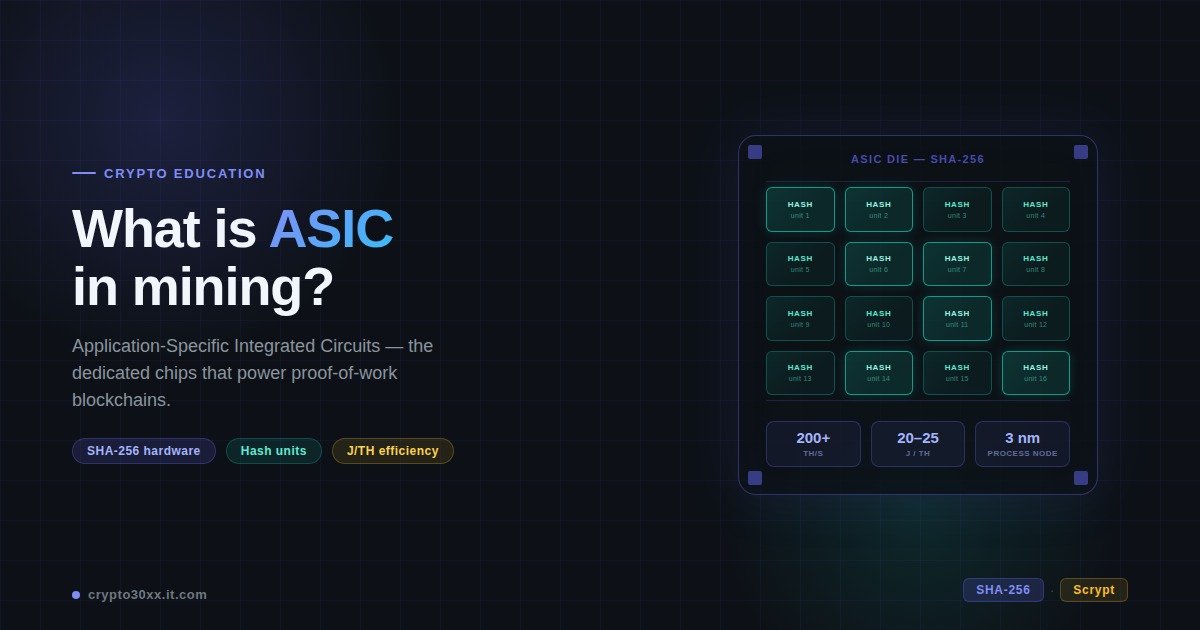
What is ASIC in mining: An ASIC miner is a piece of hardware built to perform one cryptographic computation — and nothing else. The letters stand for Application-Specific Integrated Circuit: a custom chip designed at the transistor level to solve the hash puzzle a particular blockchain uses to validate blocks. Because every circuit path on the chip exists solely for that one function, an ASIC executes it far faster and with far less electricity than a general-purpose processor ever could. That efficiency gap is why ASICs now produce the vast majority of hashrate on Bitcoin and several other major proof-of-work networks.
What does ASIC mean in the context of mining?
An application-specific integrated circuit is a chip manufactured for a single defined task rather than for general computation. In mining, that task is running a hash function millions of times per second, comparing each output to a target value, and returning a valid block header when one is found. The chip layout — its logic gates, memory cells, and data paths — is optimized entirely around that one algorithm. Nothing else runs on it.
This differs fundamentally from a CPU or GPU. A CPU is built to switch rapidly between unrelated tasks. A GPU is built to run thousands of shader operations in parallel across a flexible pipeline. Both designs carry circuitry that an ASIC miner simply does not need. That unused silicon costs power and space. An ASIC eliminates it.
The logic gate level: what makes an ASIC fast
Every digital computation ultimately reduces to logic gate operations: AND, OR, NOT, XOR. A hash function like SHA-256 — the algorithm Bitcoin miners compute — is a fixed sequence of bitwise operations applied to a 512-bit message block across 64 rounds.
When a chip designer knows the algorithm will never change, they can wire those exact operations directly into the silicon. The SHA-256 round function becomes a physical path through transistors rather than a software instruction fetched from memory. Clock cycles drop sharply. Power per operation drops with them.
A modern high-performance ASIC chip can fit hundreds of SHA-256 computation units on a single die, each running in parallel. The result is a hashrate measured in terahashes per second (TH/s) — trillions of hash attempts every second — from a chip drawing somewhere between 20 and 30 watts per terahash in competitive designs.
How ASIC miners work step by step
Understanding the hardware makes the economics easier to follow.
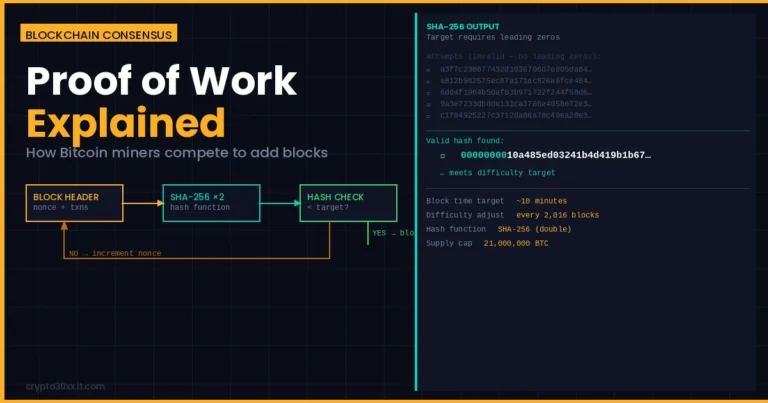
- Block header assembly: The miner’s software constructs a candidate block header — an 80-byte data structure containing the previous block hash, a Merkle root of pending transactions, a timestamp, the current difficulty target, and a 32-bit nonce field.
- Nonce iteration: The ASIC chip increments the nonce value, feeds the modified header into its SHA-256 pipeline, and checks whether the output hash falls below the current target.
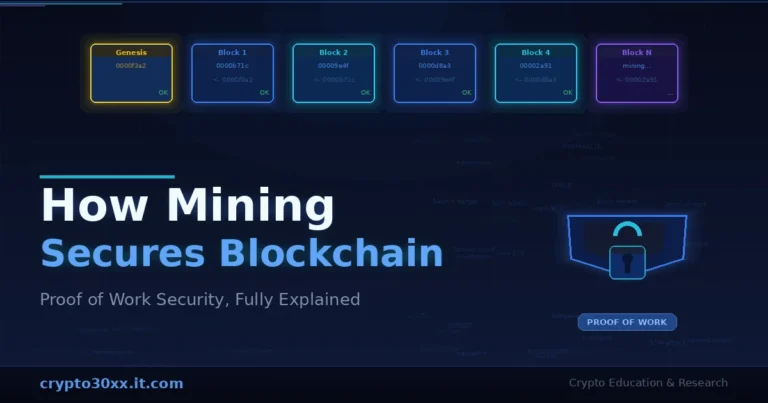
- Double-SHA-256 execution: Bitcoin’s proof-of-work applies SHA-256 twice to the same input. Both passes are hardwired into the ASIC pipeline, so no intermediate result needs to leave the chip.
- Valid block detection: When an output hash satisfies the target, the chip signals the controller board. The miner broadcasts the completed block to the network.
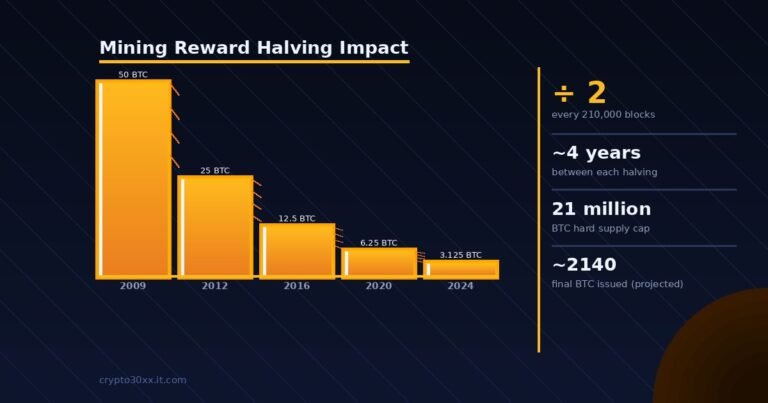
- Difficulty recalibration: Every 2,016 blocks (roughly two weeks), the Bitcoin protocol adjusts the difficulty target so that blocks continue to arrive approximately every ten minutes, regardless of how much total hashrate the network runs.
Steps 2 and 3 repeat billions of times per second. The ASIC’s sole advantage is executing them with minimal wasted energy.
Hashboards, control boards, and cooling
A commercial ASIC miner is not just a chip. It is a system. The main components are:
- Hashboards: PCBs carrying multiple ASIC chips in series. A single miner unit often contains two or three hashboards, each with dozens of chips.
- Control board: A small embedded computer running Linux-based firmware that coordinates the hashboards, connects to the mining pool, and monitors chip temperatures.
- Power supply unit (PSU): Converts AC grid power to the DC voltages the hashboards require. Power efficiency — measured in joules per terahash (J/TH) — is the primary performance metric for competitive mining.
- Cooling system: ASIC chips generate significant heat at load. Most commercial units use high-speed fans. Immersion cooling systems, where hashboards are submerged in dielectric fluid, are increasingly used in large-scale operations to reduce noise and improve thermal headroom.
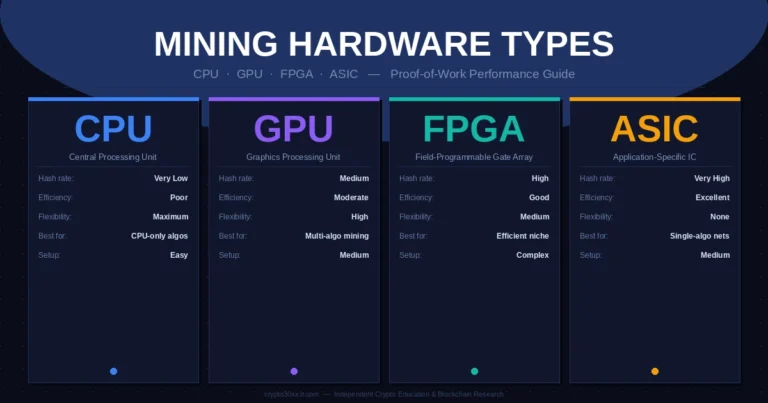
ASIC vs GPU vs CPU: what each chip actually does
The comparison matters because mining’s hardware history moved through all three.
| Feature | CPU | GPU | ASIC |
|---|---|---|---|
| Primary design goal | General task switching | Parallel graphics / compute | Single fixed algorithm |
| Hashrate on SHA-256 | ~100 MH/s | ~100–200 MH/s | ~200–300 TH/s |
| Power efficiency (SHA-256) | Very poor | Poor | Best available |
| Flexibility | Full | High | None outside target algorithm |
| Cost per unit | Low–moderate | Moderate–high | Moderate–very high |
| Resale value if algorithm changes | High (general hardware) | High (gaming / AI market) | Effectively zero |
The hashrate gap between a high-end GPU and a competitive ASIC on SHA-256 is roughly six orders of magnitude. That is not a marginal improvement. It is a structural displacement.
CPUs mined Bitcoin in 2009 when the network’s difficulty was low enough to make them viable. GPU mining became dominant around 2010–2011 as more participants joined and the difficulty climbed. ASIC miners began appearing commercially around 2012–2013, and within roughly 18 months of their introduction, GPU mining on SHA-256 became economically unviable.
Why GPUs still matter for some networks
Several proof-of-work blockchains deliberately chose memory-hard algorithms — Ethash (formerly used by Ethereum), Kawpow (Ravencoin), Autolykos (Ergo) — specifically because these algorithms require large amounts of fast memory access. Designing an ASIC that contains the required memory is significantly more expensive, and the efficiency advantage shrinks. GPUs remain competitive or even dominant on those chains as a result.
ASIC resistance: why some blockchains rejected dedicated miners
Not every blockchain community welcomed ASICs. The argument against them centers on two concerns: mining centralization and barrier to entry.
The centralization concern
When ASIC manufacturing is commercially viable, it tends to concentrate among a small number of fabrication companies. The upfront cost of designing a custom chip, negotiating access to a semiconductor foundry, and producing it at scale runs into the hundreds of millions of dollars. That makes ASIC manufacturing a business with high barriers, dominated by a few players in any given cycle.
Critics argued that ASIC dominance shifts mining from a distributed activity to an industrial one, where most hashrate sits in large facilities operated by well-capitalized entities rather than being spread across thousands of individual miners.
The algorithm modification response
Several networks responded by modifying or replacing their proof-of-work algorithm when ASIC miners emerged. Monero switched algorithms multiple times — eventually adopting RandomX, which is optimized for general-purpose CPU execution and is deliberately inefficient on ASICs and GPUs. The design uses random code execution, memory-intensive operations, and frequent algorithm variation to resist fixed-function hardware.
Vertcoin developed Verthash with a similar goal. Zcash took a different path: it launched with Equihash, which was initially memory-hard, but ASICs for Equihash eventually appeared anyway, and part of the community forked to preserve GPU mining.
The counterargument: why some communities accept ASICs
Bitcoin’s community largely accepted ASIC mining as a feature rather than a problem. The reasoning is that purpose-built hardware creates a stronger security commitment. An ASIC miner has no alternative use. If a miner attacks the network and destroys its value, the hardware becomes worthless. That economic alignment — sometimes called “skin in the game” — theoretically creates stronger incentives to behave honestly compared to a GPU miner who can simply redirect hardware to another chain.
There is a real tension here. Neither position is obviously correct. The tradeoff is between decentralization of participation (favoring ASIC resistance) and depth of committed capital securing the chain (arguably favoring ASICs).
ASIC economics: hashrate, difficulty, and miner margins
Understanding what makes a mining operation profitable requires understanding how the difficulty adjustment creates a self-regulating market.
The hashrate and difficulty cycle
When ASIC manufacturers release a new generation of more efficient hardware, miners who adopt it early gain a temporary revenue advantage. More profitable mining attracts more participants. Total network hashrate rises. The protocol’s difficulty adjustment responds — on Bitcoin, every 2,016 blocks — by raising the target difficulty proportionally. Revenue per unit of hashrate falls back toward the market equilibrium where total mining revenue approximately equals total mining cost.
This cycle has repeated with each hardware generation. Early adopters of a new ASIC generation capture above-average margins briefly. Margins compress as the new hardware becomes standard. Miners running older, less efficient units get pushed toward unprofitability first — a pattern called miner capitulation.
Illustrative profitability framework
A miner’s gross revenue depends on three variables: hashrate contribution as a percentage of total network hashrate, total block rewards paid per day, and the market price of the mined coin. Expressed differently:
Miner revenue ≈ (miner hashrate ÷ network hashrate) × daily block reward
If a miner controls 0.001% of network hashrate on a network paying 450 BTC per day in block rewards, expected gross revenue is approximately 0.0045 BTC per day before costs. Electricity is the dominant cost variable. A machine producing 100 TH/s at 30 joules per terahash draws 3,000 watts. At an electricity rate of $0.05 per kWh, that is $3.60 per day in power cost. Whether that is profitable depends entirely on the value of the block reward earned.
This is illustrative math with round numbers. Actual outcomes vary with pool fees, hardware depreciation, firmware overclocking, cooling overhead, and coin price.
ASIC generations and efficiency benchmarks
Each chip generation has produced meaningful efficiency improvements. Early commercial ASIC miners operated in the range of 1,000 joules per terahash or worse. Competitive hardware in recent years has approached 20–25 J/TH. The direction is consistent: each generation computes more hashes per watt, increasing pressure on operators running older equipment.
Common misconceptions about ASIC miners
Misconception 1: ASICs can mine any cryptocurrency
An ASIC is algorithm-specific, not blockchain-specific. An ASIC designed for SHA-256 cannot mine Litecoin (Scrypt) or Monero (RandomX). Different algorithms require entirely different chip designs. Litecoin and Dogecoin, both using Scrypt, do share compatible ASICs. But SHA-256 ASICs and Scrypt ASICs are completely separate product lines.
Misconception 2: More hashrate always means more revenue
Hashrate is relative to the network. Adding hashrate increases expected revenue only until the difficulty adjustment incorporates it — which Bitcoin’s protocol does every two weeks. A miner doubling their hashrate on a static network doubles their share, but network-wide hashrate growth means expected per-unit-of-hashrate revenue trends downward over time.
Misconception 3: ASIC mining is passive income
Operating commercial ASIC hardware involves real ongoing work: monitoring firmware, managing pool connections, maintaining cooling systems, managing power contracts, and replacing failed hashboards. Large-scale operations run 24/7 monitoring. The hardware itself degrades over time; fan replacements and chip failures are routine maintenance items.
Misconception 4: ASICs made small miners completely irrelevant
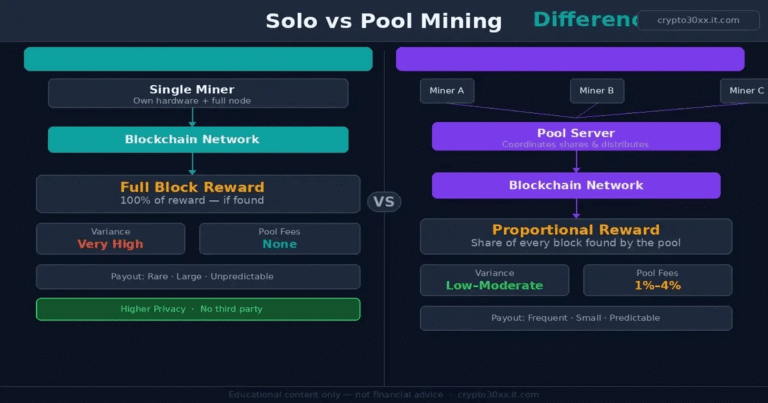
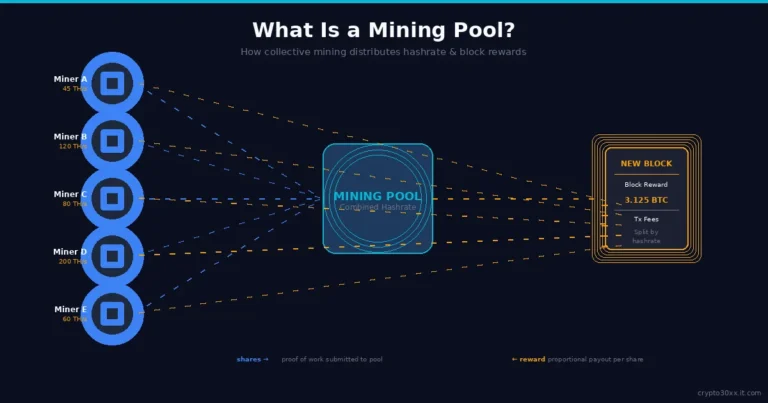
Mining pools changed this dynamic. A solo miner with a single ASIC unit contributes to a pool’s combined hashrate and receives proportional payouts minus pool fees. While the probability of a solo miner finding a block independently is extremely low on high-hashrate networks, pool participation means predictable smaller payouts rather than sporadic large ones. Small-scale mining still exists; it is just pool-dependent.
FAQs
What is an ASIC miner in simple terms? An ASIC miner is a piece of hardware built from the ground up to compute one specific cryptographic algorithm — the hash function used by a particular blockchain. It does this faster and more efficiently than any general-purpose hardware, but it cannot run other software or mine coins that use a different algorithm.
What does ASIC stand for? ASIC stands for Application-Specific Integrated Circuit. “Application-specific” means the chip is designed for one task rather than general computation. “Integrated circuit” refers to the transistors, logic gates, and data paths embedded together on a single chip die.
Can ASIC miners mine Bitcoin and Ethereum? Bitcoin uses SHA-256, and ASIC miners designed for it are widely available. Ethereum switched from proof-of-work to proof-of-stake in the Merge, so there is no longer a mining process for Ethereum and no relevant ASIC market for it. Attempting to use a Bitcoin SHA-256 ASIC to mine an Ethash algorithm chain would produce no meaningful result.
What is the difference between ASIC mining and GPU mining? GPU mining uses graphics cards that can run many different algorithms across many different coins. ASIC mining uses purpose-built chips optimized for one specific algorithm. On algorithms where ASICs exist, they outperform GPUs by several orders of magnitude in both hashrate and power efficiency. GPUs retain an advantage on memory-hard algorithms that resist custom chip design.
What is ASIC resistance? ASIC resistance refers to a proof-of-work algorithm’s design that makes building an efficient dedicated chip difficult or uneconomical. Techniques include requiring large amounts of fast memory (which is expensive to include on a custom chip), introducing random or variable computation patterns, and designing the algorithm to favor CPU-accessible instruction sets. No algorithm is permanently ASIC-resistant — given enough financial incentive, custom hardware can be built for almost any fixed computation.
How long do ASIC miners last? Physically, the hardware can run for several years with proper maintenance. Economically, the useful lifespan depends on how quickly the next hardware generation improves efficiency. A machine that is competitive today may become unprofitable within two to four years as more efficient hardware enters the market and network difficulty rises accordingly.
What is joules per terahash (J/TH)? Joules per terahash is the standard efficiency metric for ASIC miners. It measures how much energy the machine consumes to produce one trillion hash computations. Lower is better. A machine rated at 20 J/TH draws 20 joules of electrical energy per trillion hashes produced, making it more efficient than a machine rated at 40 J/TH.
Do ASIC miners generate a lot of heat and noise? Yes. Commercial ASIC units run cooling fans at high speeds — often producing noise levels in the range of 70–80 decibels, similar to a loud vacuum cleaner. Heat output is proportional to power draw; a machine drawing 3,000 watts produces roughly 3,000 watts of thermal energy that must be removed from the operating environment. Industrial mining facilities manage this with large-scale ventilation, immersion cooling, or both.
Disclaimer
This article is written for educational and research purposes. It explains how ASIC mining hardware works as a factual and technical topic. Nothing in this article constitutes financial advice, investment guidance, or a recommendation to purchase mining hardware, cryptocurrencies, or any related asset. Mining involves real financial risk, including hardware depreciation, energy costs, and the possibility of operating at a loss. Readers should conduct independent research and, where appropriate, consult qualified professionals before making any financial or technical decisions.
Mining hardware is one of the clearest examples of how economic incentives shape technical infrastructure. When a computation has real monetary value attached to it, capital flows toward whatever performs that computation most cheaply. ASICs are the outcome of that pressure applied to proof-of-work algorithms. Whether a given blockchain chooses to accommodate or resist that pressure tells you something meaningful about what that network’s designers valued most.
Think smarter, not harder—our efficiency-boosting expert articles show you how.