What is a mining pool: how collective mining works
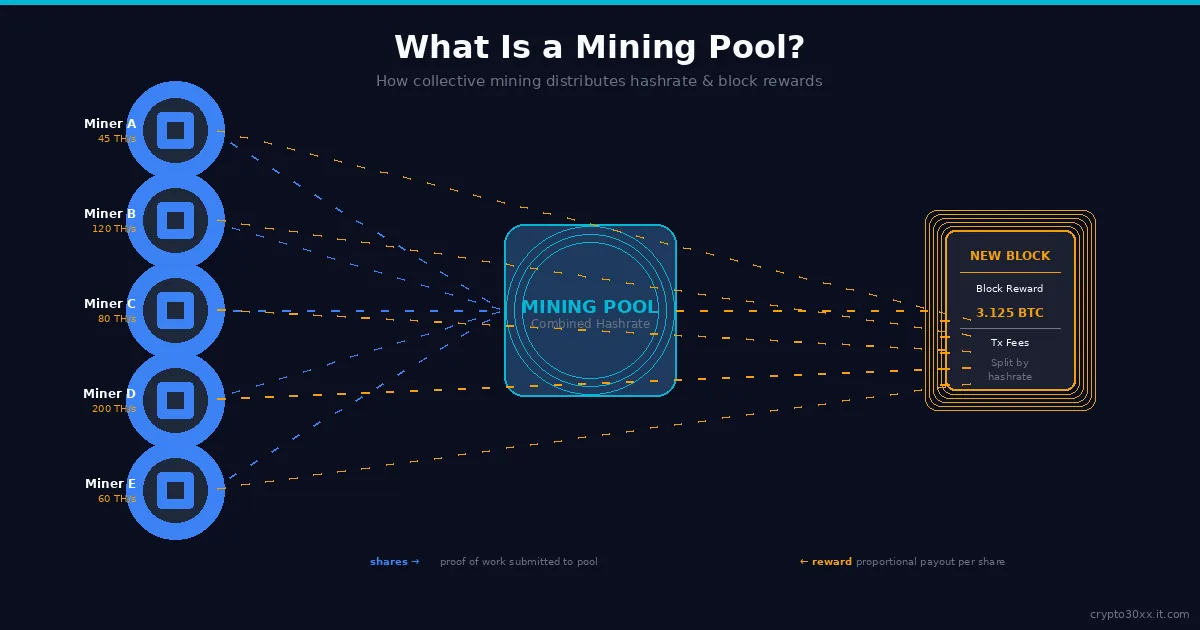
A mining pool is a group of cryptocurrency miners who combine their computational power over a shared network to improve their collective probability of finding a valid block and claiming the associated reward. When any miner inside the pool solves the cryptographic puzzle that produces a valid block hash, the entire pool receives the block reward. That reward is divided among participants in proportion to the computational work each one contributed. Solo miners face near-zero odds against a network running at hundreds of billions of hash attempts per second. Pooling transforms that near-zero chance into a measurable, regular income stream, at the cost of splitting whatever the pool earns.
What is a mining pool and why does it exist?
A mining pool exists because the odds of any single miner finding a valid block dropped from near-certain to nearly impossible as Bitcoin’s network grew. In Bitcoin’s early years, anyone with a consumer-grade CPU could mine a block roughly once a day. As more machines joined and the protocol’s difficulty adjustment raised the bar to match total network power, a single ASIC miner might statistically wait years between block discoveries. That unpredictability made solo mining economically unworkable for most participants.
The problem pools were built to solve
Bitcoin adjusts its mining difficulty every 2,016 blocks, roughly every two weeks, to keep block production averaging one block per ten minutes regardless of how much hardware joins or leaves the network. As difficulty climbs, the expected time for any individual miner to produce a valid block extends. A machine contributing 100 TH/s to a network running at several hundred exahashes per second controls a vanishingly small fraction of the total hash rate. At those odds, waiting months or years for a single payout is not a mining strategy. It is a lottery.
Mining pools solve this by aggregating hash rate. Instead of each machine searching independently, every machine in the pool searches a different portion of the same solution space simultaneously. When any member finds the valid block hash, the reward flows to the pool, and the pool distributes it according to each member’s measured contribution.
When did pooled mining begin?
The first recorded mining pool, known as Slush Pool, launched in November 2010, roughly two years after Bitcoin’s genesis block in January 2009. By that point, network difficulty had grown enough that individual CPU miners were already losing ground to GPU miners. The pool model spread quickly once it demonstrated consistent payouts against the erratic returns of solo mining.
How does a mining pool work?
A mining pool works by assigning each connected miner a separate segment of the hash search, tracking each miner’s contribution through submitted “shares,” and splitting block rewards in proportion to those shares when the pool discovers a valid block. The process runs continuously across thousands of connected machines without any miner coordinating directly with another.
The share system
A share is a proof-of-work submission that meets a difficulty target set by the pool, lower than the full network difficulty but still requiring real computation. Shares have no value on the blockchain itself. They are the pool’s internal accounting unit for measuring how much work each miner contributed during any given period.
The pool sets each miner’s share difficulty individually. A machine with 500 TH/s receives a harder share target than one running at 10 TH/s, so both machines submit shares at roughly the same rate, about once every two or three seconds. This keeps the pool’s accounting load manageable and gives an accurate read of each machine’s actual output.
When any miner produces a hash that meets the full network difficulty target (not just the pool’s internal share target), that hash is a valid block. The pool broadcasts it to the Bitcoin network, claims the block reward, and initiates payout calculations based on the shares each miner has accumulated.
The pool operator’s role
Pool operators maintain the infrastructure that coordinates all of this: the servers that build candidate blocks, the software that assigns work segments to miners, and the systems that verify incoming shares and execute payouts. Most pools charge a fee, typically between 1% and 2% of block rewards, for running this infrastructure. The fee comes out of the reward before distribution.
Operators also choose which pending transactions to include in each candidate block. This is an underappreciated point of influence: pools make real decisions about which transactions get confirmed and in what order.
How miners connect
Miners connect to a pool using a protocol called Stratum, which handles communication between each miner’s hardware and the pool’s servers. The miner’s firmware or mining software receives a block template and a work assignment from the pool, runs hashes continuously, and sends valid shares back to the pool server. The miner does not need to know anything about the broader network state; the pool handles that.
Payout methods: how rewards are distributed
Not all mining pools distribute rewards the same way. The payout method determines who bears the risk of a pool having an unlucky streak without finding a block, and how transaction fees factor into each miner’s earnings. The four most common methods are PPS, FPPS, PPLNS, and PPS+.
PPS (Pay Per Share)
Under PPS, the pool pays a fixed amount for every valid share a miner submits, regardless of whether the pool actually finds a block during that period. The pool absorbs all the variance. If the pool goes several hours without solving a block, miners still get paid for their shares. The tradeoff is that PPS typically excludes transaction fees from the payout (only the block subsidy is factored in) and the pool charges higher fees to cover the risk it absorbs. Basic PPS can cost miners meaningful revenue during periods of elevated transaction activity.
FPPS (Full Pay Per Share)
FPPS works like PPS but includes an estimated transaction fee component in each share payout. The pool calculates an average transaction fee over a recent window and adds that estimate to the fixed per-share payment. Miners get predictable daily income that accounts for both the block subsidy and fees. FPPS has become the dominant model for large pools because it removes variance for miners while keeping revenue estimates close to actual earnings. It does carry a higher pool fee than PPLNS to compensate for the additional risk the pool takes on.
PPLNS (Pay Per Last N Shares)
PPLNS pays miners only when the pool actually finds a block. The reward is distributed based on each miner’s share count within a rolling window (the “last N shares”) at the moment the block was found. If the pool has a lucky run and finds blocks quickly, PPLNS miners can earn more per unit of hash rate than they would under FPPS. If the pool goes through a dry spell, PPLNS miners receive nothing during that gap. Pool fees on PPLNS are often lower, sometimes 0% to 2%, because miners carry the variance rather than the pool.
PPS+ (hybrid)
PPS+ splits the difference. The block subsidy portion of the reward is paid on a PPS basis, meaning a fixed payment per share regardless of block luck. Transaction fees are distributed on a PPLNS basis, meaning they depend on the pool actually finding a block. PPS+ smooths the most predictable part of income while allowing miners to benefit from high-fee blocks when they occur.
Payout method comparison
| Method | Pays per share | Includes tx fees | Who bears variance | Typical pool fee |
|---|---|---|---|---|
| PPS | Yes | No | Pool | Higher (1.5–2.5%) |
| FPPS | Yes | Yes (estimated) | Pool | Higher (2–3%) |
| PPLNS | No (block-based) | Yes (actual) | Miner | Lower (0–2%) |
| PPS+ | Yes (subsidy only) | Yes (block-based) | Split | Medium |
Solo mining vs. pool mining
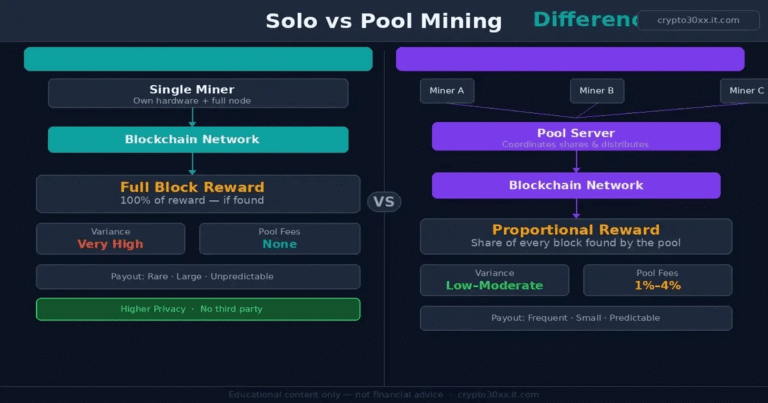
The core difference between solo mining and pool mining is how variance is distributed. Both approaches give the miner the same expected reward over a long enough time horizon, assuming equal hash rate. What they do not give equally is consistency.
Expected value and variance
If a miner controls 0.001% of Bitcoin’s total hash rate, they statistically expect to mine 0.001% of all blocks. Solo, that might mean one block every several years, a single large payout with nothing in between. In a pool, that same hash rate earns a proportional share of every block the pool finds, which at a large pool might be dozens per day. The daily payouts are small, but they are regular.
For miners running commercial-scale operations with predictable energy costs and financing obligations, variance is operationally damaging even when expected value is the same. Pool mining converts an unreliable income stream into a predictable one.
When solo mining makes sense
Solo mining is not entirely obsolete. A miner with unusually high hash rate, or one targeting a smaller coin where total network difficulty is low enough that a single machine finds blocks regularly, may prefer to go solo rather than pay pool fees and split rewards. Some miners also object to the trust required when delegating block template construction to a pool operator.
Risks and structural problems with mining pools
Mining pools solve the variance problem but introduce several structural risks that affect individual miners and the broader blockchain network. These deserve careful attention before committing hardware to any pool.
Centralization and the 51% threshold
The most significant structural concern is that pooling concentrates hash rate into a small number of entities. In a Proof-of-Work network like Bitcoin, a single actor controlling more than 50% of total hash rate can theoretically rewrite recent blocks, censor specific transactions, or attempt double-spend attacks. This is known as a 51% attack.
Historically, the concentration of pool-level hash rate has reached levels that make this a legitimate concern. The top two or three pools have, at various points, controlled well over half of Bitcoin’s global hash rate. No coordinated attack has been executed at this scale, partly because doing so would destroy the attacker’s own revenue stream. But the capability existing and the capability not being used are two different things.
The Nakamoto Coefficient, a measure of how many distinct entities must collude to disrupt a network, has often been estimated at just two or three for Bitcoin’s mining layer. That number reflects pool-level centralization, not the count of individual miners behind those pools.
Pool operator trust and custodial risk
When a miner joins a pool, they are trusting the pool operator to accurately report hash rates, correctly calculate share counts, execute payouts as promised, and not tamper with block templates. Most major pools operate transparently and have strong financial incentives to do so. But pool operators are custodians of earned rewards until payout thresholds are met. A pool that fails, gets hacked, or faces regulatory action can delay or prevent payouts.
Minimum payout thresholds vary widely. Miners with small operations may have earned rewards sitting in pool custody for extended periods before reaching the threshold for withdrawal.
Fee structures and hidden costs
Pool fees are not always what they appear. A pool advertising a 1% fee on FPPS may pay out less in total than a pool charging 2% on PPLNS if the FPPS pool uses a conservative transaction fee estimate. The interaction between payout method, fee level, and transaction fee treatment determines actual miner revenue. Comparing pools on fee percentage alone is unreliable.
Some pools have historically understated miner hash rate contributions, effectively siphoning a portion of earnings beyond the stated fee. Verifying actual payouts against expected payouts based on submitted shares is the only reliable check against this practice.
Transaction censorship
Because pool operators build the block templates that their miners work on, pools control which transactions get included in blocks. A pool under legal or regulatory pressure can refuse to include transactions from specific addresses without any individual miner being aware. This is a meaningful departure from the theoretical censorship-resistance of Proof-of-Work systems. Protocols like Stratum V2, which shift block template construction authority back to individual miners, exist specifically to address this concern, but adoption has been limited.
How to evaluate and choose a mining pool
Selecting a pool involves more than picking the one with the lowest advertised fee. Several factors interact to determine actual earnings and operational risk.
Hash rate and block frequency
Larger pools find blocks more frequently, which smooths payouts. Under PPLNS, a small pool finding a block once every three days creates long gaps between payouts. A large pool finding blocks dozens of times per day produces near-daily distributions. Miners who need regular cash flow should weight block frequency alongside fee structure.
Pool size also affects network centralization. Miners concerned about hash rate concentration may deliberately choose smaller pools with competitive but not dominant share of the network, even if it means slightly less frequent payouts.
Transparency and verifiability
Reputable pools publish real-time data on total pool hash rate, individual miner hash rate as observed by the pool, share counts, and block history. This data allows miners to verify that their machines are contributing as expected and that payouts match share submissions. A pool that obscures this information cannot be independently audited.
Payout thresholds and frequency
Minimum payout thresholds vary significantly across pools. Miners running a few machines on a major coin may accumulate rewards slowly and prefer a pool with a low minimum threshold and frequent automatic payouts. Miners with large-scale operations may not care about threshold levels at all.
Geographic server locations
Stale shares, those that the pool receives after the network has already moved on to the next block, cost miners real earnings. A share submitted a fraction of a second after another miner elsewhere solved the same block is a stale share and typically goes unpaid. Connecting to a pool server geographically close to the miner’s location reduces latency and stale share rates.
FAQs
What is a mining pool in simple terms? A mining pool is a group of cryptocurrency miners who work together, combining their computing power to find blocks faster. When the group earns a reward, it is split among members based on how much computing work each one contributed.
Do I need a lot of hardware to join a mining pool? No. Mining pools were specifically designed to allow miners with modest hardware to participate. Even a single consumer-grade ASIC can join a pool and receive regular small payouts proportional to its contribution, rather than waiting years for a solo block discovery.
What is a share in a mining pool? A share is proof that a miner’s hardware completed a computational task assigned by the pool. Shares are the pool’s internal accounting unit for measuring each miner’s contribution. They carry no value on the blockchain itself and exist only for reward allocation purposes.
How much do mining pools charge? Most mining pools charge between 0% and 2.5% of block rewards as a fee. The exact amount depends on the payout method. PPS and FPPS pools typically charge more because they absorb the risk of payment regardless of block luck. PPLNS pools often charge less because that risk is passed to miners.
Is it safer to mine solo or in a pool? “Safer” depends on context. Pool mining produces more consistent, predictable income. Solo mining involves extended periods with no payout, followed by an occasional full block reward. From a financial-planning perspective, pools reduce income volatility. From a trust perspective, solo mining requires trusting no third party, whereas pools require trusting the pool operator with both block construction and reward custody.
Can a mining pool be hacked? Yes. Pool operators hold custodial balances before payout thresholds are met. Like any custodial service, pools are potential targets for theft or fraud. Choosing pools with transparent security practices and withdrawing earnings promptly reduces exposure.
What is PPLNS vs PPS? PPS pays a fixed amount for every share submitted, regardless of whether the pool finds a block; the pool absorbs the variance. PPLNS pays only when the pool discovers a block, distributing the reward based on recent share contributions; the miner absorbs the variance. PPS is more predictable; PPLNS typically costs less in fees over time.
What is pool centralization risk? If a small number of mining pools collectively control more than half of a network’s total hash rate, they could theoretically coordinate to censor transactions or manipulate block ordering. This is the primary structural risk of pool-based mining and applies regardless of how many individual miners those pools represent.
Disclaimer
This article is written for educational and research purposes only. Nothing here constitutes financial advice, investment guidance, or a recommendation to engage in cryptocurrency mining or any related activity. Cryptocurrency mining involves significant financial, technical, and regulatory risks. Readers should conduct independent research and consult qualified professionals before making any financial decisions.
Mining pools solved a real problem: they made consistent participation in Proof-of-Work networks possible for miners who cannot compete individually against total network hash rate. The tradeoff, giving pool operators meaningful control over block templates, transaction selection, and reward custody, is not trivial. Understanding both sides of that tradeoff is what allows a miner, researcher, or observer to evaluate the model accurately. The mechanics are straightforward; the structural implications require more careful thought.
From good to great—our excellence-focused expert posts help you make the leap.