Proof of work explained: the complete beginner guide
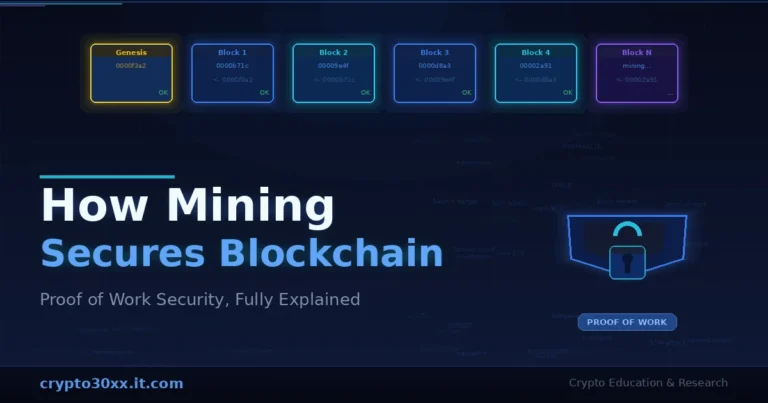
Proof of work explained: Proof of work is a consensus mechanism where computers compete to solve a computationally expensive mathematical puzzle, and the winner earns the right to add the next block of transactions to the blockchain. The puzzle is deliberately hard to solve but trivially easy to verify — a design choice that transforms raw computing power into a security guarantee. Bitcoin has used proof of work since its first block in January 2009, and it remains the most battle-tested method for achieving decentralized agreement without any central authority.
What is proof of work and where did it come from?
Proof of work predates Bitcoin by more than a decade. The concept was first formalized in a 1993 academic paper by Cynthia Dwork and Moni Naor as a way to deter email spam: force senders to perform a small computation before sending a message, making mass spam economically painful. The term “proof of work” itself appeared in a 1999 paper by Markus Jakobsson and Ari Juels. Satoshi Nakamoto adapted the idea in Bitcoin’s 2008 whitepaper, using it not to stop spam but to solve the double-spend problem in a trustless payment network.
The double-spend problem proof of work solves
Digital files can be copied perfectly. If a digital currency works like a file, nothing technically stops someone from sending the same coin to two people. Traditional payment systems solve this with a central database (a bank says who owns what). Bitcoin’s question was: can a network of strangers agree on a single transaction history without trusting any one participant?
Proof of work answers yes. By requiring miners to spend real-world resources — electricity and hardware — before proposing a new block, the protocol makes it expensive to write history and expensive to rewrite it. The computational work is the commitment.
How proof of work actually functions
The mechanism rests on a specific type of mathematical function called a cryptographic hash function. Bitcoin uses SHA-256.
What a hash function does
A hash function takes any input and produces a fixed-length output (called a hash or digest). SHA-256 always outputs 256 bits — 64 hexadecimal characters. The relationship between input and output has three critical properties:
- Deterministic: the same input always produces the same hash
- Avalanche effect: changing one character in the input completely changes the output
- One-way: given only the output, there is no mathematical shortcut to reconstruct the input
This last property is what makes the mining puzzle hard. You cannot work backwards from a target hash. You can only guess and check.
The mining puzzle, step by step
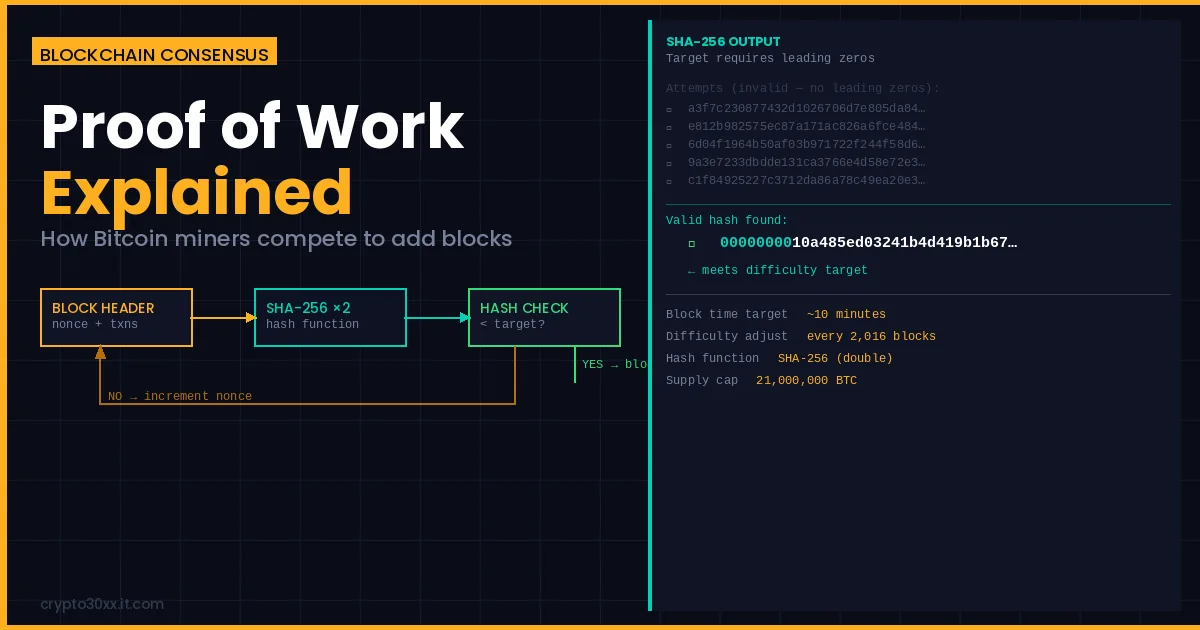
When a miner wants to add a new block, they must find a hash that meets the network’s current difficulty target. That target is expressed as a requirement that the hash must start with a certain number of leading zeros.
- The miner takes the block header — which includes the previous block’s hash, a timestamp, a summary of pending transactions (the Merkle root), and a difficulty target.
- They add a variable called the nonce (a number used once) to the block header.
- They run SHA-256 twice on the block header and check the output.
- If the hash starts with enough leading zeros to meet the target, the block is valid.
- If not, they increment the nonce by one and try again.
That’s it. There is no clever algebra. The miner just hashes, checks, and tries again — potentially billions of times per second — until they find a valid result.
How difficult is the puzzle?
The difficulty target determines the probability that any single hash attempt succeeds. A rough example illustrates the scale: if the target requires a hash to start with 20 leading zeros, the probability of any single attempt succeeding is approximately 1 in 16²⁰ — about 1 in 1.2 quadrillion. Modern mining hardware makes hundreds of terahashes per second (trillions of attempts per second), yet the network collectively still targets an average of one valid block roughly every ten minutes.
Difficulty adjustment
Bitcoin automatically recalibrates difficulty every 2,016 blocks (approximately two weeks). If blocks were found faster than ten minutes on average, difficulty increases. If slower, it decreases. This self-correcting mechanism keeps block times stable regardless of how much or how little mining hardware is connected to the network.
What miners actually win
Finding a valid block earns the miner two types of compensation.
Block reward (newly issued bitcoin)
When a miner adds a valid block, they include a special first transaction — the coinbase transaction — that creates new bitcoin and pays it to their own address. This is the only mechanism through which new bitcoin enters circulation. The reward started at 50 BTC per block, halves approximately every four years (every 210,000 blocks), and will approach zero around the year 2140 as the total supply asymptotically approaches 21 million BTC.
Transaction fees
Every transaction included in the block pays a fee to the miner. Fees are set by senders based on how urgently they want their transaction confirmed. When blocks are full, fee markets become competitive. Over the long term, as the block reward shrinks, transaction fees are designed to become miners’ primary economic incentive.
Why proof of work provides security
The security guarantee of proof of work comes from the cost of an attack, not from any cryptographic secret.
The 51% attack model
To rewrite transaction history — say, to reverse a payment already confirmed in the blockchain — an attacker would need to rebuild the chain from the point of the payment, racing against the honest network. To consistently outpace the honest network, the attacker would need to control more than 50% of the network’s total hash rate.
For Bitcoin, which has an enormous amount of mining hardware deployed globally, this is theoretically possible but economically prohibitive. The attacker would need to acquire or rent hardware representing more than half of the total network hash rate. They would also pay ongoing electricity costs for the duration of the attack. And a successful attack would likely destroy confidence in Bitcoin, crashing the value of any bitcoin they might steal.
The attack is not impossible — it has succeeded against smaller proof-of-work chains. Security scales with total hash rate. This is why miners joining the network improves security for all participants.
Confirmations and finality
Proof of work does not provide instant finality. Instead, each block added on top of a transaction’s block makes it exponentially harder to reverse. The probability of a successful re-org falls off rapidly with depth:
| Confirmations | Approx. reversal cost |
|---|---|
| 0 (unconfirmed) | No mining required |
| 1 block | Must redo 1 block |
| 6 blocks | Must redo 6 blocks faster than the honest chain |
| 100+ blocks | Practically irreversible for any rational attacker |
Six confirmations — roughly one hour — is the widely used standard for high-value transfers. Simple wallet-to-wallet transfers are often considered safe at three confirmations. Larger exchanges and institutional recipients sometimes wait for more.
Proof of work vs. proof of stake
Proof of stake is the main alternative consensus mechanism. It replaced proof of work in Ethereum’s network in 2022. The two approaches differ fundamentally in how they make attacks expensive.
| Feature | Proof of work | Proof of stake |
|---|---|---|
| Security source | Real-world energy + hardware | Staked capital at risk of slashing |
| Consensus participation | Anyone who can run mining hardware | Anyone who can stake the minimum validator deposit |
| Energy use | High (continuous hash computation) | Low (digital signatures only) |
| Block time (Bitcoin vs Ethereum) | ~10 minutes | ~12 seconds |
| Finality type | Probabilistic (deepens over time) | Deterministic (after two-thirds attestation) |
| Attack reversal cost | Must acquire majority hash rate | Must acquire and risk majority stake |
| Track record | ~15 years of continuous operation (Bitcoin) | ~3 years on Ethereum mainnet |
Neither mechanism is objectively superior. The choice between them involves trade-offs in energy use, decentralization of participation, capital requirements for validators, speed of finality, and operational history. Bitcoin’s developer community has maintained that proof of work’s simplicity and the length of its security record are arguments for keeping it.
Common misconceptions about proof of work
“Mining is solving complex math problems”
Technically inaccurate in the sense most people mean. Mining is not like solving an equation or a puzzle that requires analytical thought. It is brute-force guessing — hashing a number, checking the result, incrementing, and repeating. The “complexity” is computational volume, not mathematical sophistication.
“Miners verify transactions”
Miners include transactions in blocks and achieve consensus about ordering. But any full node on the network independently validates every transaction against Bitcoin’s consensus rules before accepting a block. Miners do not have special authority to approve or reject specific transactions — they choose which valid transactions to include based on fee income.
“Wasted energy is waste”
Energy use is a design choice, not a flaw. The expenditure of real-world resources is precisely what makes proof of work’s security guarantee credible. Whether that expenditure is “worth it” is an economic and philosophical debate. Characterizing it as simply waste treats the outcome — security — as zero-valued, which is a category error.
“A faster computer solves the puzzle faster”
True at the individual level, but the difficulty adjustment neutralizes this at the network level. If all miners doubled their speed simultaneously, blocks would initially arrive faster, and the next difficulty adjustment would double the required difficulty. The race is always relative to the current network, not absolute.
How energy use and hardware fit into proof of work
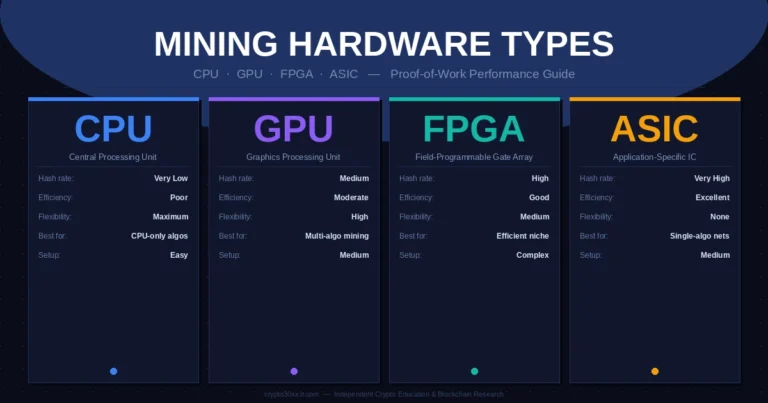
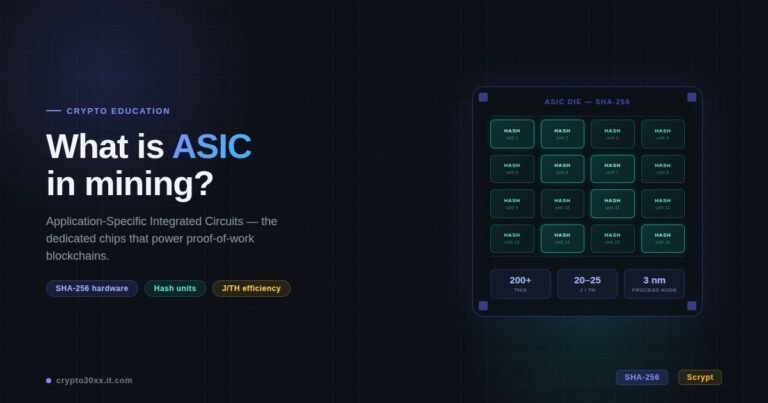
Mining at competitive scale requires specialized hardware called ASICs — Application-Specific Integrated Circuits. These chips are designed exclusively to compute SHA-256 hashes as efficiently as possible. General-purpose CPUs and then GPUs dominated early mining, but ASICs have been the only economically viable option on the Bitcoin network for over a decade.
The economics of mining depend on three variables: hardware hash rate (TH/s or PH/s), electricity cost (typically measured in cents per kilowatt-hour), and the current bitcoin price. Miners operate on thin margins. When bitcoin prices fall and difficulty stays high, less efficient miners shut off their hardware — a self-regulating mechanism sometimes called “miner capitulation.”
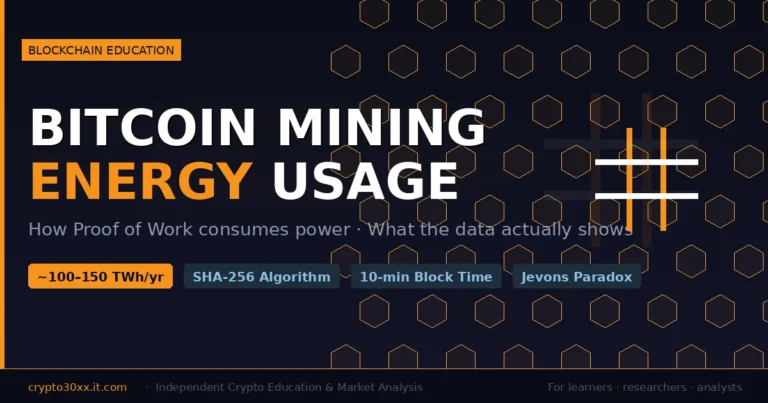
Energy sourcing varies widely. Some mining operations use surplus hydroelectric or geothermal power. Others operate near natural gas flare sites, converting waste gas into electricity. Some use grid power in regions with cheap baseload energy. The mix of energy sources is empirically contested, with various studies producing substantially different estimates of renewable share.
FAQs
What does proof of work actually prove? It proves that the miner expended a quantifiable amount of computational work to find a valid block hash. Because the work cannot be faked or shortcut, it serves as evidence that real-world resources were spent — giving the block’s claimed transaction history a credible cost of production.
Why does Bitcoin use SHA-256 specifically? Satoshi chose SHA-256 because it was a well-tested NSA-designed standard with no known vulnerabilities at the time of Bitcoin’s launch. SHA-256 is also memory-light, meaning it can be optimized heavily in silicon — a property that has shaped the ASIC mining industry. Some later proof-of-work coins deliberately chose memory-hard functions to resist ASIC optimization.
Can proof of work ever be hacked or broken? Proof of work’s security depends on the computational hardness of SHA-256. A theoretical break of SHA-256 by a sufficiently powerful quantum computer could undermine it, but this would also compromise most of the internet’s cryptographic infrastructure simultaneously. A more practical concern is a 51% attack by a well-resourced actor on a small chain. Bitcoin’s sheer scale of hash rate makes this extremely difficult.
What happens when all 21 million bitcoin are mined? The block reward reaches zero, and miners will depend entirely on transaction fees. Whether fees alone will provide enough incentive to sustain a large mining ecosystem is one of the significant open questions in Bitcoin’s long-term design. The transition happens gradually over decades as the block reward continues to halve.
Is mining the only way to participate in proof of work? Mining is the only way to actively participate in block production. But any user can run a full node, which independently validates every block and transaction without mining. Full nodes enforce the rules; miners produce the blocks. Both roles exist simultaneously and check each other.
Why does proof of work use so much energy compared to proof of stake? In proof of work, security comes from continuous expenditure of electricity. The moment miners stop spending energy, the security guarantee dissolves. In proof of stake, security comes from staked capital that validators put at risk. The staked capital is not consumed by the process of validating — only the digital computation of signing is required, which uses a negligible amount of energy compared to hashing.
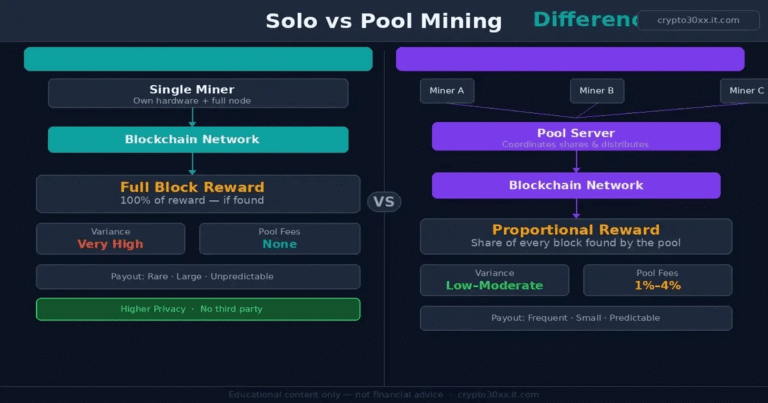
What is a mining pool? A mining pool is a group of miners who combine their hash rate and share block rewards proportional to each member’s contributed work. Because the probability of any single miner finding a block is very low on a large network, pools smooth out income. The pool operator coordinates work distribution and reward payouts. Mining pools have no elevated authority over Bitcoin’s consensus rules.
Can proof of work be gamed by submitting false work? No. When a miner claims to have found a valid block, any node on the network can verify the claim in milliseconds by running the SHA-256 calculation once. If the hash does not meet the target, the block is rejected. The asymmetry — hard to produce, trivial to verify — is what makes the system work.
Disclaimer
This article is published for educational and research purposes by crypto30xx.it.com, an independent blog. Nothing here constitutes financial advice, investment recommendations, or an endorsement of any asset, protocol, or mining operation. Cryptocurrency involves substantial risk of loss. Readers should conduct their own research and, where appropriate, consult qualified professionals before making any financial decisions.
Proof of work is old by cryptocurrency standards. Its energy use generates genuine debate, and faster alternatives have emerged. But the mechanism’s logic is sound: by requiring real-world expenditure to write blocks and making that expenditure trivially verifiable, it creates a security guarantee that depends on physics rather than trust. Whether that trade-off is worth the energy cost is a question each person in the network evaluates for themselves.
The content gap between you and your goals ends here—explore our targeted blog reads.